Fork
CONDITIONAL / BRANCHING — *chooses a path based on what's true right now.*
Listen along — Fork
Loading audio…
Press play to listen along. The line being read lights up as you go.
Show full transcript
Loading transcript…
Chapter 2 — Fork and the Two-Path Decision
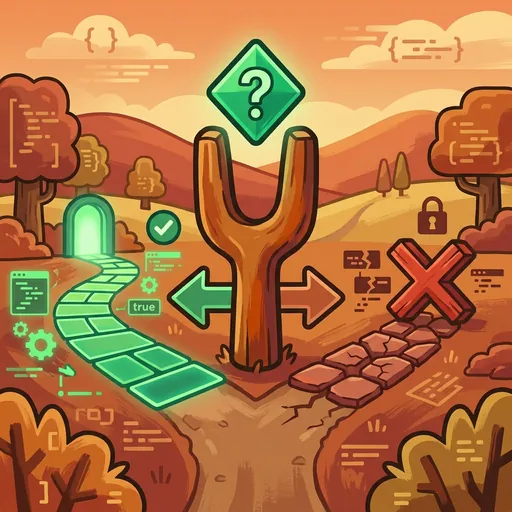
Fork wasn’t a fluffy squirrel. Fork wasn’t a talking badger. Fork was, well, a fork. Not a dinner fork, though. This Fork was a small, painted wooden sign. It looked like a road sign you might see on a tiny path.
It had a little diamond shape floating above it. The word “IF” was written inside the diamond. Two arrows pointed away from the diamond. One arrow went left. The other arrow went right. Fork showed you two different ways to go.
Loop clapped her hands. “Alright, team! Meet Fork!” she announced. Loop always sounded excited. “Fork helps us make choices. Not Fork’s choices, mind you. Our choices. Or, really, the program’s choices.”
I looked at Fork. It just sat there. It didn’t look like it was making any choices.
“See the diamond?” Loop asked. “That holds a question. A ‘condition.’ If the answer to the question is YES, we go one way. If the answer is NO, we go the other.”
“Like what kind of question?” I asked.
Loop grinned. “Excellent question! Let’s say we want a super-sparkle from the Sparkle Collector machine.”
The Sparkle Collector was a big, clunky contraption. It usually just coughed out regular sparkles. Getting a super-sparkle was rare.
“The machine is picky,” Loop explained. “It only gives super-sparkles if you have exactly five regular sparkles already.”
“Aha!” Loop pointed to Fork’s diamond. “This is where Fork comes in. The question in the diamond is: ‘Do we have five sparkles?’”
“If the answer is YES,” Loop said, pointing to the left arrow, “the program goes this way. It tells the machine to give us a super-sparkle. Hooray!”
“But if the answer is NO,” she continued, pointing to the right arrow, “it goes that way. It tells us to find more sparkles. Boo!”
“So Fork doesn’t decide?” I asked. “It just shows the paths?”
“Exactly!” Loop beamed. “Fork is a branch-point. Not a decision-maker. The condition makes the decision. If the condition is true, we branch one way. If it’s false, we branch the other.”
“Conditions are like yes-or-no questions,” Loop explained. “They are either TRUE or FALSE. No ‘maybe’ allowed in code! It’s super strict.”
“Like, ‘Is the sky blue?’” she asked. “TRUE!”
“Are pigs flying right now?” she asked. “FALSE! Unless you know something I don’t.”
I giggled. “So the condition is just a simple fact?”
“Yep! A fact we check,” Loop confirmed. “We can ask if things are the same. We use two equals signs for that: ==.”
“Like, ‘Is your name == ‘Alex’?’” she offered. “Or, ‘Is the number of sparkles == 5?’”
“We can also ask if things are not the same. That’s an exclamation mark and an equals sign: !=.”
“So, ‘Is your shirt color != ‘red’?’” I tried.
“Perfect!” Loop cheered. “Or, ‘Is the machine != broken?’”
“We can also ask if one thing is bigger or smaller than another. We use > for bigger and < for smaller.”
“Is your age > 9?” Loop asked me. “Or, ‘Is your shoe size < 12?’ These are all conditions. They all give us a TRUE or FALSE answer.”
“What if we need to ask two questions at once?” I wondered.
“Great thinking!” Loop said. “Sometimes we do. We can combine conditions. We use ‘AND’ or ‘OR’.”
“Think about our super-sparkle machine,” she continued. “Maybe it only works if you have five sparkles AND the machine is turned on.”
“For the ‘AND’ path, both conditions must be TRUE. You need five sparkles and the machine must be on. If even one is false, you go the other way.”
“What about ‘OR’?” I asked.
“For ‘OR’, only one condition needs to be TRUE,” Loop explained. “Like, ‘Do you have five sparkles OR is it your birthday?’”
“If you have five sparkles, you get the super-sparkle. Even if it’s not your birthday. If it’s your birthday, you get it. Even if you don’t have five sparkles.”
“Verity from DiscreteQuest taught us all about AND and OR. She’s super smart about logic. She says they are the building blocks of good thinking.”
“What if the ‘true’ path has another Fork?” I asked. “Like, a fork inside a fork?”
“You’re on fire!” Loop exclaimed. “That’s called nesting. A conditional inside another conditional. It’s like a path that leads to another choice.”
“Like, ‘IF you have five sparkles, THEN you go to a new Fork. That new Fork asks: IF the machine is on, THEN get the super-sparkle.’”
“Nesting helps us make really tricky decisions. It builds up complex branching. Like a tree with many paths.”
“What if there are lots of choices? Not just two?” I asked. “Like, what if the machine gives different sparkles based on the day of the week?”
“Good point!” Loop said. “Monday, Tuesday, Wednesday… that’s seven different paths! We could use lots of ‘if’ statements. ‘If it’s Monday, do this. Else if it’s Tuesday, do that…’”
“That sounds like a lot of ‘if’s,” I said.
“It can get messy,” Loop agreed. “But there’s a neater way. It’s called a ‘match’ or ‘switch’ statement. It’s like a big menu of options.”
“You pick the one that matches the day. Then you go that way. It keeps the code tidy. Loop loves tidy code.”
“Does Fork always know the answer to the condition?” I asked. “Like, does it know if I have five sparkles before I even get there?”
“Nope!” Loop grinned. “That’s the clever part. The condition is checked right when you need it.”
“It’s not decided ahead of time. It depends on what’s happening right now. Different inputs mean different paths. That’s the magic of branching!”
Loop tapped Fork’s little diamond. “So, remember,” she said. “Fork is the conditional. If a thing is true, go this way. If not, go that way. Programs branch based on conditions. Fork is a branch-point, not a decision-maker.”
“It’s not hard. Branch based on condition. True, this way. False, that way.”
The CodeRealm ensemble
Fork is part of CodeRealm's distributed-narrative cast. Each character embodies a different curricular primitive; together they teach the full subject.
-

Stash
Variable / storage — the labeled box that holds a value until you call for it
-
Trek
Loop / iteration — keeps going around until the work is done
-

Module
Function / encapsulation — does one job well and can be called anywhere
-

Glitch
Debugging / inspection — finds bugs gently, never shaming; 'there's always a reason'
-

Order
Sequence / syntax — reminds you that order matters in code
-
Row
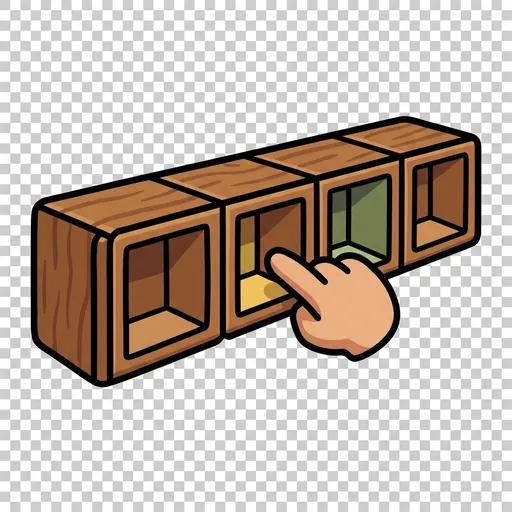
A list: many values lined up in a numbered row, so you can grab item number three instantly or walk through them one by one.
-

Port
Input and output: the doorway that brings information in from the world (a key press, a sensor) and sends results back out.
-
Ping
An event: a waiting bell that does nothing until its trigger happens, then runs its code the instant it is struck.
-

Shuffle
Randomness: a fresh unpredictable value each time — a dice roll, a shuffled deck — so a program can surprise, vary, and stay fair.