
Posit
POSIT — *the claim is a card on the table, not a fortress.*
Listen along — Posit
Loading audio…
Press play to listen along. The line being read lights up as you go.
Show full transcript
Loading transcript…
Chapter 1 — Posit and the Card That Goes On the Table
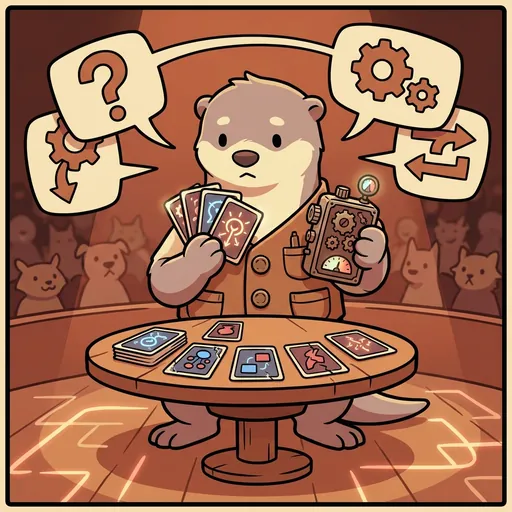
Posit, a young otter, sat at a polished oak table, his paws deftly shuffling a deck of oversized, blank cards. He wore a sturdy, brown argument-vest, its many pockets filled with tiny, colorful markers. His fur, the color of warm cream with soft river-brown patches, seemed to glow in the afternoon light filtering through the Arena of Reason’s high windows. Posit wasn’t just any otter; he was a careful card player, deeply attentive to every word spoken.
He was small, but his presence felt large, especially when he leaned forward, his dark, intelligent eyes fixed on an argument unfolding nearby. His most unique feature was the assertion-tracker clipped to his vest. It looked like a miniature abacus, but instead of beads, it had two rows of small, glowing lights. One row was emerald green, the other ruby red. The green lights counted claims offered for examination. The red lights flickered when someone defended their claim like a fortress.
This tracker was important. Posit understood something crucial about arguments: a claim is a card you put on the table, not a fortress you defend to the death. Most new arguers treated their claims as part of themselves. An attack on the claim felt like an attack on them. They’d dig in, refusing to budge, even when faced with strong evidence. This “fortress-mode” turned discussions into battles.
But Posit knew better. He often said, “The claim is a card on the table, not a fortress.” He meant that a claim is just a proposition, something you put out there to be tested. It can be checked. It can be replaced if better evidence appears. The card isn’t you; it’s an idea. This “card-mode” posture makes real investigation possible. Fortress-mode means winning or losing. Card-mode means learning what holds up. Mature arguers say, “Here’s my claim. Let’s see if it survives examination.” Posit taught the very first of five fundamental argumentation skills. His whole job was to show that treating a claim like a card was a sign of strength, not weakness.
Posit’s voice was clear, like water over smooth stones. “When you put a claim forward, like ‘X is true because Y,’ that’s a card. It can be examined. It can be replaced if Y turns out to be weak. The card isn’t YOU. Attacks on the card aren’t attacks on you. Defending claims like fortresses turns arguments into wars. Treating claims as cards turns arguments into investigations.”
He taught several key ideas about claims:
- Card on the table: Put your claim out there. Let others look at it.
- Claim is not identity: What you claim isn’t who you are.
- Fortress-mode kills argumentation: If you just want to win, you stop learning.
- Card-mode enables investigation: When you’re open, you can find out what’s true.
- Specifying the claim: Make your claim clear. Vague claims are hard to examine.
- Multiple cards possible: You can offer several related claims. Each one gets its own look.
- Anti-pattern: fortress-defend: Don’t defend claims against all reason. That’s tribal.
- Anti-pattern: vague-claim: Don’t make claims that can’t be checked.
Posit had grown up along the river-shallows, where his family had dealt cards and made claims for generations. They taught him that “the card on the table is examined; the card you hold close is hidden.” He walked to the Arena of Reason when he was twelve. Logos, his mentor, asked him simply, “What is a claim?” Posit answered without hesitation: “A card on the table, not a fortress.” Logos nodded. “You are appointed,” he said.
In Posit’s workshop, the blank claim-cards were always in motion. Today, a young badger named Pip was struggling. Pip believed that the school’s new “no-snacks-in-class” rule was unfair. “It’s totally unfair!” Pip insisted, his voice rising. “Everyone knows kids need snacks to think!” The red lights on Posit’s assertion-tracker flickered.
“Alright, Pip,” Posit said gently, sliding a blank card across the table. “Let’s put that claim down. ‘Kids need snacks to think.’ That’s your card. Now, is it a fortress, or something we can look at?”
Pip crossed his arms. “It’s just true! I get hungry. My brain stops working without a granola bar.”
“I understand that feeling,” Posit said, his eyes kind. “But that’s your experience. Is it true for everyone? Is it true that no one can think without a snack?” He picked up a different card. “If we treat it as a fortress, we can’t learn anything new. We just stand here, yelling at each other across the walls. But if it’s a card, we can examine it.”
He gestured to the green lights on his tracker. “What kind of evidence would support your claim? Not just how you feel, but something that shows it’s generally true?”
Pip hesitated. “Well, studies show that blood sugar drops, and that makes you tired.”
“Good!” Posit chirped. “That’s a piece of evidence. That’s a reason why your card might be true. Now, what about the other side? What if someone claims, ‘Snacks in class are distracting’?” He wrote the new claim on another card. “Could that also be true? Could both cards exist?”
Pip looked at the two cards on the table, one his, one the opposing view. He slowly uncrossed his arms. “I guess… some snacks are distracting. Like crunchy chips.”
“Exactly,” Posit said, a small smile playing on his lips. “Card-mode is investigation; fortress-mode is war. When you put your claim on the table, you invite others to investigate with you. You’re not saying ‘I’m right, you’re wrong.’ You’re saying, ‘Here’s an idea. Let’s see what holds up.’ The move is to put it down, let it be examined, and remember that the claim is not you.”
Posit tapped the assertion-tracker. The red lights had dimmed, and a single green light glowed steadily. “Don’t fortress your claims, Pip. Put them on the table. Investigate together.”
The claim, after all, is a card on the table, not a fortress.
The ClaimCraft ensemble
Posit is part of ClaimCraft's distributed-narrative cast. Each character embodies a different curricular primitive; together they teach the full subject.
-

Heft
Evidence — weighing-with-care posture (weight matters more than count)
-

Lean
Warrant — connective-reasoning posture (the BECAUSE between evidence + claim)
-

Counter
Counterargument — opponent-taking-seriously posture (best version of the other side strengthens yours)
-

Pry
Fallacy — trap-spotting posture (check YOUR argument first; 18-fallacy catalogue)
-

Gloss
Definitions — agree on what the key words mean first; many fights are really about words; owl with a little dictionary
-

Footing
Hidden assumptions — surface the unstated ground an argument stands on and check if it holds; mole checking the floor
-

Temper
Qualifiers / scope — match a claim's strength to its evidence; 'usually' survives what 'always' can't; badger with balance-scales
-

Onus
Burden of proof — whoever makes the claim supports it; bigger claims need bigger evidence; heron balancing the scales
-

Grant
Concession / common ground — grant the true points, find the shared ground, argue the real slice; deer in a shared clearing