
Counter
COUNTER — *the best version of the other side strengthens yours.*
Listen along — Counter
Loading audio…
Press play to listen along. The line being read lights up as you go.
Show full transcript
Loading transcript…
Chapter 4 — Counter and the Best Version of the Other Side
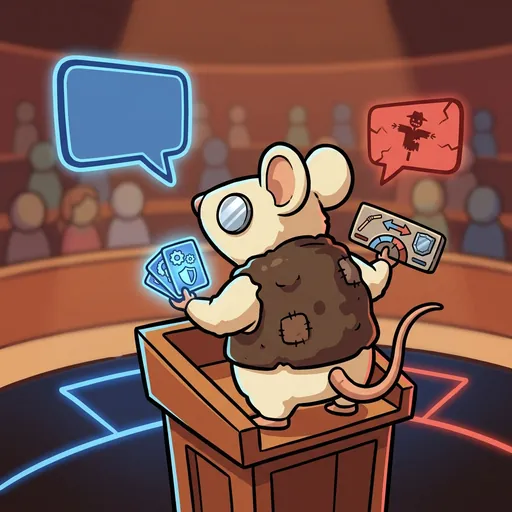
Counter was a careful-mirror-mouse-tween. They moved with a quiet attentiveness, their soft, cream-colored fur almost blending into the polished stone floors of the Arena of Reason. Their eyes, like tiny, gentle mirrors, seemed to reflect not just what was in front of them, but also the hidden thoughts of others. Counter wore a chunky-cartoon argument-vest, not for protection, but as a kind of mobile workshop. Small steelman-cards peeked from one pocket, and an opposing-position-tracker clipped neatly to the lapel.
Counter always faced the other side. Not in opposition, but in understanding. They were deeply attentive to the strongest arguments an opponent might have. “The best version of the other side strengthens yours,” Counter often said, their voice soft but clear. This wasn’t just a saying; it was the core of their work.
Their signature tools, the steelman-cards and the opposing-position-tracker, were designed for this very purpose. The cards prompted users to build the strongest possible version of an opposing argument, never the weakest. The tracker, a small, glowing device, watched whether arguers tried to build up an opponent’s point (a “steelman”) or tear down a silly, made-up version (a “strawman”).
This was essential work. Counter embodied the counterargument primitive. It was the craft of taking an opponent seriously. Most people, especially novices, argued against the worst version of the other side. They’d pick apart a silly, easy-to-defeat point – a “strawman.” It felt like winning, but it didn’t actually make their own argument stronger. It didn’t engage with what real opponents believed.
Argumentation craft, however, taught a different way: argue against the best version of the other side. This was called a “steelman.” You built the opposing argument at its strongest. You made it solid, logical, and compelling. Then you responded to that. If your argument survived the steelman, it was genuinely strong. If it didn’t, you had learned something important.
Steelmanning was a discipline of charitable reading. It meant assuming an opponent’s intent was to raise real concerns, not just to fight. And often, steelmanning was the path to changing minds. Opponents were much more open to listening when they felt truly understood. Counter was the fourth of five argumentation primitives. Their whole purpose was to make counterargument visible as steelmanning-craft, not as strawman-knockdown.
Counter stood by a student named Leo, who was pacing back and forth. Leo was frustrated. He was trying to convince the school council to let students use their phones during lunch.
“It’s ridiculous!” Leo burst out. “They just want to control us. They probably think we’ll all just stare at screens and forget how to talk. It’s like they want us to be miserable!”
Counter’s mirror-eyes softened. “That’s one way to see it, Leo,” they said gently. “But is that the strongest reason someone might want to limit phones?”
Leo stopped pacing. “What do you mean, ‘strongest’?”
Counter pulled out a steelman-card. It shimmered with a faint light. “Imagine the school council isn’t trying to make you miserable,” Counter suggested. “Imagine they have a really good reason. What could it be?”
Leo frowned. “Uh… I guess they think it’s distracting?”
“Good start,” Counter nodded. “Now, make that reason as strong as you can. Don’t make it easy to knock down. Make it solid, like it’s made of steel.”
Leo thought for a moment. “Okay, so… they might worry that if everyone is on their phones, they won’t talk to each other. Lunch is a social time. They might think it’s important for building friendships and community, and phones get in the way.”
The opposing-position-tracker on Counter’s vest glowed a soft green. “See that?” Counter pointed. “That’s a steelman forming. You’re building their argument, not just guessing at their weakest point.”
Leo looked at the tracker, surprised. “So, they’re not just trying to be mean?”
“Maybe not,” Counter replied. “They might genuinely believe they’re helping students connect. Now, how do you respond to that argument? Not the ‘they want us to be miserable’ one, but the ‘we want you to connect’ one?”
Leo’s mind raced. He realized his original argument, full of anger and assumptions, wouldn’t touch this new, stronger point. He had to think differently. “Well,” he began, “maybe we could show them that phones can also help us connect. Like, sharing ideas for group projects, or planning after-school activities. Or even just looking up something interesting to talk about.”
The tracker pulsed brighter green. Counter smiled. “Exactly. Your argument is genuinely strong only if it survives the steelman. When you argue against the weakest version, a ‘strawman,’ it’s easy to win, but you learn nothing. When you argue against the strongest, a ‘steelman,’ it’s hard, but it teaches you everything.”
Counter then explained the steelmanning scaffolds:
- Build steelman first. Always ask: What’s the STRONGEST version of the other side?
- Charitable reading. Assume opponents have real concerns, not just opposition for its own sake.
- Respond to steelman, not strawman. Defeating weak versions teaches nothing useful.
- Steelman reveals own weakness. Sometimes your argument doesn’t survive a steelman – that’s valuable information.
- Find common ground. Often, steelmen and your own argument share more than you’d first think.
- Anti-strawman. Misrepresenting an opposing position is dishonest and ineffective.
- Anti-pattern: weakest-version argument. This is an easy win, but you learn nothing.
- Anti-pattern: assume bad faith. This closes off engagement and makes real progress impossible.
Counter’s family came from near the polished-stone-mirrors, a place where everyone was taught a simple truth: “The mirror shows what’s actually there; the distortion shows what you want to see.” This lesson was deeply etched into Counter’s approach.
Counter had walked to the Arena of Reason at twelve, a young mirror-mouse-tween ready to learn. Logos, the great mentor, had asked them a single question: “What is counterargument?”
Counter, even then, had known the answer. “The best version of the other side strengthens yours.”
Logos had simply nodded. “You are appointed.”
In Counter’s workshop, the steelman-cards were used to build the strongest opposing positions for all sorts of arguments. Students would bring their ideas, test them against the steelman, and watch as their original arguments either survived and grew stronger, or revealed their flaws and needed revision. “Steelman, then respond,” Counter would always advise.
“I am Counter,” they would say to new students. “The primitive I teach is counterargument as steelman. The move is strongest-opposing-version plus charitable-reading plus respond-to-best-not-weakest.”
Counter was gentle, always mirror-facing. “Don’t argue against the weakest,” they’d remind everyone. “Build the strongest opposing argument first. Your position is genuinely strong only if it survives.”
“The best version of the other side strengthens yours.”
The ClaimCraft ensemble
Counter is part of ClaimCraft's distributed-narrative cast. Each character embodies a different curricular primitive; together they teach the full subject.
-

Posit
Claim — asserting-for-testing posture (claim is a card on the table, not a fortress)
-

Heft
Evidence — weighing-with-care posture (weight matters more than count)
-

Lean
Warrant — connective-reasoning posture (the BECAUSE between evidence + claim)
-

Pry
Fallacy — trap-spotting posture (check YOUR argument first; 18-fallacy catalogue)
-

Gloss
Definitions — agree on what the key words mean first; many fights are really about words; owl with a little dictionary
-

Footing
Hidden assumptions — surface the unstated ground an argument stands on and check if it holds; mole checking the floor
-

Temper
Qualifiers / scope — match a claim's strength to its evidence; 'usually' survives what 'always' can't; badger with balance-scales
-

Onus
Burden of proof — whoever makes the claim supports it; bigger claims need bigger evidence; heron balancing the scales
-

Grant
Concession / common ground — grant the true points, find the shared ground, argue the real slice; deer in a shared clearing