
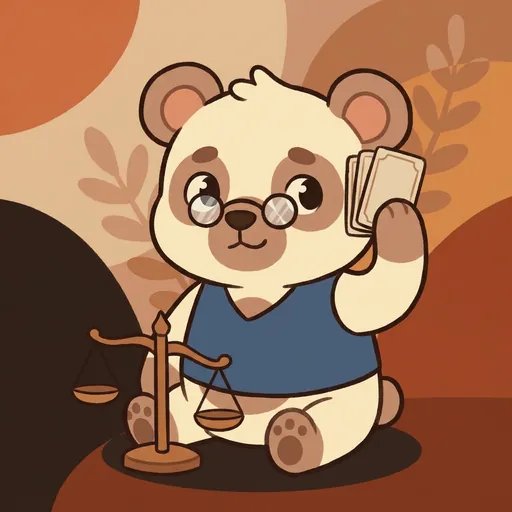
Verdis
VERDIS — the patient listener. weigh sides; don't pre-decide.
Listen along — Verdis
Loading audio…
Press play to listen along. The line being read lights up as you go.
Show full transcript
Loading transcript…
Chapter 1 — Verdis and the Slow Weighing of Sides
In the middle of the Youth Council room, three kids were all talking at once, and Verdis was not saying a single word.
She sat in the low wooden chair she liked best, her spectacles pushed down her nose, a small brass scale resting on the table in front of her. One kid wanted the empty lot turned into a park. One wanted the money spent fixing the cracked-up potholes on Mill Street. One kept jabbing a finger at a folder of papers nobody else had read.
“Well?” the finger-jabber demanded. “You’re the listener. Say who’s right.”
“Not yet,” Verdis said.
She reached out and set a small stone on the left pan of the scale. “That’s the park.” A second stone, right pan. “That’s the potholes.” She tapped the folder. “And this is everyone who isn’t in the room. The little kids who’d use the park. The grown-ups whose tires blow out on Mill Street. They get weight too.”
The three kids went quiet, watching the scale tip a hair one way, then settle.
“See how it moves?” Verdis said softly. “When I only heard the loudest voice, the scale wasn’t even out. I was just agreeing with whoever spoke first.” She nudged her spectacles up. “So I stop. I listen to all of it. I read the folder. Then I let the scale do what it does — slowly.”
“That’s so slow,” the finger-jabber groaned.
“It is,” Verdis agreed, not one bit sorry. “The slow part is the whole point.”
Verdis had learned that the hard way, back home in the slow-river valley.
When she was small, two of her cousins had a furious fight over whose turn it was on the rope swing, and Verdis — wanting it to stop, wanting to be helpful — had blurted out an answer before either of them finished talking. “It’s Bram’s turn. Obviously.”
It was not, obviously, Bram’s turn. She’d guessed. And because she’d said it loud and fast and sure, both cousins believed her, and the quieter one walked off hurt, thinking nobody had even heard her.
That night Verdis felt awful in a way she couldn’t name. Her stomach was tight. She kept replaying the quiet cousin’s face.
Her grandmother, an old bear with a slow, low voice, sat down beside her. She didn’t say you were wrong. She just asked, “You decided before you listened, didn’t you?”
Verdis nodded, miserable.
“That itchy, guilty feeling — that’s a good feeling to have,” her grandmother said. “It’s telling you the truth. You skipped the weighing. You wanted the arguing to end more than you wanted to be fair.” She patted Verdis’s paw. “Being fair isn’t about being fast, little one. It’s about holding every side long enough to feel its real weight. Even the side that’s standing off in the corner, saying nothing.”
The tight feeling loosened, just a little. It still hurt — but now it had a shape. I decided before I weighed. Somehow, naming it made it something Verdis could carry, and learn from, instead of just ache over.
She walked to the Youth Council at twelve, because a place that argued about what was fair ought to have someone who wasn’t in a hurry.
Liberty, the mentor who ran the council, met her at the door and asked one question. “What is justice?”
Verdis didn’t answer with a speech. She set her little scale on the table, put a stone on each pan, and let it wobble to a stop between them.
“It’s not about picking a winner fast,” she said. “It’s the weighing. You listen to every side — even the side that isn’t in the room. You read what things actually say. Then you decide. And you stay honest about it: sometimes the weighing gives a clear answer, and sometimes it just shows you that good people really do disagree.”
Liberty looked at the scale, still trembling toward level. “Most people,” she said, “come in already knowing who they want to win.”
“That’s not weighing,” Verdis said. “That’s just looking for someone to agree with.”
Liberty smiled. “You belong here.”
Verdis’s workshop filled up fast, because there is never a shortage of arguments.
A boy came in one afternoon, arms crossed, sure of himself. “I already know who’s right,” he announced. “I don’t need the scale.”
“Okay,” Verdis said mildly. “Tell me the other side’s best point.”
The boy opened his mouth. Closed it. “I… don’t know their best point. I know why they’re wrong.”
“Those aren’t the same thing.” Verdis pushed the folder across to him. “Read this first. It’s from the people your side never talks to.” She waited while he read, watching his crossed arms slowly come undone.
“Huh,” he said finally. “They’re not being unfair on purpose. They just want a different thing, and it kind of makes sense for them.”
“Now put a stone on the scale for them.” He did. The pan dipped. “Feel that? The scale just told you your first answer was too light. You’d only weighed one pan.”
“So who wins?” he asked.
“Weigh it and see.” Verdis leaned back. “Maybe one side really is better once you count everybody. Then you say so — clearly. Or maybe both sides have a fair claim, and the honest answer is this is genuinely hard, and here’s exactly where we disagree.” She tapped the level scale. “Saying that out loud isn’t weakness. It’s the bravest, most honest thing a council can do.”
The boy stared at the two stones, balanced, neither one falling. And for the first time all day, he didn’t look like he was trying to win. He looked like he was thinking.
Later, when the room had emptied, the boy came back. He was quieter now.
“When the scale just… stays even,” he said. “When you can’t pick a side. Doesn’t that mean you failed?”
Verdis thought about the rope swing. About the quiet cousin’s face. About her grandmother’s slow, low voice in the dark.
“No,” she said. “That’s the honest weight. You held every side. You read the folder. You counted the people who weren’t even here. And the truth turned out to be this is hard.” She looked at the little scale, level and calm. “Skipping that — deciding fast so the arguing stops — that’s the only real failure. I know, because I did it once, and I still remember exactly how bad it felt.”
The boy nodded slowly.
“The weighing isn’t the boring part before the answer,” Verdis said. “The weighing is the answer. When you’ve truly held all of it — the loud and the quiet, the here and the not-here — there’s this steady, settled, unhurried feeling. Like a scale that’s finally allowed to rest.” She smiled. “That feeling means you were fair. And being fair, it turns out, feels a lot like being patient.”
The CivicForge ensemble
Verdis is part of CivicForge's distributed-narrative cast. Each character embodies a different curricular primitive; together they teach the full subject.
-

Aera
Liberty (open-window) — keeper of open windows; snowy owl on shuttered window frame
-

Span
Equity — the bridge-builder; heron with mismatched planks for mismatched riverbanks
-

Cordis
Civility — disagreement-without-disrespect host; striped badger with mismatched cups + bow tie
-

Kindle
Participation — the door-opener; prairie dog at a half-open door pointing outward
-

Tellus
Stewardship — the long-view caretaker; ancient tortoise planting trees they will never sit under
-

Level
Rule of law — the line reads level whoever holds it, even the one who set it; mountain goat with a stone level + plumb-bob
-

Rung
Due process — climb every step in order, never skip to the verdict; woodpecker climbing a trunk rung by rung
-

Muster
Consent of the governed — nothing proceeds until everyone's gathered and the yes is real; meerkat counting raised paws from the burrow-mound
-

Herald
Transparency — a decision no one can see isn't finished; crane keeping an open notice-board in the square