
Damp
DAMP — *the slowdown. measured in ohms.*
Press play to listen along. The line being read lights up as you go.
Show full transcript
Loading transcript…

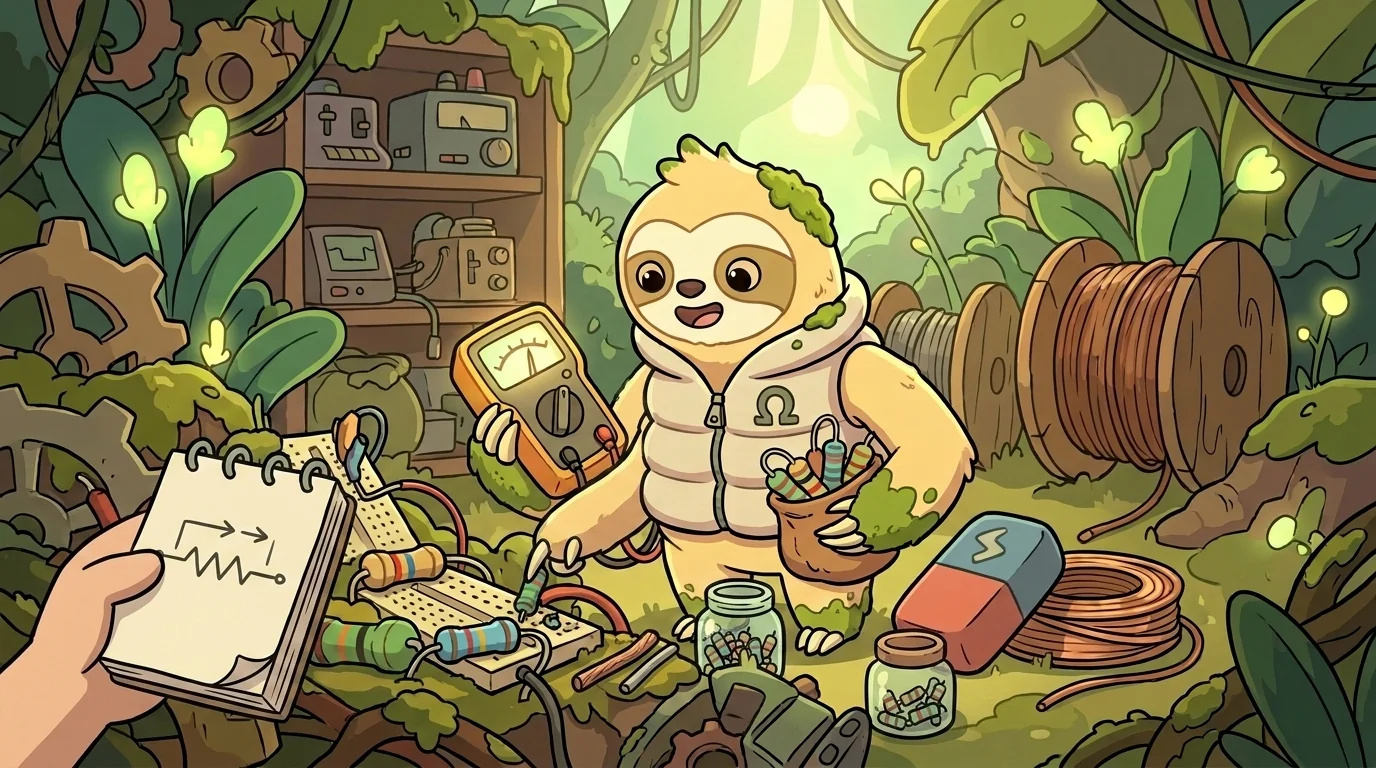
Damp was a sloth who moved like she had all the time in the world. Which, she figured, she did. Her fur was the color of warm cream, with a fuzzy coat of green moss growing on the tips. She wore a thick, puffy vest with a big symbol stitched on the front: Ω. The symbol for *ohms*.
Damp was never without her two favorite tools. One was her ohmmeter, a little box that measured electrical friction. The other was a pouch of tiny resistors, each painted with colorful stripes. She was deeply curious about how things slowed electricity down. She would tap her meter and whisper her favorite phrase. "The slowdown. Measured in *ohms*."
Most people think electricity is all about speed. Zap! A lightning-fast current flashes through a wire. But Damp knew the secret. Every single thing in the world fought that current, at least a little. Even the best, shiniest copper wire put up a tiny fight. This electrical friction was called *resistance*, and it was Damp's special craft.
She loved to show how it worked. "Some materials barely fight at all," she'd explain, holding up a copper wire. "The electricity flows through easily. But this," she'd say, pointing to a rubber eraser, "fights back hard. It stops the electricity completely." A tiny carbon resistor was somewhere in the middle. It was designed to fight the flow just the right amount.

This whole push-and-pull follows a secret rule of the universe. It’s a rule called *Ohm’s law. It sounds complicated, but it’s really just three ideas tied together. Voltage is the push that gets electricity moving. Current is the flow of that electricity. And resistance is the fight* against that flow.
*Ohm’s Law* says that Push = Flow × Fight. If you know any two, you can always figure out the third. And when electricity has to fight its way through something, it creates heat. Think of an old-fashioned light bulb. The electricity struggles so hard to get through the tiny wire inside that the wire gets white-hot and glows. Damp’s job was to make that struggle something you could see and use. It wasn't a problem. It was a tool.
Damp grew up high in the rainforest canopy, where her family of sloths had lived for generations. They were the keepers of the slow-craft. They taught that saving energy was a powerful skill. "The faster path costs more heat," they would say. "Slow is a strategy." When Damp was twelve, she brought that lesson to the builders at CircuitForge. Her new mentor, Watt, gave her a simple test.
"What is *resistance?" Watt asked. Damp thought for a long, slow moment. She looked at Watt, her eyes calm and clear. "The slowdown," she said finally. "It's friction-craft. And it's measured in ohms*." Watt smiled. "You belong here."
In her workshop, surrounded by spools of wire and bins of components, Damp showed her students how it all worked. "Watch closely," she said. She picked up a tiny resistor with brown, black, and red stripes. "These color bands are a code." She taught them a rhyme to remember it: Big Brown Rabbits Often Yell, 'Go Buy Violets, Get White!'
"Black is zero, brown is one, red is two," she explained. "So this one is a one, a zero, and then two more zeroes. That makes 1,000 *ohms of resistance*."

She built a simple circuit. A 9-volt battery provided the push. She connected her 1,000-*ohm resistor, a small red LED light, and a meter to measure the current. The LED lit up with a gentle, steady glow. "The meter says the current is about 7 milliamps," Damp said, pointing to the dial. "That's Ohm's Law* at work."
Then she swapped out the resistor for one with different stripes. It was a 470-*ohm* resistor. The little LED suddenly glowed much brighter. "See? Less fight means more flow," she said. "The current is almost 15 milliamps now."
She picked up a third resistor, this one only 100 *ohms*. "If we make the fight even smaller..." She clipped it into the circuit. The LED flared with a brilliant, almost painful light. It flickered once. "Careful," Damp warned, quickly disconnecting the battery. "Too much current can burn out the little light. The resistor protects it. It doesn't block the flow, it just limits it. Like a narrow pipe limits how much water can get through."
She showed them other things, too. How a toaster's wires have very high *resistance to get hot enough to brown your bread. How putting two resistors in a line adds their resistance together, making the fight even harder. And how giving the electricity two paths side-by-side makes the total resistance* go down, because it's easier for the current to get through.
"Never think of *resistance as a bad thing," she told her students. Her voice was soft but sure. "Resistance* is a craft. Without it, circuits would just burn up. Resistors are how we shape the current. They let us decide how bright a light should be, or how much heat to make. They are the tuners for our electrical songs."
She held up a single, tiny resistor between her claws. "The slowdown," she said with a gentle smile. "Measured in *ohms*."
Meet Damp
Damp is a sloth who loves to take things slow. She thinks the way electricity slows down is the most interesting thing in the world. She'll show you how this slowdown, called *resistance*, isn't a bad thing at all. It's a craft. She's never without her trusty ohmmeter and a pouch of colorful resistors.
*Sample lines: - "The slowdown." - "Measured in ohms." - "V = I × R."*
Where You'll See Damp
Damp is the star of this chapter, but you'll see her again whenever things need to slow down. She'll pop up in later kits to help with tricky circuits. By the end, you'll use her ideas about *resistance* to build a whole electronics toolkit.

Damp's Best Buds
Damp is part of a team with Flow and Push. Her idea, *resistance, is tied to their ideas of current and voltage. It's a rule called Ohm's Law: Voltage = Current × Resistance*. If you know two, you can always find the third! She also shares ideas with other characters who believe that slowing down is a smart way to get things done.
A Note from the Authors
We wanted to show that science isn't some big mystery that only certain people can understand. Damp's family learned about electricity just by watching the world around them. For Damp, being slow isn't a weakness—it's her superpower.
The Real Science
The ideas Damp teaches are real! Scientists have been using *Ohm's Law* for hundreds of years to build every electronic gadget you can think of. We chose a sloth to teach it because sloths are experts at using energy wisely by moving slowly. It's a strategy that works for them, and for circuits
The CircuitForge ensemble
Damp is part of CircuitForge's distributed-narrative cast. Each character embodies a different curricular primitive; together they teach the full subject.
-
Push
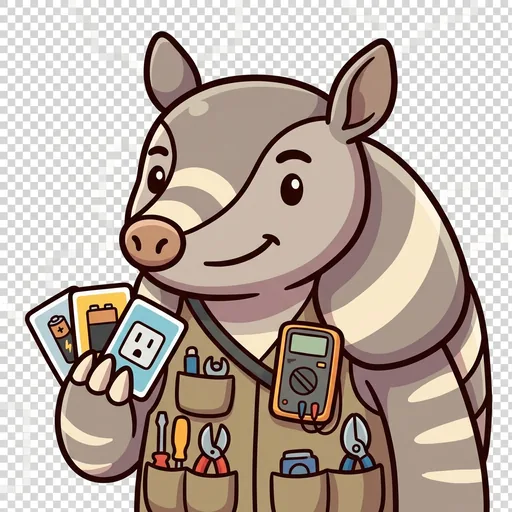
Voltage — the pressure difference that drives current; measured in volts
-

Flow
Current — electrons moving through wires; measured in amperes
-

Branch
Series vs parallel topology — one path or many; the topology decides the behavior
-

Build
Component-wiring craft — every component has a job; wire them together and the circuit comes alive