
Branch
BRANCH — *one path or many. the topology decides the behavior.*
Press play to listen along. The line being read lights up as you go.
Show full transcript
Loading transcript…
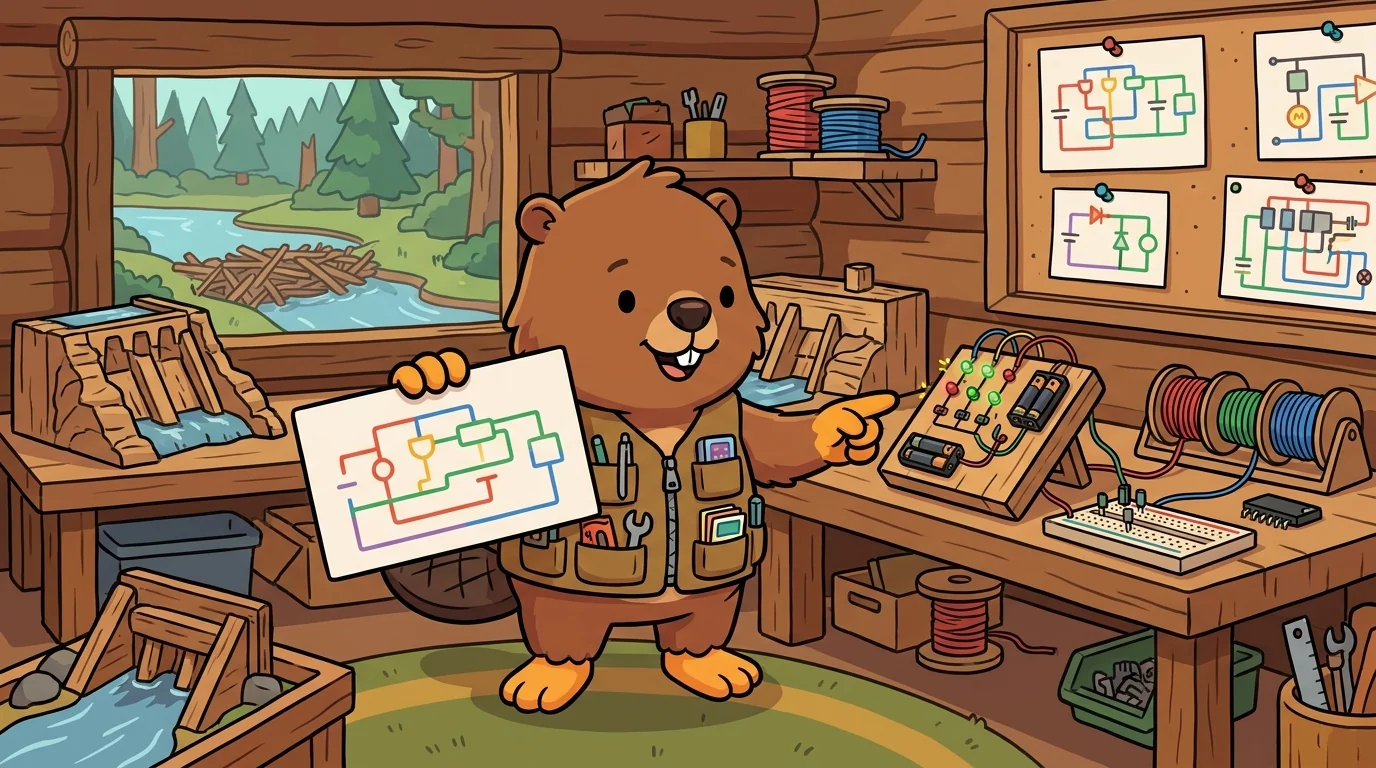
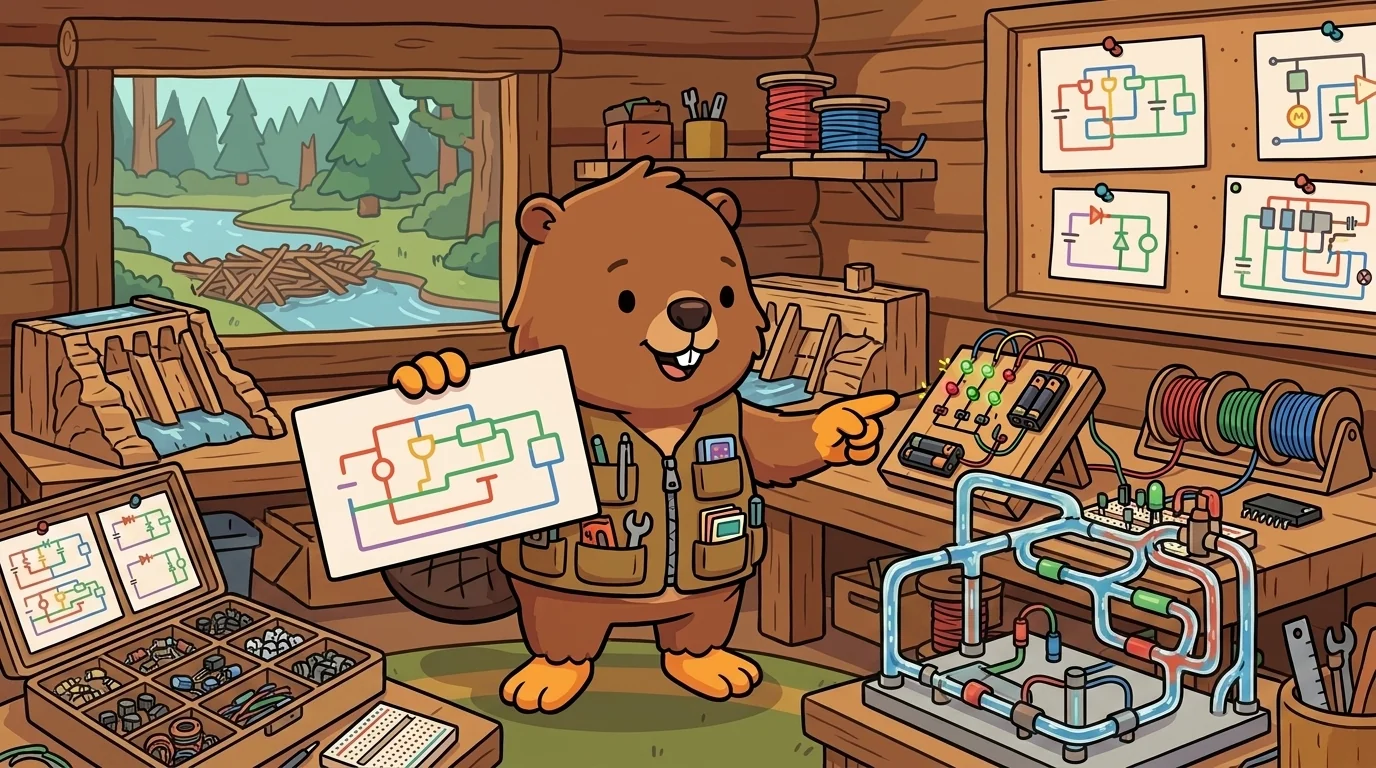
Branch hummed a little tune, a low, rumbling sound deep in his chest. His paws, tipped with soft amber, carefully arranged a handful of tiny wires on his workbench. He was a beaver, yes, but not just any beaver. He was a circuit-weaver, a path-finder, obsessed with the invisible roads electricity traveled.
He was small, warm-cream colored, and wore a chunky-cartoon topology-vest. Loops and branches were stitched onto the fabric, a map of connections. His most important tools, a series-vs-parallel-card-set and a node-diagram-tracker, lay spread before him. The cards showed different ways to link up parts, like a single closed loop or paths that split and rejoined. The tracker, a small, glowing stylus, could trace the flow through each design.
Branch believed in one simple truth: "One path or many. The topology decides the behavior."
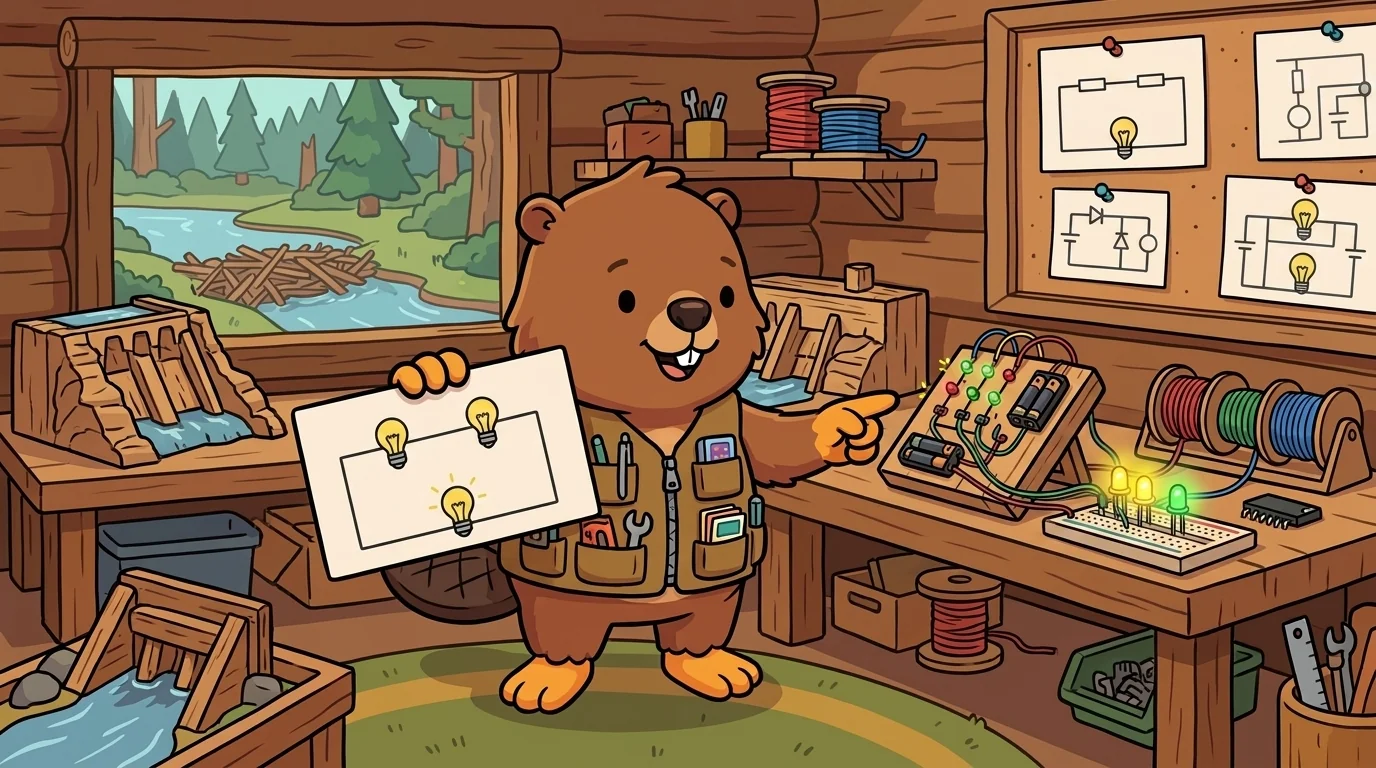
This truth was the heart of his work. Branch taught *circuit topology, the craft of understanding how connecting components differently changes everything. Most beginners thought a circuit was just one long line. But Branch knew better. He knew that components could be wired in series – all in a single line, sharing the same current. Or they could be wired in parallel* – branching out, each on its own path, sharing the same voltage. The same parts, arranged differently, created completely different results.
He picked up two small, shiny LEDs and a 9V battery. "Watch," he murmured, his voice gentle but firm. He connected the LEDs one after the other, in a single loop with the battery. This was a *series* connection. Both LEDs glowed, but they were dimmer than they would be alone. Each one got only about half of the battery's power.
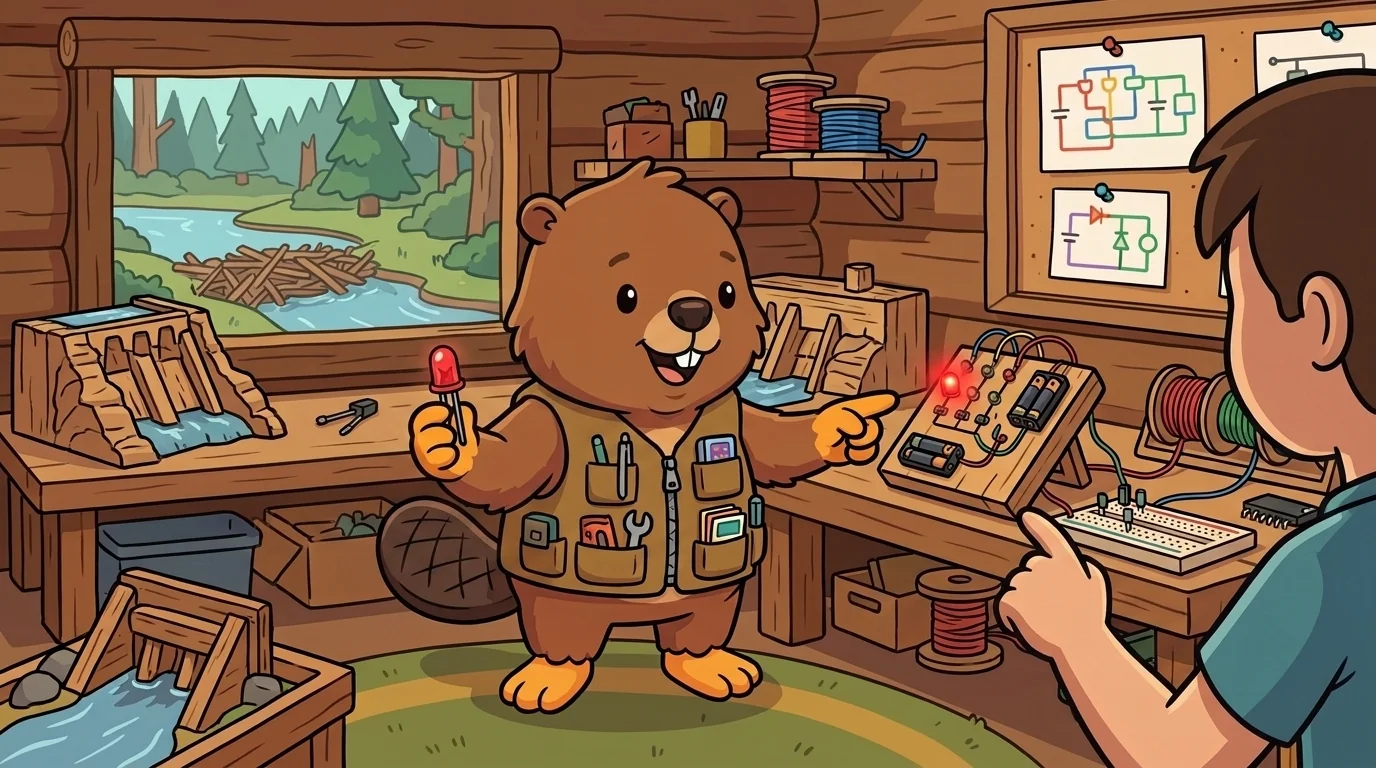
"See?" he said, pointing with his stylus. "The current goes through both. It's the same current for each LED. But the voltage, the push from the battery, that divides between them." He carefully unplugged one LED. The other immediately went dark. "If one fails, the whole loop breaks. Both go dark."
Then, with practiced movements, he rewired the LEDs. This time, he connected each LED directly to the battery, creating two separate branches. This was a *parallel* connection. Both LEDs lit up, bright and strong, just as if they were alone.
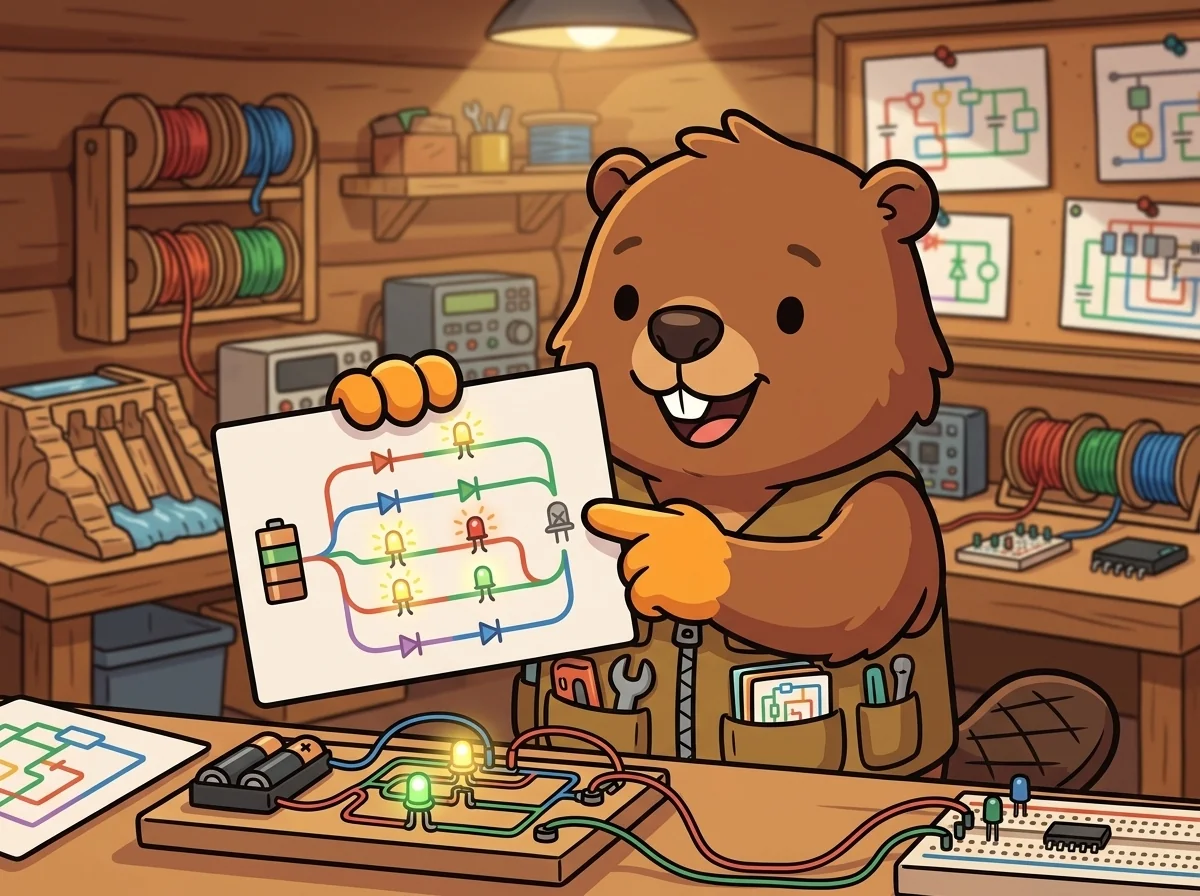
"Now, each LED is on its own branch," Branch explained. "They both get the same voltage from the battery. The current, though, that divides between them. The battery has to send out double the current it did before." He unplugged one LED. The other stayed brightly lit. "If one fails, the other still works. Same components; different topology; different behavior. The way you wire something, that's an engineering choice."
Branch had learned this lesson early, growing up along the lodge-streams. His family had been the long-channel-designers for the village. Their dam wasn't just one big wall; it had multiple spillways. Generations of beavers had been taught: "One channel breaks, the lodge floods. Many channels share the work. Resilience comes from branching." Branch had carried that wisdom forward, applying it to the flow of electricity.
He remembered the day he walked into CircuitForge, barely twelve. Watt, the wise old mentor, had asked him, "What is topology?" Branch hadn't hesitated. "One path or many. The topology decides the behavior. Path-choice-craft." Watt had simply nodded. "You are appointed."
Branch knew that understanding topology meant understanding the fundamental rules of electricity. He often showed how these rules applied:
Series: Components in a single line, forming one loop. The current is the same everywhere, but the voltage divides among the components. *Parallel: Components on branches, creating multiple paths. The voltage is the same across all branches, but the current divides among them. *Combined Circuits: Real circuits often mix both series and parallel. The trick is to identify the groups, simplify them step by step, and predict the overall behavior. *Kirchhoff's Current Law (KCL): At any junction where paths split or join, the total current flowing into that point must equal the total current flowing out. It's like water in a river: no water just disappears or appears from nowhere. *Kirchhoff's Voltage Law (KVL):* If you trace a path around any complete loop in a circuit, the sum of all the voltage drops and rises will always add up to zero. It’s about energy conservation within the loop.
He liked to use the example of holiday lights. "Think about old-style Christmas lights," he'd say. "One bulb failed, and the whole string went dark. That's because they were wired in series. But modern strings? One bulb goes out, and the rest stay on. Those are parallel."
"It's the same reason household wiring is parallel," he continued. "Every outlet in your home sees the same 120 volts. Appliances plug into their own branches. You can plug in many things, and the voltage stays stable, even though the total current drawn from the wall adds up."
Sometimes, new students would come to him with funny ideas. "Some folks think wiring things in series makes a circuit 'stronger'," Branch explained, shaking his head gently. "But series actually adds resistance. That means, for the same voltage, you get less current. It's different behavior, not necessarily 'stronger'."
"Or they think parallel means 'double the power'," he added. "Parallel does double the current for the same voltage, if you add another identical branch. But each branch still behaves the same way it would alone. Sometimes it's useful, sometimes it's just wasteful."
He always made sure to warn about the dangers, too. "What if you bridge two points in a parallel circuit with almost no resistance?" he asked, tapping a card. "That's a short circuit. Infinite current tries to flow, which can cause a fire. That's why fuses exist – to break the circuit before things get too hot."
Branch looked at his cards, then back at the two small LEDs, one still glowing brightly. He was Branch. The primitive he taught was circuit topology. The move was simple: series means same current, divided voltage; parallel means same voltage, divided current. The topology is always an engineering choice.
"Don't choose topology randomly," he advised, his voice soft but clear. "Choose it for the behavior you need. Christmas lights need to keep working when one bulb fails – parallel. Voltage dividers need controlled voltage drops – series. Most real circuits mix both. You have to identify the groups, simplify them, and design for the behavior you want."
He picked up his node-diagram-tracker, ready for the next lesson. "One path or many. The topology decides the behavior."
The CircuitForge ensemble
Branch is part of CircuitForge's distributed-narrative cast. Each character embodies a different curricular primitive; together they teach the full subject.
-

Push
Voltage — the pressure difference that drives current; measured in volts
-

Flow
Current — electrons moving through wires; measured in amperes
-

Damp
Resistance — the slowdown; measured in ohms; Ohm's Law (V = I × R) emerges from Push + Flow + Damp together
-

Build
Component-wiring craft — every component has a job; wire them together and the circuit comes alive