Dr. Quark
DR. QUARK — every science craft is an investigation. pick a lab and start asking.
Listen along — Dr. Quark
Loading audio…
Press play to listen along. The line being read lights up as you go.
Show full transcript
Loading transcript…
Chapter 3 — Dr. Quark and the Science Labs
The doors of the Science Labs swung open, and a kid marched in with a question already spilling out of her.
“How do plants make food out of sunlight?” she said, all in one breath. “That doesn’t even make sense. You can’t eat light.”
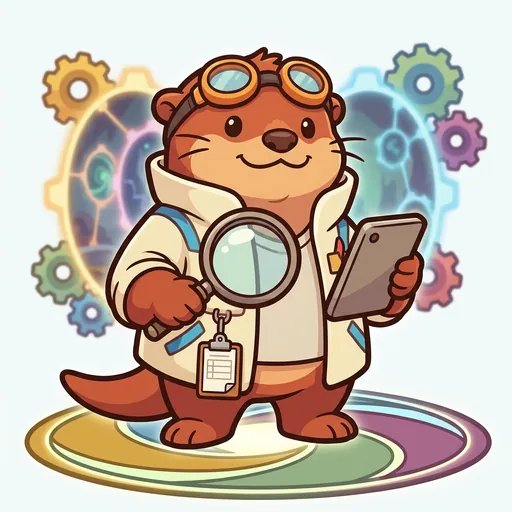
Dr. Quark was an otter with round goggles pushed up on her forehead and a small clipboard hanging from a cord around her neck. She did not answer the question. She grinned like the kid had handed her a present.
“Say that again,” she said. “Slower. Where does the food come from?”
“From… sunlight? And air? And water?”
“There it is.” Dr. Quark flipped a card on her clipboard, ran a paw down a list, and tapped one line. “That’s a living-cell question. And I know exactly which lab has the tools for it — GrowForge, down the green corridor. They’ve got a whole chapter where you watch it happen inside a single leaf-cell.” She pointed with her pencil. “Go. Ask them everything.”
The kid blinked. “You’re not going to teach me?”
“Nope.” Dr. Quark said it cheerfully. “I don’t do the teaching. I do the matching. You came in with a question. My whole job is knowing which lab was built to answer it.” She watched the kid trot off down the green corridor, then turned to the next one already waiting. “Next. What’s the question?”
Dr. Quark hadn’t always been so quick with an answer. Once, she’d been the kid standing in the middle of a hall, frozen.
She was small then, and she’d wanted to know everything — why the tide came in, how bones knew to stop growing, whether stars ran out. But every time she asked a grown-up, they’d say the same tired thing: “That’s complicated. You’ll understand when you’re older.” And the questions just piled up inside her, heavy and going nowhere, until she felt less curious and more stuck. Like her chest was full of half-open doors.
An old librarian-otter had found her sitting under a table one afternoon, arms crossed, glaring at nothing.
“You look like someone with too many questions and nowhere to put them,” the librarian said.
Dr. Quark had nodded, furious about it.
The librarian didn’t say you’ll understand when you’re older. Instead she pulled a card from her pocket and started writing. “Tide question — that’s over there, the water desk. Bones — that’s the body desk, third row. Stars — top floor, by the window.” She kept writing. “None of these are too hard for you. They just live in different rooms. You weren’t confused. You just hadn’t been shown the map.”
Dr. Quark took the card. And the strangest thing happened — the heavy, stuck feeling loosened. The questions weren’t a pile anymore. They were a set of directions. Every single one had a room it belonged to.
She never forgot that. The problem was never that a question was too big. The problem was only ever not knowing which door to walk through.
She came to the Science Labs at twelve, clipboard already around her neck, and asked to be the one who stood at the door.
Volt, one of the old mentors from the workshops across the way, met her there. He didn’t test her strength or her memory. He just gestured at the busy hall of labs behind him and said, “A kid’s going to come in scared that the ocean is dying. What do you do?”
Dr. Quark didn’t hesitate. “I don’t tell them it’ll be fine and I don’t tell them it’s hopeless. I ask them what part they’re worried about. Then I send them to ClimateQuest or over to the citizen-science lab — because those two are built to hand a worried kid something they can actually do. The lab does the comforting. I just make sure they land in the right one.”
Volt studied her for a moment. “And if you don’t know which lab fits?”
“Then I say so, and we figure it out together, and I write it down so I know next time.” She tapped her clipboard. “I’m not the one with all the answers. I’m the one who knows where the answers live.”
Volt looked at the clipboard, then at the otter holding it, and smiled. “You belong here,” he said.
By afternoon the hall was loud with questions, and Dr. Quark loved it.
A boy shuffled up to her desk, shoulders low. “I want to know how bacteria work,” he mumbled, “but everyone acts like germs are just… bad. Gross. Like there’s nothing to learn.”
Dr. Quark leaned forward. “Who told you that?”
“Everyone.”
“Everyone was pointing you at the wrong desk.” She flipped her clipboard around so he could see the list. “Watch how I do this. Your question is: are all bacteria bad? True or false?”
The boy thought. “I… don’t actually know.”
“Perfect answer. ‘I don’t know’ is where every investigation starts.” She tapped a line. “MicrobeLab. Their whole cast opens with the helpful microbes — the ones in your gut, in your food, keeping you alive. You’ll meet characters named for the bacteria that make yogurt and bread. By the end you’ll know exactly which ones help and which ones don’t, and you’ll have checked it yourself instead of taking my word for it.”
The boy’s head came up. “So it’s not gross?”
“It’s an investigation. Everything is, if you pick the right lab and start asking.” She handed him a card with the corridor written on it. “That’s the difference between ‘science is too hard’ and ‘here’s the desk where you can find out.’ One of those is a dead end. The other one is a door. I only ever deal in doors.”
He took the card and stood a little straighter. “What if I get there and I have more questions?”
“Then you come back,” Dr. Quark said, delighted, “and I’ll match those too. That’s the whole point. You’re never done. You just keep finding the next room.”
When the hall finally emptied, Dr. Quark sat on the edge of her desk and let the quiet settle.
She thought about the little otter under the table, arms crossed, chest full of half-open doors. She thought about how it had felt when the librarian turned that pile of stuck questions into a list of places to go — how the heaviness had lifted, all at once, into something that felt like permission.
That was the feeling she was really handing out, card after card. Not answers. Permission. The steady, unfrozen feeling of your question belongs somewhere, and you’re allowed to go find out.
She looked down the empty corridors — green for the growing things, blue for the water, a warm glow from the lab where the microbes waited — and felt the same lightness she’d felt at seven, sitting on the floor with a card in her paw.
None of it is too hard, she thought, warm and sure. It’s just spread across a lot of rooms. And somebody has to stand at the door and say: yes, that one. Go on in.
The AdventureHub ensemble
Dr. Quark is part of AdventureHub's distributed-narrative cast. Each character embodies a different curricular primitive; together they teach the full subject.
-
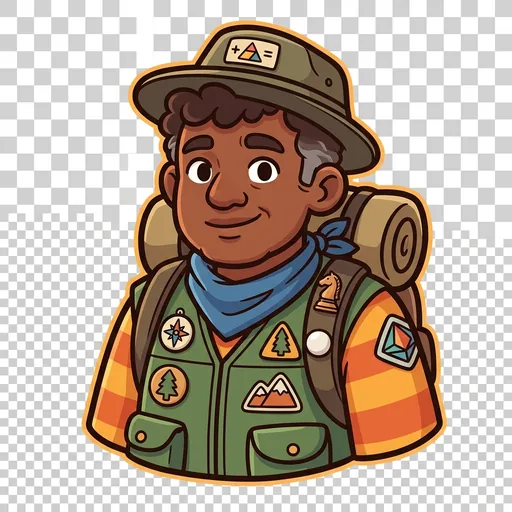
Trailmaster Theo
Math Mountains zone host — math + logic + ratios + chance + functions + geometry + proof + discrete + chess/Go/Xiangqi/backgammon/bridge tactics; 10+ source apps federated
-
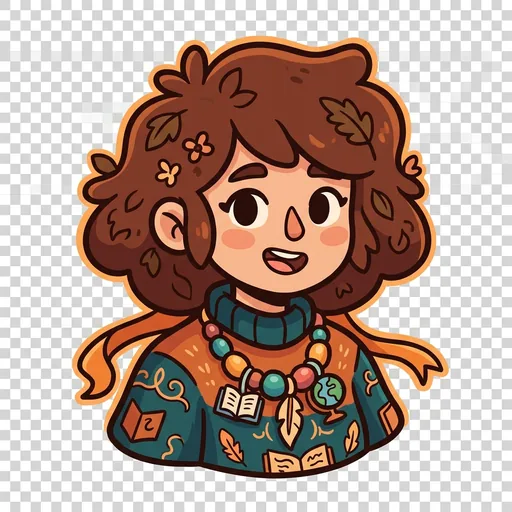
Loresinger Mae
Word Woods zone host — spelling + grammar + reading + writing + dialogue + character + poetry + voice + world-languages; 10+ source apps federated
-
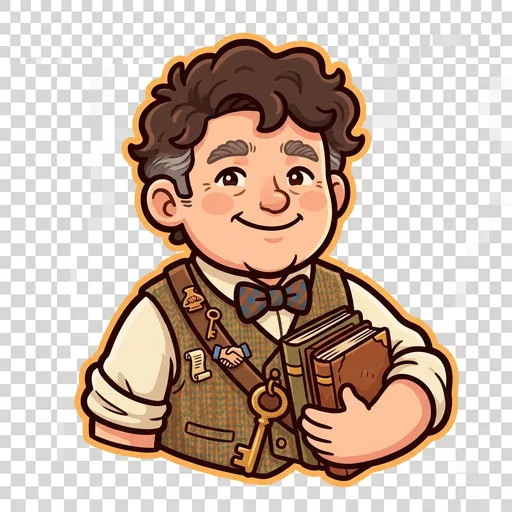
Archivist Atlas
History Ruins zone host — history + civics + culture + folklore + chronology + ethics; 5+ source apps federated
-
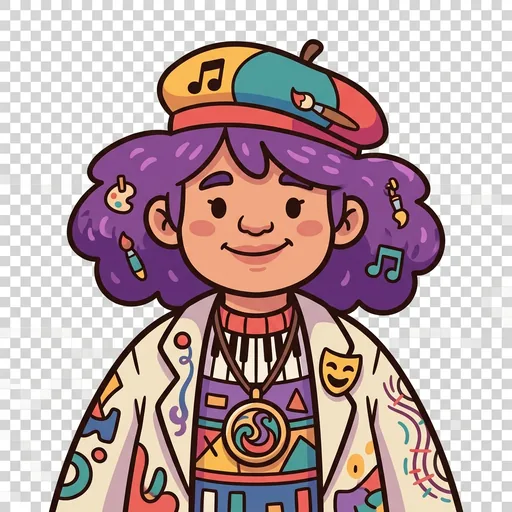
Maestro Mira
Creative Studio zone host — visual art + music + dance + theater + lyrics + motif + composition; 5+ source apps federated