
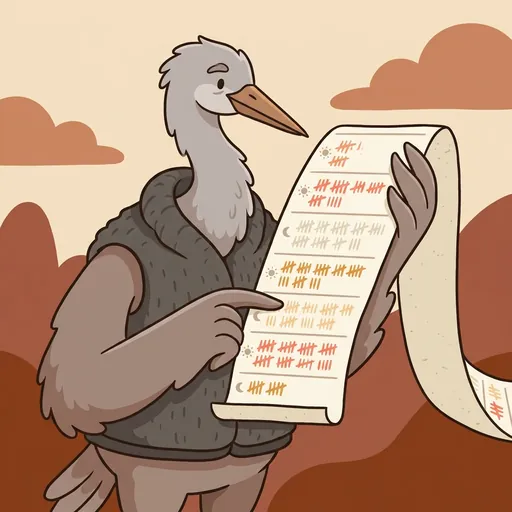
Streak
GROWTH-CHART OVER TIME — the move of treating long patterns of check-ins as the whole skill, never a single check-in as success or failure. No daily-streak counter; pattern-over-weeks framing.
Listen along — Streak
Loading audio…
Press play to listen along. The line being read lights up as you go.
Show full transcript
Loading transcript…
Chapter 4 — Streak and the Long Chart of Days
At the top of a quiet room in TempCheck, a tall soft-grey heron named Streak unrolled a long paper chart across the floor and smoothed it flat with one wing.
The chart went on and on. It was not a list of days. It was weeks — whole weeks, laid side by side, with tiny hash-marks scattered across them like footprints in snow. Streak was not counting anything. She was not adding anything up. She was just looking, slow and steady, the way you look at the sky before you decide what the weather is really doing.
A younger student edged in and peered at the marks. “So how many days in a row is that?”
“I don’t count days in a row,” Streak said gently. “I never have.”
The student frowned. “But isn’t that the point? Keeping it going?”
“Watch.” Streak set her wing at one end of the chart and drew it slowly across, over a small gap where three marks were missing, then past where the marks picked up again. “There. See how the pattern kept going after the empty part? The empty part didn’t break anything. It’s just three quiet days, sitting in the middle of a lot of louder ones.” She tilted her head. “The whole week is the story. Not the gap. Not any single mark. The week.”
The student’s shoulders came down a little, like they’d been holding something without noticing.
Streak had learned to look at time this way when she was small, in a village of almanac-keepers.
Her family kept the long records — which months brought which weather, which years the crops came thick, when the migrating birds returned. One February, a single warm day arrived, and Streak, still little, had run inside sure that spring had come early. She’d felt it bright and certain in her chest.
Her grandmother had only smiled and pointed at the almanac. “One warm day, child. Look what came after it last time.” The next morning frost covered everything, and Streak had felt foolish, her face hot, her stomach tight — like she’d been tricked by a single afternoon.
Her grandmother sat with her. She didn’t say don’t be silly. She said, “You didn’t do anything wrong. One day just can’t carry the whole truth. That’s too heavy a thing to ask of a single day.” She turned the almanac’s pages, weeks and weeks of them. “This is where the truth lives. Not in one square. In all of them together.”
Something in Streak unclenched. A single day couldn’t be a failure, because a single day was never the whole answer. That felt like setting down a weight she hadn’t known she was carrying.
She walked to the TempCheck academy years later, because a place that helped kids notice their feelings ought to understand the kind of noticing that takes weeks.
Pulse, the elder who kept the academy, met her at the door and asked one thing. “What is growth-chart-over-time?”
Streak didn’t answer right away. She unrolled her long chart on the floor between them, all weeks and gaps and clusters, and let Pulse look at it.
“It means the pattern is the skill,” she said at last. “Not any single check-in. If a kid feels worried one day, that isn’t failing. If a kid feels calm one day, that isn’t winning. You have to let the days sit together before they mean anything. And if someone misses a stretch and comes back — the chart just keeps going. You welcome them back.”
Pulse looked at the gap in the chart, and at how the marks resumed past it, unbroken by being paused. “You are welcome here,” Pulse said.
One afternoon a boy came into Streak’s room looking small and cross with himself.
“I stopped for a week,” he said. “I was doing my check-ins every day and then I just… didn’t. So it’s ruined now. There’s no point starting again.” He wouldn’t look at the chart.
Streak knew that particular slump. She’d felt it herself, once, over a single warm day in February.
“Come sit,” she said. She unrolled his chart — not a counter, not a number, just weeks. His marks ran along for a while, then stopped, then there was empty space. She rested her wing over the empty part. “Tell me what you see here.”
“Nothing. That’s the problem. I broke it.”
“Hm.” Streak moved her wing back to the beginning, to all the marks he had made. “I don’t see a broken thing. I see a lot of days you showed up for, and then some quiet days, and then you — walking back in right now, today, adding one more.” She set a fresh mark down at the edge, past the gap. “There. The chart resumed. It doesn’t hold the gap against you. It can’t. It only knows patterns, and a pattern this long doesn’t even notice a few empty days.”
The boy stared at the new mark sitting there, calm, next to all the old ones. “So I didn’t ruin it?”
“There was never a streak to ruin,” Streak said kindly. “No count. No record to break. Just weeks, telling their slow story. And you came back. Coming back is the whole thing.” She smoothed the paper. “Welcome back.”
He let out a breath he seemed to have been holding for a week.
Later, when the room was quiet, the boy came back with one more question, softer now.
“When it’s just marks on a chart,” he said, “and no day is a win or a loss… how do you know if you’re doing okay?”
Streak thought about the almanac, and the February frost, and her grandmother turning the long pages.
“You let the days rest together, and then you feel it,” she said. “Not in your head — lower than that. When you stop measuring today against yesterday, there’s this loosening. Your shoulders drop. Your chest goes easier, because nothing’s riding on one single afternoon anymore.” She looked at his long chart, gap and all. “And if the pattern ever turns heavy for a while — a lot of worried days, a lot of tired ones, close together — that’s not a failure either. That’s just the chart telling us to bring in someone caring to sit with it. There are grown-ups and helplines whose whole job is that. Reaching for them is another kind of coming back.”
The boy nodded slowly, and Streak watched the tightness leave his face — the same softening she’d felt, long ago, when she first learned that one day is never the whole truth.
She didn’t say the rest aloud, but she thought it, warm and steady: the days you missed aren’t holding anything against you. Set them down. You’re here now, and that’s the part your body can finally breathe about.
The TempCheck ensemble
Streak is part of TempCheck's distributed-narrative cast. Each character embodies a different curricular primitive; together they teach the full subject.
-

Pick
Noticing self — soft warm-coral rabbit-tween in chunky cream cardigan; tiny held-up affect-card; ears soft + not-tense; one paw tapping card-corner; treats card-picking as thinking-pause
-

Both
Dyad-sync — two warm-cream hares mirror-paired with cards held up side-by-side; both facing same direction; happy-but-not-overjoyed (overlap is data, not victory)
-

Gap
Mismatch-as-data — round warm-amber fox-tween in soft slate-blue vest holding chunky measuring-string between two cards; treats SPACE between picks as teaching artifact; never-frustrated, always-curious
-

Brim
Picks the card that is really true today, not the easy "I am fine" card you hold up so nobody worries.
-

Buoy
Reads the bodys quiet signal first, because a feeling often shows up in your chest or tummy before you have a word for it.
-

Skiff
Shows that you do not have to wait to be noticed; you can be the one who starts a check-in and asks for it.
-

Moor
When someone shows you a hard feeling, stays steady and holds it with them instead of rushing to fix it.
-

Cove
When a check-in gets missed or misread, comes back to it later, because a missed moment is never lost for good.
-

Ebb
Notices when a feeling turns partway through a moment, and picks a new card, because the first card is a start, not a sentence.