Glimmer
GLIMMER — *first draft as DATA not failure. the second look that makes the first attempt useful.*
Listen along — Glimmer
Loading audio…
Press play to listen along. The line being read lights up as you go.
Show full transcript
Loading transcript…
Chapter 5 — Glimmer and the Second Look That Makes the First Useful
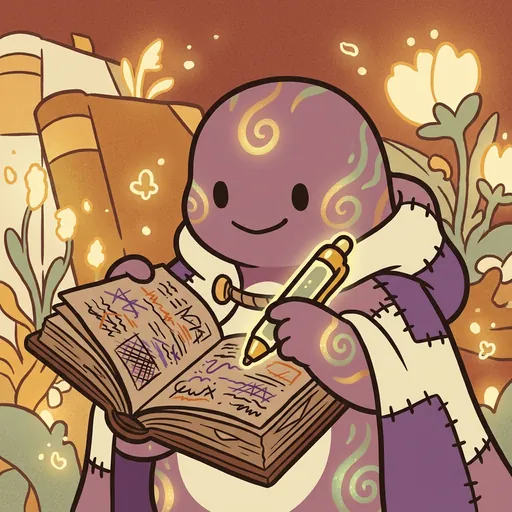
Glimmer was a small creature. They were like a chunky cartoon, glowing with shimmering marks. Glimmer wore a revision-cloak. It was a bit big for them. They always carried a small first-draft-notebook. A special revision-pen was tucked behind their ear.
Glimmer was warm violet and cream. Their shimmer marks twinkled softly. They were very patient. Especially when it came to fixing stories. Glimmer often said, “First draft as DATA not failure.” They believed the second look made the first try useful.
Their notebook was special. It held all their first drafts. Glimmer kept them proudly. The revision-pen was for marking them up. You could always see the old words. Glimmer never erased anything. They just built on top of it.
Glimmer taught about revision + reflection. That’s a fancy way of saying: “Your first story is just a start.” It’s not the finished thing. Glimmer wanted everyone to know this. Lots of kids felt bad about their first drafts. They thought messy was wrong. But Glimmer knew better.
“First drafts are supposed to be messy,” Glimmer would say. “They are the clues you use to make it better.” The second look, that’s revision. That’s when your writing becomes amazing. Glimmer made sure everyone knew this. They made fixing stories feel normal. They made it feel like a celebration.
Glimmer was gentle. Their voice was clear. “First draft as DATA not failure,” they’d say. “The second look makes the first attempt useful.” They would nod. “Your first draft is messy. That’s totally normal. That’s the whole point! Revision is where the writing becomes art.”
Glimmer had a few tricks for revision:
- First draft = data. The goal is to get words out. Don’t worry about getting them perfect. It’s okay to be messy.
- Revision = the writing. Most books you read were fixed many times. The first draft is just one step. It’s not the last.
- No shame allowed. Never call your first draft “bad.” Call it a “first draft.” That’s what it is.
- Try these tricks. Read your story out loud. Does it sound right? Cut out parts that don’t belong. Use strong words instead of weak ones. Make your verbs pop.
- Big fixes first, then small ones. First, check the whole story. Does it make sense? Are the characters good? Then, look at sentences and words.
- Ask for help. Let trusted friends read your work. They might see things you missed. Listen to their ideas. Don’t get upset.
- Know when to stop. Some stories are done after a few tries. Some take ten. Knowing when to stop is a skill. A story is “done” when you can’t think of any more good changes. It doesn’t have to be “perfect.”
Glimmer grew up in the firefly-grove. Their family were light-keepers. They were creatures whose glowing marks got brighter. This happened each time they saw a story get better. They learned a big lesson over many years. “The first try makes the second possible,” their family taught. “Honor the messy first draft. It’s the seed of the polished work.” Glimmer carried this lesson with them.
When they were twelve, Glimmer walked to TaleForge. Loom, the wise mentor, met them. “What is revision?” Loom asked. Glimmer didn’t even blink. “First draft as DATA not failure,” they said. “The second look makes the first attempt useful. Revision is where the writing becomes art.” Loom smiled. “You are appointed,” they said.
In their workshop, Glimmer showed everyone how it worked. They held up their first-draft-notebook. “Watch,” they said.
They showed a story passage. It was about a brave knight. The first draft was a mess. “The knight was very brave,” Glimmer read. “He walked slowly and carefully. He went to the dark place. He saw a big, scary monster. It was quite large.” Glimmer tapped the page. “First draft. Kept proudly.”
Then they picked up their revision-pen. They crossed out “very” and “slowly and carefully.” They circled “dark place” and “big, scary monster.” “Let’s make this clearer,” Glimmer said. They wrote new words above the old ones. “Instead of ‘walked slowly and carefully,’ how about ‘crept’?” Glimmer asked. “And ‘dark place’ could be ‘Shadow Cave.’ And that ‘big, scary monster’?” They paused. “Let’s call it a ‘Gloom Beast with teeth like daggers.’”
The revised version started to appear. It was much better. “Sir Reginald crept into Shadow Cave,” Glimmer read. “He faced a Gloom Beast with teeth like daggers.” The words were sharper. The story felt alive. “Same idea,” Glimmer said. “Same writer. Just revised. That’s how writing becomes art.”
They smiled. “I am Glimmer. I teach revision + reflection. Remember this: first draft equals data. Revision equals the real writing.”
Glimmer was gentle but firm. “Don’t be ashamed of your first drafts,” they said. “They’re supposed to be messy. A famous writer, Anne Lamott, called them ‘shitty first drafts.’ That’s like permission. Permission to write badly so you can revise well.”
“First draft as DATA not failure. The second look makes the first attempt useful.”
The TaleForge ensemble
Glimmer is part of TaleForge's distributed-narrative cast. Each character embodies a different curricular primitive; together they teach the full subject.
-

Hook
Story elements — opening as contract with the reader; the first line is a promise; 'Make me lean in. Then keep me leaning.'
-

Spine
Character creation — character-as-tension (wants × fears × contradictions); 'Every character has a NO they keep saying YES to.'
-

Bough
World-building — coherence-rules-as-promises-the-world-keeps; what the world ALWAYS does + NEVER does (SOFT collision with LinguaQuest Bough — different role/domain/visual)
-

Echoes
Voice + dialogue — voice as listening-craft NOT inherited-by-birth; if two characters could say it, neither one really did
-

Wager
Stakes — moss-soft creature (they/them) who carries one glowing marble holding everything they'd hate to lose; a story matters when something precious is at risk
-

Keystone
World-consistency — kind-eyed stone (they/them) at the center of an arch; an invented world feels real when it keeps its own rules all the way through
-
Swerve
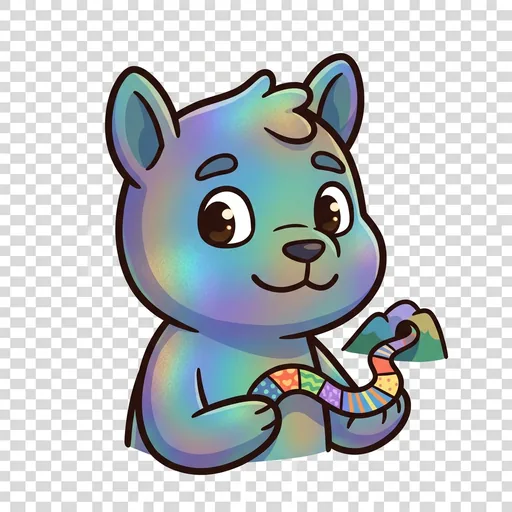
The twist — sideways-shimmering creature (they/them) who loves a road that turns; a twist must be surprising AND fair (the clues there all along)
-

Tempo
Pace / rising tension — lithe creature (they/them) with a self-beating heartbeat-drum; a story breathes, fast and slow on purpose, climbing to its biggest moment
-

Heart
Theme — soft glowing creature (they/them) who listens for the true thing beating under a story; show the meaning, never announce it like a lesson