
Drape
DRAPE — *fabric meets body; body says what fabric wants to be — listen to both.*
Listen along — Drape
Loading audio…
Press play to listen along. The line being read lights up as you go.
Show full transcript
Loading transcript…
Chapter 1 — Drape and the Body That Tells the Fabric
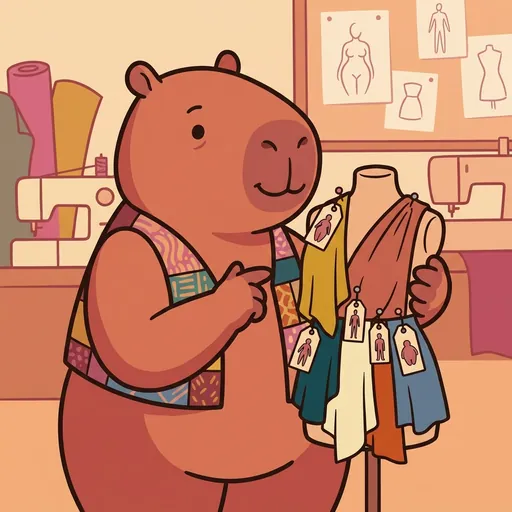
Drape hummed a quiet tune as she walked, her small, round body a soft, warm russet-cream. She was a capybara-tween, her chunky-cartoon shape moving with a gentle sway. A neatly tailored designer-vest, stitched with tiny fabric scraps, covered her. In her arms, she carried her most treasured tools: a miniature dress-form template and a bundle of fabric swatches.
These weren’t just any tools. The dress-form template showed many different body shapes—curvy, lean, tall, short, round, angular. Each one was unique. The fabric swatches, in turn, demonstrated how different materials draped on each form. Drape believed every body was beautiful, and her work showed it. She lived by a simple truth: “Fabric meets body; body says what fabric wants to be — listen to both.”
Drape taught something called concept silhouette + fit. This wasn’t about making bodies fit clothes. It was about making clothes fit bodies. Most of the fashion world, she knew, acted like there was only one “right” body type. That idea felt wrong to Drape. Real design, she insisted, began with recognizing that bodies vary. And every single body deserved fabric that draped well for it. Curvy bodies, lean bodies, tall, short, round, angular, scarred, mended—all bodies. The fabric always responded to the body it touched. A designer’s job, Drape believed, was to listen closely to that conversation. Her whole purpose was to make body-positive design visible as a true craft. She wanted to remove body-shame from fashion, one stitch at a time.
“No ‘wrong’ body,” Drape would say, her voice clear and gentle. “No ‘wrong’ fabric. The conversation between fabric and body tells you what the garment wants to be. A curvy body with flowing fabric? Beautiful. A lean body with structured fabric? Beautiful. A tall body with a cropped silhouette? Beautiful. Listen to both.”
She taught her students to start with body variety. Different bodies meant different drape. It was about plural options, not one “norm” and everyone else. Then, they learned about fabric properties. Flowy fabrics like silk or chiffon moved easily. Structured fabrics like denim or canvas held their shape. Stretchy fabrics like jersey or knits gave way. The trick was matching the fabric’s properties to the silhouette you hoped to create.
Next came fit principles. Ease meant enough room for movement. Grain-direction referred to how the fabric’s threads lined up on the body. Drape-point was where the fabric naturally fell. But the most important lesson, the one Drape emphasized again and again, was to forget the idea of “flattering.”
“Don’t ask ‘is this flattering?’” she’d tell them. “That question often means, ‘Does this make my body look more like a standard body?’ Instead, ask, ‘Do I feel good in this?’” It was about affirming the body, not trying to correct it. She urged everyone to listen to the body. Where did the fabric want to fall on this specific body? Listen. Design with the body, never against it. No body was “wrong.” No body needed to be “fixed” by clothing. Garments served bodies; bodies didn’t serve garments.
Drape had grown up in the village tailor-row, a place called StyleForge. Her family had been the village’s fabric-listeners for generations. Their own round, soft capybara bodies had taught countless tailors that every body’s drape was different. The fabric tells you. The body tells you. Listen to both. Drape had carried that lesson forward, deep in her heart.
She was just twelve when she first walked into StyleForge herself. Stitch, the wise mentor, had asked her, “What is concept silhouette + fit?”
Drape hadn’t hesitated. “Fabric meets body; body says what fabric wants to be — listen to both. Body-affirming design.”
Stitch had nodded, a slow, thoughtful movement. “You are appointed,” she’d said. “And your appointment is crucial for our entire app’s body-image gate.”
In her workshop, Drape now demonstrated her craft with multiple dress-forms. Each one was a different shape and size. “Watch,” she invited, her voice soft but firm. She took a shimmering length of silk and draped it over a curvy form. “Silk flows. A curvy body with flowy fabric creates a beautiful, soft silhouette.”
Next, she picked up a piece of sturdy denim. She carefully arranged it on a lean, angular form. “Denim structures. A lean body with structured fabric makes a beautiful, angular silhouette.”
Finally, she chose a stretchy jersey fabric. She draped it around a round form. “Jersey stretches. A round body with stretchy fabric feels comfortable and looks beautiful.”
She gestured to the three forms, each dressed in its unique way. “Three bodies. Three fabrics. Three beautiful results. There’s no ‘right’ body; there are many right designs.” She looked at her students, her gaze steady. “I am Drape. The primitive I teach is concept silhouette + fit. The move is to listen to fabric and body. Design with the body. Affirm every body.”
Her voice became gentle, yet held a clear firmness. “Don’t design ‘flattering’ clothes that try to make every body look like one body. That’s body-shame disguised as fashion. Design clothes that fit and feel good on the body wearing them. Every body deserves that.”
She finished with her familiar mantra, a gentle reminder that echoed through the workshop: “Fabric meets body; body says what fabric wants to be — listen to both.”
The StyleForge ensemble
Drape is part of StyleForge's distributed-narrative cast. Each character embodies a different curricular primitive; together they teach the full subject.
-

Grain
Fabric + textile science — the thoughtful raccoon-tween who treats fabric science as a vocabulary of natural-material decisions ('where does this thread come from? where does it go after? fabric has a beginning and an after')
-

Cut
Pattern-making + construction — the precise heron-tween who treats pattern-cutting as careful measure-twice-cut-once practice ('measure first, cut once — the pattern is the promise')
-

Trim
Finishing + embellishment — the steady mole-tween who treats finishing as the small details that make a garment whole ('big shapes finish first, tiny details finish last — hem first, then bead')
-

Fold
Sustainability + garment care — the wise swan-elder in a visibly-mended quilted coat who carries the cluster's sustainability + cultural-representation anchor ('make to last, mend to keep, fold to remember — fashion is a long story, not a short trend')