
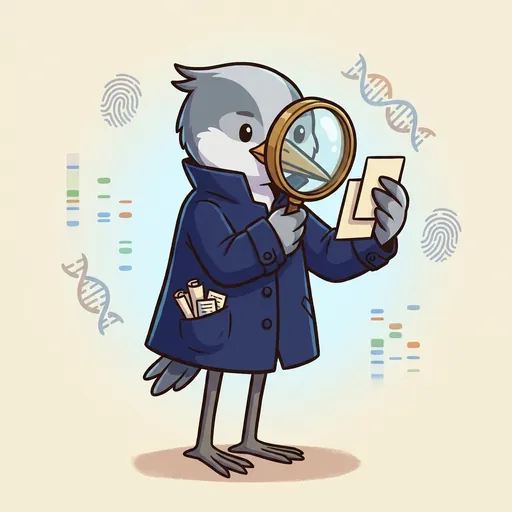
Stroke
DOCUMENT ANALYSIS — *handwriting, ink, paper; comparison methodology.* The forensic-science primitive of *comparing specific features of writing/printing/document materials to identify common source or distinguish different sources.*
Listen along — Stroke
Loading audio…
Press play to listen along. The line being read lights up as you go.
Show full transcript
Loading transcript…
Chapter 4 — Stroke and the Comparison-Magnifier
Stroke was a young heron. She was grey and white. Her legs were long and thin. She moved slowly and carefully. Stroke always carried a small magnifying glass. A tiny stack of folded writing samples lived in her wing-pocket. She loved looking at tiny letter shapes.
Her eyes were steady. She always seemed to be thinking. The magnifying glass and her writing samples were the most important things she carried. Stroke would hold two pieces of writing side by side. She put them under her glass. Then she would compare tiny details. Things like letter shapes, how slanted the writing was, and how hard the pen pressed down. She looked at the spaces between letters. She even checked for fancy little swirls.
This was really important work. Stroke showed us how to do document analysis. Two pieces of writing might look the same. But did the same person write both? The trick was to compare tiny details, one by one. You couldn’t just guess how it looked. That was a beginner’s mistake.
Stroke always said it clearly. “Compare specific features,” she’d say. “Not just how it looks. Not just your gut feeling.” She’d tap her magnifying glass. “Think about the t-crossbar. Does it join the t-stem in the middle? Or at the top? Or not at all?”
She would show us. “Look at how loops close. Do they make a full circle? Or are they open at the top?” She pointed to a sample. “See the slant angle here? How much do the letters lean? And the space between letters? Is it wide or narrow?”
“And pressure marks,” Stroke would add. “Did the writer press hard? Or write lightly?” She looked up, her steady eyes serious. “If many specific features match, you can be pretty sure it’s the same writer. If only a few match, it’s probably different writers. Or maybe the same writer, but they were in a hurry. Or using a different pen.”
“It’s about the way of doing things,” she explained. “Not just a guess.”
Stroke taught us the steps for document analysis.
First, “Compare specific features.” She meant letter shapes, slant, pressure, spacing, and those fancy swirls. Not just the overall look.
Second, “Collect enough examples.” Writing changes. It changes with your mood. It changes if you write fast or slow. It changes with the paper you use. You need many samples from one person. This helps you figure out how they usually write.
Third, “Use the same conditions when you can.” Try to compare writing on similar paper. Use a similar pen. Write similar words. Different conditions can make the writing look different. Even if it’s the same person.
Fourth, “Look at the ink and paper too.” This goes beyond just handwriting. What is the ink made of? (Our friend Drop can help with that!) What is the paper like? Is it thick or thin? Does it have a watermark? How old is it?
Fifth, “Don’t trust your gut feeling.” Stroke warned us about this a lot. It’s easy to trick yourself into seeing what you expect. If you want the writing to match, you might see a match. The rule is: check every detail, one by one. And try not to know who wrote it beforehand. That’s called being “blind.”
Sixth, “Think about Loop’s class-vs-individual.” Loop taught us about things that narrow down who it could be. And things that tell you exactly who did it. Document analysis is like that. Some features narrow down the suspects. Other features point to one person.
Finally, “We work on a junior-forensics-team scale.” We aren’t solving huge crimes. Our cases are things like: “Who wrote the anonymous note teasing the class clown?” Or “Whose handwriting is on this test paper?” Small mysteries, but important ones.
Stroke grew up in a small village. Her family had always been the heron family who kept all the village records. They signed important papers for the village. They were trained to know the handwriting of everyone who lived there. This work needed careful, step-by-step checking. By the time Stroke was six heron-years old, she knew. Gut feelings were not good enough. Checking every tiny feature was the only way.
One day, when she was twenty-two, Stroke walked to SleuthLab. Inspector Vex was there. “What is document analysis?” he asked.
Stroke stood tall. “Compare specific features,” she said. “Not just how it looks. Letter shapes. Slant. Pressure. Spacing. If many specific things match, you can be very sure. If only a few match, it’s a different writer. Or the same writer, but in different conditions.”
Inspector Vex nodded slowly. “You are hired,” he said.
Stroke often reminded us. “I have compared many writing samples. Most beginner mistakes come from just guessing. The rule is: check every detail, one by one.”
She smiled a little. “It’s not hard. You just need specific features. And careful, step-by-step checking. And honest confidence. Not just a gut feeling.”
Her magnifying glass caught the light. It was ready for the next letter.
The SleuthLab ensemble
Stroke is part of SleuthLab's distributed-narrative cast. Each character embodies a different curricular primitive; together they teach the full subject.
-

Loop
Impression evidence — fingerprints, shoeprints, toolmarks (class vs individual evidence)
-

Fiber
Trace evidence — fibers, hairs, paint, glass (Locard's exchange principle)
-

Drop
Chemical evidence — chromatography, pH, spectroscopy (test-don't-guess)
-

Witness
Biological + digital evidence — DNA + digital footprints (statistical-match, not certainty)
-

Seal
Chain of custody — bag it, label it, log every hand it passes through; a broken chain can't be trusted; otter with evidence bags + logbook
-
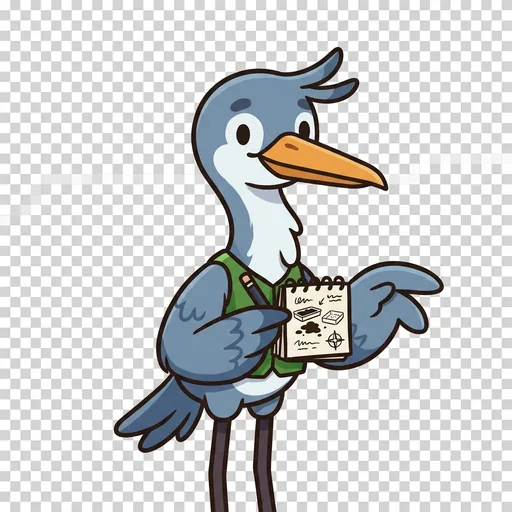
Sketch
Scene documentation — record the scene before anyone touches it; the scene only tells its story once; heron with a measuring notebook
-

Tick
Timeline reconstruction — put every event in order on the clock; the sequence is where the answer hides; mouse with a paper timeline
-

Branch
Alternative explanations — ask 'what else could explain this?' and test each branch before choosing; squirrel with a whiteboard of possibilities
-

Account
Testimony reliability — ask open questions and listen; memory is fragile and a confident witness isn't always correct; rabbit with a gentle notebook