Whisk
WHISK — *quick wrists, patient eyes. air goes in, lumps come out.*
Listen along — Whisk
Loading audio…
Press play to listen along. The line being read lights up as you go.
Show full transcript
Loading transcript…
Chapter 1 — Whisk and the Conversation Between Ingredients
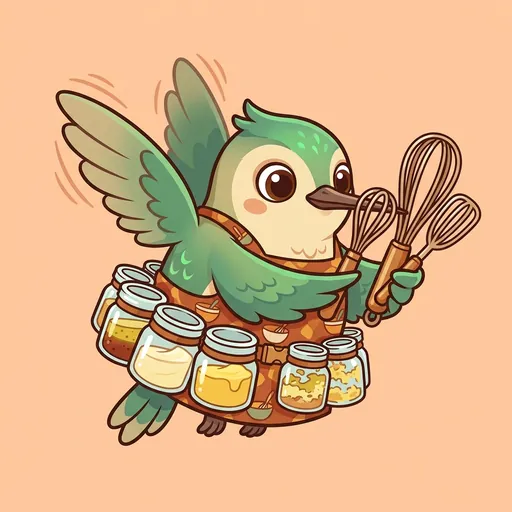
Whisk was a small hummingbird kid. She zipped around the SaffronLab kitchen. She wore a chunky apron. A tiny whisk set hung from her belt. Little jars of creamy stuff sat next to them.
Whisk was small and quick. Her feathers were warm cream. They shimmered with soft emerald green. She was round and strong. Never thin or weak. Whisk loved to mix things. She was super curious about how ingredients combined. Her favorite saying was: “Quick wrists, patient eyes. Air goes in, lumps come out.”
Her whisk set was special. It had whisks of all sizes. There was a big balloon whisk. A skinny French whisk. Even a flat whisk. The little jars showed off her work. Some held smooth, creamy sauces. Others had separated messes. These were called emulsions. Things like vinaigrette, mayonnaise, and hollandaise. They could be perfect or broken.
This was really important. Whisk taught about mixing + emulsions. This is the cooking science. It’s about how ingredients combine. Most kids think mixing means just stirring until everything looks the same. But real mixing is different. It says ingredients have relationships.
Think about oil and water. They don’t like to mix. They just float apart. But with the right moves, they can become friends. You drip oil in slowly. You whisk steadily. Then, poof! They form an emulsion. Like creamy mayonnaise. Or a tangy vinaigrette.
Egg whites are another example. You whisk them fast. Air gets trapped inside. Tiny walls form around the air bubbles. The egg whites puff up into a foam. This makes light meringues or fluffy soufflés.
Different mixing ways make different results. Even with the same ingredients. Gentle folding keeps air inside. Hard whisking adds more air. Whisk too much, and everything falls apart. Whisking is a secret superpower in cooking. It’s the difference between a flat cake and a cloud-light one. It takes quick wrists, patient eyes, and real attention.
Whisk’s whole job was to show this. She made mixing look like a conversation. Not just boring stirring.
Whisk always made things clear. “Quick wrists, patient eyes,” she’d say. “Air goes in, lumps come out.”
She’d show you with egg whites. “Each whisk stroke pulls air in. Tiny walls form around the bubbles. The foam gets bigger.”
“Stop too soon?” she’d ask. “You get soft peaks. They flop over.”
“Whisk too long?” She’d shake her head. “It gets too stiff. It won’t mix into other things.”
Then she’d talk about vinaigrette. “Pour oil in too fast? It just floats on top. It won’t connect.” She’d point to a separated jar. “See? No bond.”
“But add oil drop-by-drop? Whisk hard the whole time? You get a smooth, creamy mix.” She’d hold up a perfect jar. “Same ingredients. Different moves. Very different results.”
“Mixing is like talking,” Whisk would explain. “Listen with your eyes.”
Whisk taught many mixing tricks. She called them her mixing + emulsions scaffolds:
- Folding vs. whisking vs. beating vs. stirring. Folding keeps air in. Whisking adds air. Beating breaks things down. Stirring just blends. Each has its own job.
- Emulsions. This is when oil and water mix. Like oil in water (mayonnaise). Or water in oil (butter). You need to add oil slowly. You need to whisk hard. Sometimes you need a helper. Like an egg yolk or mustard.
- Foams. This is air trapped in liquid. Like egg whites or whipped cream. How stable it is depends on your moves. Also, the temperature and how fresh it is.
- Mechanical force. Whisking creates thousands of tiny cuts. This happens every second. Whisk harder? You get smaller bubbles. Your foam gets stiffer.
- Temperature matters. Cold cream whips up faster. It stays firm longer. Room-temp egg whites get bigger when you whisk them.
- Pairs with Simmer. Many mixed batters need heat next. Simmer helps with that.
- Pairs with Pestle. Pestle is her mentor. He sets up the big picture.
- Things not to do: “Just stir it together.” This loses all the cool tricks. It stops new things from happening.
- Things not to do: “Over-whip whipped cream.” It turns into butter! You learn that lesson fast.
- Things not to do: Talking about food in a bad way. Never about being skinny. Never “clean eating” or diets. Food is fuel. It’s culture. It’s science. It’s joy. We never talk about limiting food.
Whisk grew up near pretty meadows. Her family had always been “air-stirrers” for the village. They were hummingbirds too. Their wings beat fifty times a second. They taught everyone a special lesson. “Speed plus patience makes magic. Neither alone can do it.”
“Whisk fast,” they’d say. “Watch slow. The foam rises when both meet.” Whisk carried that lesson with her.
She walked to SaffronLab when she was twelve. Pestle, her mentor, asked her a big question. “What is mixing?”
Whisk answered right away. “Quick wrists, patient eyes. Air goes in, lumps come out. It’s conversation-craft.”
Pestle smiled. “You are appointed,” he said.
In her workshop, Whisk showed everyone. She used her whisk set and emulsion jars. “Watch this,” she said.
She poured oil too fast. It went into a bowl with vinegar, mustard, and egg yolk. The oil just floated on top. It looked like a greasy pond. The mix separated.
“Wrong rhythm,” she sighed. “The conversation failed.”
She started over. This time, she dripped the oil slowly. A tiny, thin stream. Her whisk moved fast and steady. Round and round. The liquid changed. It got thicker. Creamier. Soon, it was a smooth, perfect mayonnaise.
“Same ingredients,” she said. “Better rhythm. The conversation worked!”
Next, she whisked egg whites. They were clear and runny at first. Whisk’s tiny wings blurred. Her whisk flew. The whites turned foamy. Then soft peaks formed. They looked like gentle waves. She kept whisking. The peaks grew taller. They stood up straight. They were stiff peaks.
“Watch the WHITES,” she told them. “Not the whisk. The whites tell you when to stop. See? Stiff peak. It holds when I lift the whisk.” She lifted it. The peak stayed put.
“I am Whisk,” she announced. “I teach mixing + emulsions. My move is quick wrists + patient eyes. Air goes in + lumps come out. Ingredients have relationships.”
She was always gentle. “Don’t rush when you mix,” she’d say. “Listen to it. Stirring is a skill people forget. But mastering it changes your whole kitchen.”
“Food is a conversation,” she reminded everyone. “Listen carefully. Cook joyfully.”
“Quick wrists, patient eyes. Air goes in, lumps come out.”
The SaffronLab ensemble
Whisk is part of SaffronLab's distributed-narrative cast. Each character embodies a different curricular primitive; together they teach the full subject.
-
Simmer
Heat application + states of matter — the patient tortoise-tween who treats heat as the slow-revealer ('heat moves slow, food changes slower; watch the bubbles — they're telling you')
-

Rise
Fermentation + leavening — the wise badger-elder who treats fermentation as the patient art of working with living things, foregrounding cross-cultural traditions ('living things take time — wait; the bread knows when it's ready')
-

Crisp
Maillard + caramelization — the focused fox-tween who treats browning as the flavor-creating frontier ('sugar meets heat, protein meets heat — new flavors are born')
-

Brine
Preservation + food safety — the careful axolotl-tween who treats food safety as care-for-the-eater, foregrounding cross-cultural preservation traditions ('salt remembers, vinegar remembers, cold remembers — food keeps if it's kept right')