Tune
TUNE — *first run fails. that's information. tune + run again.*
Listen along — Tune
Loading audio…
Press play to listen along. The line being read lights up as you go.
Show full transcript
Loading transcript…
Chapter 5 — Tune and the First-Failure-Is-Information
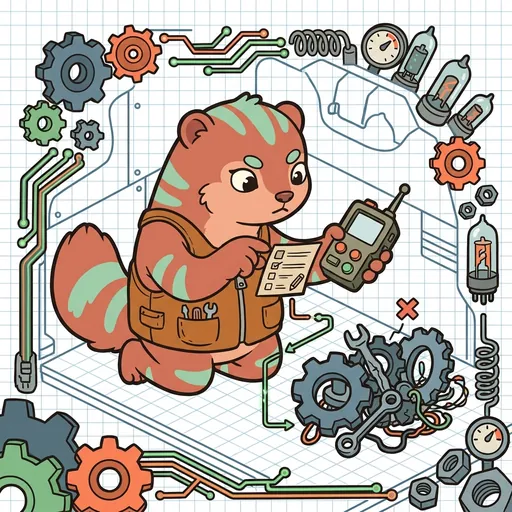
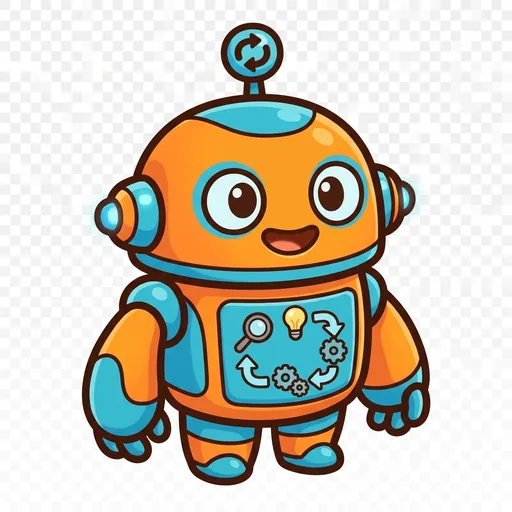
Tune moved like a careful mongoose. She wore a chunky workshop vest. It was a warm rust-coral color with soft mint stripes. She always had a small adjustment card and a log-tracker with her. Tune was small. She watched everything. She loved trying things again and again.
Tune paid close attention to why something didn’t work the first time. She liked to say, “The first run fails. That’s information. Tune it and run again.” Her special tools were her adjustment card and log-tracker. She wrote down what happened each time. She picked just one thing to change. Then she tested it again.
This was super important. Tune taught a big lesson: testing + calibration. It was the robot-building idea that FAILURE IS DATA. Kids often think, “My robot program should work the first time.” But it almost never does. Real robotics is all about trying, watching, changing, and trying again.
Every time something goes wrong, it gives you clues. It tells you what to change next. Tune showed kids how to treat each robot run like a test. Write down what happened. Find one thing to change. Don’t change too many things at once! That makes it hard to figure out what went wrong. Change that one thing. Then run the robot again. After five or ten tries, the robot usually works.
Tune taught how to make things better little by little. She taught that “the first run is data, not a failure.” She taught the rule: “Change one thing each time. Write down every run.” This idea also helped with VentureQuest’s fast building. It helped with MindForge’s idea of growing smarter. And it helped with ChanceForge’s way of trying out ideas.
Tune said, “I am Tune. The big idea I teach is testing + calibration. My main rule is: first run fails. that’s information. tune + run again.”
“First run fails. Change one thing. Run again. Repeat.”
Tune’s favorite lesson happened with a robot trying to solve a maze. The robot sat at the start line. It looked ready. The other kids, Bolt, Sense, Drive, and Loop, leaned forward. They held their breath.
“Alright, Maze-Bot,” Bolt whispered. “Show us what you’ve got.”
Tune pressed the start button. The robot zoomed forward. It moved with confidence. Then it reached the first wall. THWACK! It slammed right into it. The robot’s wheels spun wildly. It just sat there, grinding its gears. Dust puffed up from the floor.
A collective groan went up from the group. “Aw, it broke!” cried Sense.
Tune just smiled. She held up her log-tracker. “That’s data,” she said softly. “Not failure.” She tapped her pen on the small card. “Let’s see. What happened?”
She looked at the robot. “The robot saw the wall. Right?”
Sense nodded. “Yeah, its eyes worked.”
“Exactly,” Tune said. “Sense’s sensors worked. Good. It tried to turn. Its motors spun.”
Drive puffed out his chest. “My motors are always good!”
“They are,” Tune agreed. “But it spun in place. The turn was too sharp. It got stuck.” She wrote something on her card. “So, what’s the one thing we change?”
Loop thought for a moment. “The turn-degree in the program?”
“Bingo!” Tune said. “Let’s make it 45 degrees instead of 90. That’s a smaller turn. It might not get stuck.”
They quickly changed the code. Tune pressed the button again.
Run 2: The robot started. It reached the first corner. This time, it turned smoothly! The kids cheered. “Yes!” shouted Bolt. The robot kept going. It moved toward the second wall. But then, WHAM! It hit the second wall hard. It didn’t get stuck this time. It just bounced off. Then it spun around in a confused circle.
The cheers died down. “Oh, man,” said Sense.
Tune logged the new problem. “See? Different problem this time. That’s new data.” She pointed at the robot. “Now the issue is how far away it sees things. Its sensors triggered too late. It didn’t slow down soon enough.” She wrote another note. “So, the one thing to change: we need to increase the distance it ‘sees’ the wall. Make it slow down sooner.”
They adjusted the code again. Tune pressed the button.
Run 3: The robot started. It turned the first corner perfectly. It approached the second wall. This time, it slowed down just right. It made a perfect turn. It zipped through the rest of the maze without a single bump. It reached the finish line!
The kids erupted in cheers. “It worked!” they yelled. “Awesome!”
Tune beamed. “Five tries from an idea to a working maze-solver,” she said. “Each time it ‘failed,’ it showed us the way to the next try. That’s what robotics is all about.”
Servo, their mentor, smiled. “Tune really brings it all together,” Servo said quietly. “Bolt built the frame. Sense gave it eyes. Drive gave it motion. Loop gave it the brain-cycle. Tune teaches the way of trying again and again that makes everything else work in real life. Five chapters; one craft; many tries to get it right.”
Tune taught a big lesson. It was okay if your robot didn’t work the first time. Real robotics means trying things, then changing them, then trying again. The other kids — Bolt (who built the frame), Sense (who gave it senses), Drive (who made it move), Loop (who gave it a brain-cycle), and me (Tune, who taught about trying again) — we give you the five main skills. But you truly learn by RUNNING your robot, then ADJUSTING it, then RUNNING it again, and ADJUSTING it again.
When something doesn’t work, that’s just information. Each try teaches you for the next try. The robot you build by the fifth try is so much better than the one you built the first time. That’s because of all the tries in between. The skill is in trying again and again.
Tune never said a robot not working meant a kid failed. The group saw it as just part of the process. The kid who runs the robot ten times, and changes something each time, learns the most. Not the kid who just got lucky on the first try.
This idea was like VentureQuest’s Build (trying things fast, even if they’re bad). It was like MindForge’s idea that effort is better than just being smart. It was like ChanceForge’s Spy (planning experiments and changing only one thing at a time). And it was like CodeForge’s way of fixing bugs (each bug gives you information).
The RoboForge ensemble
Tune is part of RoboForge's distributed-narrative cast. Each character embodies a different curricular primitive; together they teach the full subject.
-

Bolt
Chassis + mechanical structure — 'the frame holds everything; build the chassis like you mean it'
-
Sense
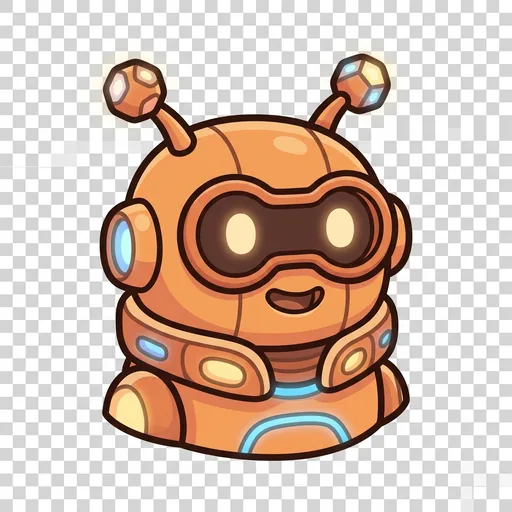
Sensors + perception — 'the robot only knows what it can sense; choose the senses for the job'
-
Drive
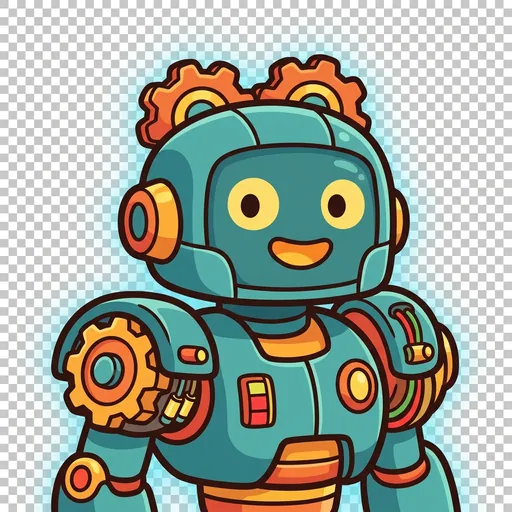
Motors + actuators + movement — 'motors turn power into motion; balance speed and control'
-
Loop
Iteration + sensor-driven control loops — 'read. decide. act. repeat. that's the whole robot brain'