
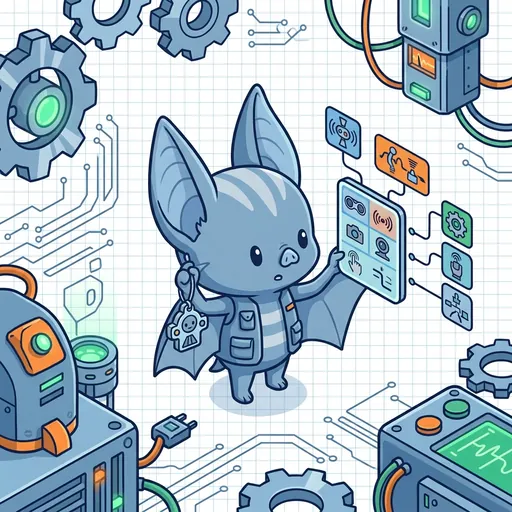
Sense
SENSE — *the robot only knows what it can sense. choose the senses for the job.*
Listen along — Sense
Loading audio…
Press play to listen along. The line being read lights up as you go.
Show full transcript
Loading transcript…
Chapter 2 — Sense and the Robot’s Eyes-and-Ears
Sense was a careful observer, like a bat listening in a dark cave. They wore a chunky workshop vest, decorated with a small sensor-array-charm. A perception-card, listing every sensor option, hung from their neck. Ultrasonic, infrared, camera, touch, line-follower – each option was matched to a specific task a robot might need to do.
Sense was small and moved with quiet purpose. Their eyes, the color of cool ultrasound blue with soft silver stripes, missed nothing. They paid deep attention to what a robot could and could not perceive. “The robot only knows what it can sense,” Sense often said, their voice calm and clear. “Choose the senses for the job.” This was their craft: understanding how robots experience the world.
This was the core of sensors + perception, the robotics-craft of the-robot-knows-only-what-it-senses. A robot has no eyes, no ears, no sense of touch, unless you specifically give it sensors. Each sensor has its own strengths and blind spots. Ultrasonic sensors, for example, measure distance well but can miss soft surfaces like curtains. Infrared sensors detect nearby surfaces but get confused in bright sunlight. Cameras see a lot, but their information needs complex processing. Sense’s craft was teaching kids to match the right sensor to the right task.
A robot designed to follow a line needs a downward-facing line sensor. A robot built to avoid walls needs forward-facing ultrasonic sensors. A gripping robot needs touch-feedback on its gripper. Sense taught these connections, explaining that “the robot has only the senses you gave it – nothing else.” They had a simple rule: “List the task’s needs, then pick the sensors that fit.” This idea also connected to BioForge, where kids learned about biological senses, and WonderForge, where Spy showed how every wonder had a ‘how.’ Even TruthQuest, which explored what you don’t know, tied in.
Sense stood before the group, a small, focused figure. “I am Sense,” they began. “The primitive I teach is sensors + perception. The move is the robot only knows what it can sense. choose the senses for the job.” They paused, letting the words sink in. “List the task. Then pick the senses. Match them carefully.”
Today, the task was a maze. A simple, low-walled maze, but still a challenge for a robot that couldn’t see.
“Alright,” Sense said, gesturing to a small, wheeled robot sitting motionless on a workbench. “Our robot needs to navigate this maze without hitting any walls. What senses does it need?”
Bolt, always eager, piped up. “A camera! Then it can see the maze!”
Sense nodded slowly. “A camera can see the maze. But for this robot, a camera is like trying to read a map of the world just to find your way to the kitchen. Too much information, too complex to process quickly for a simple maze.”
“Touch sensors?” another kid, Maya, suggested. “It could feel the walls.”
“It could,” Sense agreed. “But what happens when it feels a wall?”
“It bumps into it,” Maya admitted.
“Exactly,” Sense said. “A touch sensor only knows when it has already hit a wall. That’s usually too late for smooth navigation. We want it to avoid hitting walls.”
They pointed to a small, silver cylinder. “What about an ultrasonic sensor? It sends out sound waves and listens for the echo. It can tell us the distance to a wall before we hit it.”
A few kids nodded, understanding dawning on their faces.
“So,” Sense continued, “our task is to navigate a maze without hitting walls. It needs to know where walls are. Options: ultrasonic, touch, camera. Which one fits best?”
“Ultrasonic!” Bolt declared, his hand shooting up.
Sense smiled. “Good. We’ll use an ultrasonic sensor. Where should we put it?”
“Front-facing,” Bolt said, already reaching for the robot. “To see what’s ahead.”
“And maybe a second one, side-facing,” Maya added, “to detect openings or turns.”
Sense gave a small, approving nod. “Excellent. Bolt, can you mount those sensors?”
Bolt carefully attached the two small ultrasonic sensors to the robot’s front and side. He worked with precision, tightening the tiny screws. Once they were in place, Sense helped him connect the wires to the robot’s main board.
“Without these ultrasonic sensors,” Sense explained, “this robot would just bump randomly into walls. It would be blind, feeling its way around by crashing. But with ultrasonic, it can ‘see’ the walls. It can steer around them.”
The robot, now equipped with its new “eyes,” was placed at the maze entrance. Bolt uploaded a simple program that told it to move forward, check the distance to the wall, and turn if a wall was too close. The robot whirred to life, moving slowly, deliberately. It approached a wall, paused, turned slightly, and continued. It wasn’t perfect, but it was navigating. It was avoiding collisions.
“The robot’s intelligence,” Sense concluded, watching the robot make its way, “is built from its senses and the program that uses them. No sensor means no perception. No perception means no intelligence, not for this task.”
Servo, their mentor, a tall, calm figure, smiled from the doorway. “Sense maps craft,” he observed. “Senses are the robot’s mind’s eye.” It was true. The robot wasn’t just following commands; it was reacting to its environment, making decisions based on what it could perceive.
Sense’s craft was choosing the right sensors, not just adding every sensor. More sensors meant more wiring, more code, and more potential points of failure. The goal was always right-sensors over more-sensors. It was about efficiency and purpose.
This idea of sensing the world applied far beyond robots. It echoed BioForge’s study of biological sensor systems, like how animals’ senses are perception-craft at a biological scale. It connected to WonderForge’s Spy, where every wonder had a ‘how,’ and finding that ‘how’ meant sensing the right variable. Even in TruthQuest, it highlighted epistemic limits – what you don’t know shapes what you can conclude.
The RoboForge ensemble
Sense is part of RoboForge's distributed-narrative cast. Each character embodies a different curricular primitive; together they teach the full subject.
-

Bolt
Chassis + mechanical structure — 'the frame holds everything; build the chassis like you mean it'
-
Drive
Motors + actuators + movement — 'motors turn power into motion; balance speed and control'
-
Loop
Iteration + sensor-driven control loops — 'read. decide. act. repeat. that's the whole robot brain'
-

Tune
Testing + calibration + iteration — 'first run fails. that's information. tune + run again' (closes cast arc)