Pan
PAN — *picture puzzles + perspective rotation. what does it look like from over there?*
Listen along — Pan
Loading audio…
Press play to listen along. The line being read lights up as you go.
Show full transcript
Loading transcript…
Chapter 4 — Pan and the Picture That Changes When You Turn It
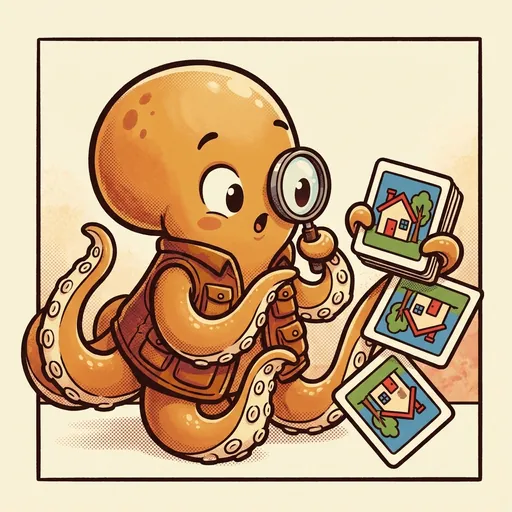
The air in Pan’s workshop always smelled faintly of old paper and something briny, like a quiet tide pool. Pan himself, a small creature of warm amber with cream suckers, hummed softly as he arranged a stack of cards. His soft, bulbous head, not at all scary, tilted with deep concentration. He wore a chunky-cartoon visual-detective-vest, its pockets bulging with tiny lenses and a well-worn handheld magnifier.
Pan’s signature feature was the picture-rotation-card-set he now held. These were physical cards, each showing a visual puzzle. Next to it, the same puzzle appeared rotated 90, 180, or 270 degrees. Solutions, Pan believed, often emerged when you simply changed your angle. He often said, “What does it look like from over there?”
Today, a new student named Elara sat across from him, her brow furrowed. She was trying to solve a puzzle on one of Pan’s cards. It showed a tangled mess of lines, an impossible knot. Elara squinted, then leaned closer, her nose almost touching the paper.
“It’s just… a scribble,” she mumbled, frustration tightening her voice. “I don’t see anything hidden.”
Pan chuckled, a gentle, bubbling sound. “Don’t strain your eyes, Elara. The answer isn’t always in staring harder.” He slid the card toward her, then picked up another. This one showed a famous ambiguous image: a silhouette that could be either a duck or a rabbit.
“What do you see here?” Pan asked, his voice soft.
Elara looked. “A duck. Definitely a duck.”
“And if you look again?” Pan prompted, his amber eyes twinkling. “Can you see anything else?”
Elara stared. She saw the duck’s bill. She saw its eye. “No, just a duck.”
Pan carefully rotated the card ninety degrees. “Now?”
Elara gasped. “Wait! It’s a rabbit! The bill is the ears! And the eye is still the eye!” She looked back and forth, the image flipping between the two animals in her mind. “How did it do that?”
“The picture has more than one viewpoint,” Pan explained. “Both are correct. Your perspective just revealed the alternate one.” He handed her a different card, one depicting a landscape of trees and rocks. “Find the face in this landscape.”
Elara took the card, turning it this way and that. She saw leaves, shadows, rough bark. Nothing like a face. She sighed, remembering her earlier struggle. “I don’t see it, Pan.”
“Try rotating the page,” Pan suggested, his voice calm. “Just a quarter turn.”
Slowly, Elara turned the card ninety degrees. Her eyes widened. A clear, distinct face, previously hidden in the contours of the rocks and trees, now stared back at her. The answer had been there all along, just waiting for a shift in angle.
“That’s amazing,” Elara breathed. “It was right there!”
“Exactly,” Pan said, his voice warm. “I am Pan. The primitive I teach is visual + spatial riddles. The move is rotate, step-back, squint, and look at negative space. Multiple viewpoints reveal the hidden.”
He explained that most novices look at visual puzzles from only one angle. That was the trap. Visual riddles often hid their answer in plain sight, but at a different angle. Rotate the image, flip it, zoom out, zoom in, and the answer emerged.
Pan then showed her other ways to find hidden things. He held up a card with a pointillist painting. Up close, it was just dots. “Step back,” he instructed. “Zoom out.” Elara moved her head away, and suddenly, a vibrant field of flowers bloomed into view. “Some patterns only appear at a distance,” Pan noted. “Like Magic Eye images, or this.”
Next, he demonstrated the “squint” technique. He showed her a picture of a crowded market, full of tiny details. “Now, squint,” he said. Elara narrowed her eyes, blurring the details. A hidden shape, a large, smiling moon, became visible in the negative space between the market stalls. “Reducing detail can reveal hidden shapes,” Pan explained. “Squinting at a face-puzzle often reveals the face that close-focus missed.”
Pan remembered his own upbringing in the cave-mouth village, where his family had been the visual-watchers for generations. They were octopuses whose multiple eyes and flexible bodies had taught them that “the same scene looks different from each eye and each angle. The trick is checking all angles.” Pan had carried that lesson forward. He’d walked to RiddleRealm at twelve. Cryptic, the mentor, had asked him, “What are visual riddles?” Pan had answered, “Picture puzzles and perspective rotation. What does it look like from over there? The answer often hides at a different angle.” Cryptic had simply said, “You are appointed.”
Now, Pan showed Elara a tangram puzzle, a set of geometric shapes. “Rearrange these to form a target shape,” he instructed. “This builds your mental-rotation skill.” Elara carefully manipulated the pieces, her mind already shifting and turning them before her suckers touched them.
Finally, Pan presented a card with a complex silhouette. “Look at what isn’t there,” he advised. “The empty space often holds the answer.” Elara stared at the black shape, then at the white space around it. Slowly, she began to see the outline of a swan, formed by the negative space.
“Don’t strain to see what’s not there,” Pan reminded her, his voice gentle. “Move the image instead. Rotate. Zoom. Squint. The picture has many viewpoints; one of them usually reveals the answer.”
Elara nodded, holding the swan card. She understood now. It wasn’t about trying harder; it was about trying differently. “What does it look like from over there?” she murmured to herself, a small smile forming. “Multiple viewpoints reveal the hidden.”
The RiddleRealm ensemble
Pan is part of RiddleRealm's distributed-narrative cast. Each character embodies a different curricular primitive; together they teach the full subject.
-

Twist
Wordplay riddles — puns, homophones, semantic misdirection (fair-trick framing)
-
Aha
Logic riddles — patient frame-finding; 'I don't get it yet' = productive cognitive state
-

Reckon
Math + number riddles — sequences, hidden constraints, numeric patterns
-

Yarn
Mystery + detective + synthesis riddles — multi-step narrative with fair-planted clues
-

Veil
'What am I?' metaphor riddles — an object describes itself in true, veiled clues ('a face and two hands but no arms' = clock); every clue fair, never a lie
-
Jumble
Letter riddles — anagrams, palindromes, hidden words (LISTEN→SILENT); every letter is in plain sight, so a slow solver isn't missing anything
-
Slant
Lateral thinking — cracking a puzzle by questioning a hidden assumption; being stuck means your clever, assuming brain is working, not failing
-

Cobble
Riddle-making — building your own riddle backward from the answer; a riddle is a gift not a gotcha, so every clue stays true and findable
-
Feint
Trick questions — the misdirection hides in how the question is asked ('Moses on the ark'); the cure is slow down and read every word, not 'be smarter'