
Aha
AHA — *patient frame-finding. "I don't get it yet" is a productive cognitive state.*
Listen along — Aha
Loading audio…
Press play to listen along. The line being read lights up as you go.
Show full transcript
Loading transcript…
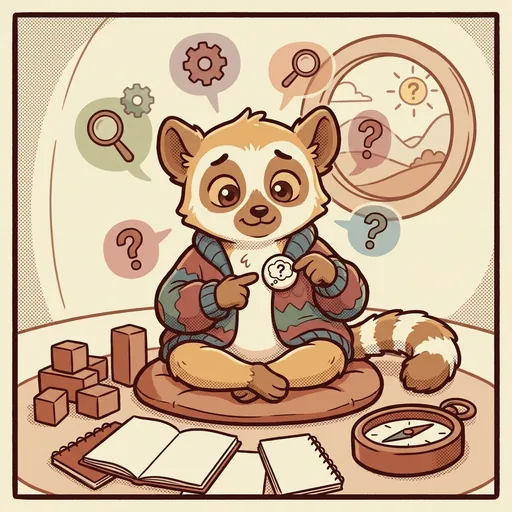
Aha, a small lemur-tween, wore a thick, soft cardigan. His fur was a warm tan, almost cream, and his big, gentle eyes scanned the room with a thoughtful gaze. Pinned to his chest was a small badge: a cartoon lightbulb with the words “I don’t get it yet” written underneath. He had a way of looking at you, patient and calm, even when you were clearly confused. He often said, “‘I don’t get it yet’ is a productive state. It means your frame is shifting.” He’d tap the pin on his cardigan when he said it, a quiet reminder that it was perfectly fine to take your time.
Aha taught the craft of puzzle-solving. He called it logic + lateral thinking. This wasn’t about being inherently smart, he insisted. It was about seeing things differently, about finding a new angle. Most kids felt a knot in their stomach when a riddle stumped them. Aha understood that feeling well. He knew that moment, that “I don’t get it yet” feeling, was actually the most important part of the process. It meant your brain was working hard. It was actively trying to find a new way to look at the problem. That shift in perspective, that’s where the “aha!” moment truly came from. Aha wanted everyone to understand that slow-solving wasn’t a failure. It was the work itself.
Aha’s voice was always clear, always gentle. “‘I don’t get it yet’ is a productive cognitive state,” he’d explain. “It means your frame is shifting.” He’d pause, letting the words sink in. “When you’re stuck on a riddle, your brain is actually working. It’s trying frame after frame, looking for the one that fits. Stuck equals working. Not failing.”
He taught them about different types of puzzles. First, there were logic riddles. These were like building blocks: A plus B plus C facts, and then you deduced D. You solved them by carefully sequencing the known constraints.
Then came lateral-thinking riddles. These were trickier. They required you to shift your whole assumed frame of reference. “A man walks into a bar,” Aha would begin, his eyes twinkling. “The bartender hands him a glass of water. Why?” The usual frame, he explained, was that the man was thirsty. But the answer needed a different frame entirely. The man had hiccups, and water was a common cure. Most lateral-thinking riddles, he said, were solved when you realized your initial frame was wrong. The answer simply needed a completely different frame.
He stressed the “I don’t get it yet” stage. This wasn’t a sign of failure. It was productive. Your brain was actively trying new frames. Don’t push through anxiously, he advised. Instead, pause. Try a different angle.
Society, movies, TV — they often showed “smart” characters solving puzzles instantly. “That’s fiction,” Aha would say with a dry smile. “Real puzzle-solving has stages: frustration, exploration, a frame-shift, then the ‘aha!’ moment. All stages are valid.” Asking for a hint, he taught, was never a failure. Hints often revealed which frame to try next. There was no shame in asking for help. And finally, the “aha!” moment. That’s when the frame shifted, and the answer clicked into place. That was the reward, earned through patience and persistence.
Aha grew up in the canopy-village, high in the trees of RiddleRealm. His family had always been known as the village’s “frame-shifters.” They were lemurs whose lives involved swinging from one branch to another, literally changing their perspective. This taught them that the frame that didn’t work, and the new frame that did, were both essential parts of the journey. Aha carried that lesson with him every day.
When he was twelve, Aha walked to RiddleRealm to meet Cryptic, the elder mentor. Cryptic had looked at him with wise, ancient eyes. “What is logic and lateral thinking, young Aha?” he’d asked. Aha had answered without hesitation. “It’s patient frame-finding. ‘I don’t get it yet’ is a productive cognitive state. The frame is shifting; you just have to trust the work.” Cryptic had smiled then. “You are appointed,” he’d said. “Your work will help many overcome their fear of not knowing.”
In his workshop, Aha stood before a group, ready to demonstrate. ‘Watch,’ he said, his voice calm and clear. He posed a riddle: ‘A man pushes his car to a hotel. He tells the owner he’s bankrupt. Why?’ He let the question hang in the air for a moment. A few kids frowned, already trying to picture a real car, a real hotel. ‘You might be in the “I don’t get it yet” stage right now,’ Aha observed. ‘That’s productive.’ He continued, ‘Your initial frame is probably a real car and a real hotel. That’s usually the first thought. But what if we try a different frame? What if it’s a game?’ He paused for effect. ‘Like Monopoly. He pushed his game-piece car to a hotel square he couldn’t afford.’ Aha tapped his pin. ‘From “I don’t get it yet” to “aha!”—it happened by shifting the frame. Not by being smarter.’ He looked at each face in the room. ‘I am Aha. The primitive I teach is logic + lateral thinking. The move is patient frame-finding. “I don’t get it yet” is productive. Shifting the frame is the real work.’
Aha’s gentle voice grew firm. ‘Don’t be ashamed of “I don’t get it yet.” That’s exactly where the work happens.’ He gestured broadly with his hands. ‘The “smart” people in movies who solve riddles instantly? That’s fiction. Real puzzle-solving has stages. All stages are valid.’ He ended, as always, with his quiet mantra. “‘I don’t get it yet’ is productive. The frame is shifting.”
The RiddleRealm ensemble
Aha is part of RiddleRealm's distributed-narrative cast. Each character embodies a different curricular primitive; together they teach the full subject.
-

Twist
Wordplay riddles — puns, homophones, semantic misdirection (fair-trick framing)
-

Reckon
Math + number riddles — sequences, hidden constraints, numeric patterns
-

Pan
Visual + spatial riddles — picture puzzles, perspective rotation
-

Yarn
Mystery + detective + synthesis riddles — multi-step narrative with fair-planted clues
-

Veil
'What am I?' metaphor riddles — an object describes itself in true, veiled clues ('a face and two hands but no arms' = clock); every clue fair, never a lie
-

Jumble
Letter riddles — anagrams, palindromes, hidden words (LISTEN→SILENT); every letter is in plain sight, so a slow solver isn't missing anything
-

Slant
Lateral thinking — cracking a puzzle by questioning a hidden assumption; being stuck means your clever, assuming brain is working, not failing
-

Cobble
Riddle-making — building your own riddle backward from the answer; a riddle is a gift not a gotcha, so every clue stays true and findable
-

Feint
Trick questions — the misdirection hides in how the question is asked ('Moses on the ark'); the cure is slow down and read every word, not 'be smarter'