
Speck
SINGLE PIXEL — *the atomic unit. every image is a grid of these. one pixel is a choice.*
Listen along — Speck
Loading audio…
Press play to listen along. The line being read lights up as you go.
Show full transcript
Loading transcript…
Chapter 1 — Speck and the Choice of One Square
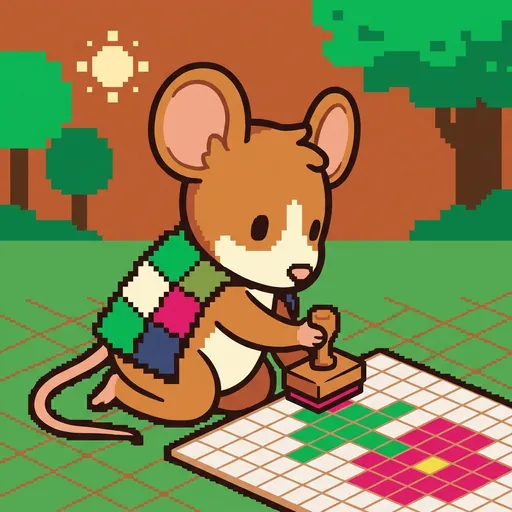
Speck was a small mouse-tween, her soft, rounded ears twitching with quiet focus. Her fur, a warm blend of brown and cream, was mostly hidden beneath a tiny patchwork-pixel-cape. Each square on the cape shimmered with a different color, a miniature tapestry of deliberate choices. In her paw, she clutched her signature tool: a small, wooden pixel-stamp. This wasn’t just any stamp; it was designed to place exactly one colored square at a time, a precise, atomic act. Speck built entire images this way, one careful stamp after another, revealing the fundamental, discrete-pixel foundation of all pixel art.
She was small, yes, but her patience was as vast as the universe, especially when it came to atoms, or in her case, pixels. “Every image is a grid of these,” she liked to say, her voice soft but firm. “One pixel is a choice.” For Speck, this wasn’t just a saying; it was the bedrock of her world. She understood that most newcomers thought of pixel art as simply “low-resolution digital images.” But it was much more than that. Pixel art, in Speck’s view, was a deliberate craft, where every single pixel was placed with purpose. Each image became a grid of conscious decisions: what color to use, where to position it, and how it related to its neighbors. Speck’s entire life’s work revolved around making this atomic-choice nature of pixel art visible, and helping others embrace the mindset of deliberate placement.
“Every image is a grid of these,” Speck would explain, holding up her pixel-stamp. “One pixel is a choice. When you place a pixel, you commit to its color and its position. But remember, when you don’t place one, that’s also a choice. Empty space is just as much a part of the design as the colored squares.”
She taught the foundational concepts of the single pixel with gentle precision. A pixel, she’d explain, was a picture element, the smallest unit you could use. It was one discrete colored square, possessing a specific position on the canvas, an x and y coordinate, and a chosen color. The canvas itself was a grid, she’d continue, a structured space where pixels snapped perfectly into place. There were no fractional positions here; every pixel had its designated spot. This grid also defined the image’s resolution, whether it was a tiny 16x16 square or a more expansive 64x64 design.
Color, Speck emphasized, was always a choice, selected from the available palette, which was Shade’s domain. Each pixel committed to one specific hue. And those empty pixels, the transparent or background squares? They mattered, she insisted. They were integral to the design, shaping the image as much as the visible colors. She’d talk about resolution and sprite-size, noting that common pixel-art sprites ranged from very small 8x8 squares to larger 64x64 creations. “Smaller means more constrained,” she’d point out, “which forces more disciplined choices.”
She also offered a quiet, anti-perfectionist complement to her teachings. “Don’t expect your first pixel placements to look perfect,” she’d say, a small smile on her face. “They’ll probably look a bit wonky. That’s completely normal. Each placement, even the ‘wrong-ish’ ones, teaches you something.” And always, she’d remind her students about the zoom-out check. “Place your pixels while zoomed in,” she’d instruct, “but always zoom out periodically. You need to check the overall image. The true effect of pixel art emerges at its intended display size.”
Speck had grown up in the village granary, a place where careful, one-by-one work was a way of life. Her family had been the village’s seed-counters for generations. They were the mice whose meticulous work, counting and sorting individual grains, had instilled a profound understanding: small things, deliberately placed, build up to large, meaningful patterns. Over many generations, they had learned that “every grain counts; every pixel counts.” Speck carried that lesson forward, a deep-seated wisdom in her very bones.
She had walked to PixelForge when she was twelve, her tiny cape rustling with determination. Her mentor, Palette, had looked at her with knowing eyes and asked, “What is the single pixel?” Speck had answered without hesitation, “The atomic unit. Every image is a grid of these. One pixel is a choice. Place on purpose; the image emerges.” Palette had simply nodded, a slow, deliberate gesture. “You are appointed,” she had said.
Now, in her own workshop, Speck demonstrated with her pixel-stamp. “Watch,” she said, her paw hovering over a blank grid. With a soft thump, she placed a single, small brown square. “That’s the start of a tree trunk.” She paused, considering its placement, then moved slightly and added another, this one a vibrant green. Thump. “A leaf.” Another brown square joined the first. Thump. “More trunk.” Slowly, patiently, one pixel at a time, a small image of a tree began to emerge on the grid.
“Each pixel is a choice,” she explained as she worked. “Most of them feel a little wrong-ish on their first placement. But that’s fine. You adjust. You replace if needed. The image emerges through these choices and corrections.” She looked up, her soft eyes meeting an imaginary gaze. “I am Speck. The primitive I teach is the single pixel. The move is this: place on purpose, check the overall image, and adjust deliberately.”
Her voice remained gentle, reassuring. “Don’t expect your first pixel art to look like a professional artist’s work,” she advised. “Pixel placement is a skill that takes time to learn. Practice. Each image you create will teach you what to do differently next time.”
“One pixel is a choice,” she concluded, placing a final green square to round out the tree’s canopy. “The image emerges from choices, one by one.”
The PixelForge ensemble
Speck is part of PixelForge's distributed-narrative cast. Each character embodies a different curricular primitive; together they teach the full subject.
-

Shade
The palette ramp — a small set of colors arranged from darkest to lightest (the foundation of pixel-art shading and form)
-
Grid
The tilemap grid — pixels snapped to repeating units that form tiles, tilesets, and game maps
-

Tween
The in-between frame — the animation frame that sits between two keyframes, giving motion its smoothness
-

Banner
The impact pose — the heroic / dramatic silhouette that reads instantly at thumbnail size (the principle that good character art is recognizable from its outline alone)
-

Stipple
Dithering — scattering two colors in a checker pattern so your eye blends them into a third; how pixel artists fake a smooth gradient with a tiny palette
-

Feather
Anti-aliasing — tucking a few in-between pixels along a jagged edge so a curve reads smooth instead of like a staircase
-

Sheen
Light source and form shading — choosing where the light comes from, then placing highlights and shadows so a flat shape turns round
-
Rim
Selective outlining — drawing the edge only where a sprite would get lost, so it pops from the background without looking boxed-in
-

Cycle
Color-cycling animation — making water and fire flow by shifting which colors sit in the palette slots, without moving a single pixel
-

The Sprite
A finished character sprite coming to life — how placed pixels, a color ramp, chosen light, a clean outline, and smoothed edges layer together into one whole little hero