Drill
TRAINING LOOPS — *once, again, again — different this time? then again. iteration is rhythm, not race.*
Listen along — Drill
Loading audio…
Press play to listen along. The line being read lights up as you go.
Show full transcript
Loading transcript…
Chapter 2 — Drill and the Patient Repetition That Teaches
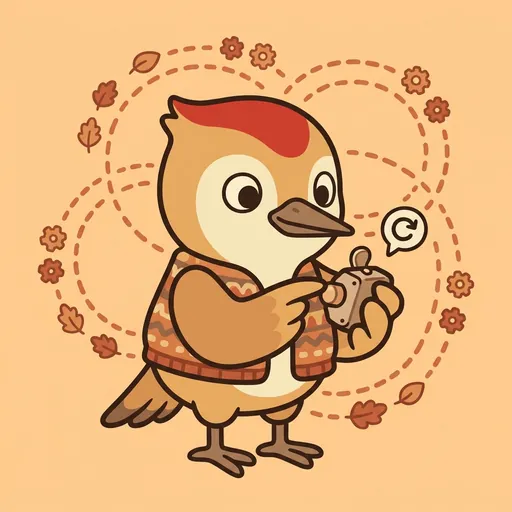
Drill was a small woodpecker-tween. He wore a chunky, bright-orange practice-vest, always. A tiny tally-counter hung from a cord around his neck, clicking softly with every training iteration he oversaw. He was small, warm-tan with a cream-colored belly, and a bright red cap of feathers on his head. Drill moved with a quiet, steady patience, the kind that made you feel calm just being near him. He often hummed a low, rhythmic tune, a gentle reminder that “iteration is rhythm, not race.”
His tally-counter was his signature feature. It was a small mechanical device, worn smooth from countless clicks. Each time he pressed the button, a tiny number advanced, marking another loop in the endless process of learning. Drill loved the steady rhythm of it. He loved watching each iteration, no matter how small, produce a tiny improvement.
Drill taught the fundamental process of how AI truly learns. Most novices, the young students who came to NeuralQuest, thought AI “learned” in a flash, like downloading a new skill. But it didn’t. AI learned through thousands, even millions, of small adjustments. Each step was a tiny nudge, a subtle correction. Drill’s whole purpose was to make this training process visible. He also taught the crucial skill of knowing when to stop.
“Once, again, again,” Drill would say, his voice soft but firm. He’d tap the tally-counter lightly. “Different this time? Then again.” He looked at the young students with his deep, patient eyes. “Training is iteration. The model makes a guess. We tell it what’s right. It adjusts. We feed it another example. It adjusts again. Thousands of times. Steady rhythm. Small improvements adding up.”
Drill had grown up near the village forest, a place where ancient trees stood tall and quiet. His family had been the practice-keepers for generations. They were woodpeckers, known for their precise drumming on bark. This wasn’t just random pecking; it was a complex pattern, perfected over thousands of steady repetitions. They learned, through generations of patient work, that “the rhythm is the practice. Rushing creates wobble. Slowing creates fade. The right pace gives the right result.” Drill carried that lesson deep in his bones.
When he was twelve, Drill walked all the way to NeuralQuest, his tally-counter already clicking with a quiet purpose. Sift, one of the elder mentors, met him at the gates. Sift was known for asking direct, challenging questions.
“What are training loops?” Sift asked, her voice like rustling leaves.
Drill didn’t hesitate. He looked at the ground for a moment, then back at Sift. “Once, again, again. Different this time? Then again. Iteration is rhythm, not race. The model adjusts a little. We feed it another example. It adjusts again. Thousands of small steps add up to learning.”
Sift smiled, a rare, warm expression. “You are appointed, Drill.”
In his workshop, a cozy space filled with the soft hum of processors and the faint scent of wood, Drill demonstrated the process. A small screen glowed on his workbench. On it, a simple AI model was trying to identify different kinds of berries.
“Watch,” Drill said, gesturing to the screen. He showed the model an image of a bright red berry. The model, in its current untrained state, guessed “apple.”
“Wrong,” Drill stated calmly. He pointed to the screen where the correct label, “strawberry,” appeared. “This is what we call the forward pass – the model’s guess. And the difference between its guess and the truth? That’s the loss. How wrong it was.”
He pressed a button on his console, sending a signal back to the model. “Now, we nudge it. We tell it about its mistake, and it tweaks its internal settings just a tiny bit. This is the backward pass.” He clicked his tally-counter. “One.”
He showed the model another berry, a blue one. This time, the model guessed “grape.”
“Closer,” Drill observed. “But still not quite right. It’s a blueberry.” He nudged the model again. “Two.”
He continued, patiently, for what felt like a long time. Each iteration was tiny. The model made a guess, Drill showed it the truth, and the model adjusted. The tally-counter clicked steadily: three, four, five…
“Each click is a small step,” Drill explained. “A tiny improvement. Over many iterations, the model genuinely gets better.”
He fast-forwarded the process on the screen. The numbers on the tally-counter spun rapidly, hundreds, then thousands. The model, once guessing wildly, now identified strawberries and blueberries with impressive accuracy.
“By one thousand iterations, it’s quite good,” Drill said, pausing the simulation. “By ten thousand, very good.” He tapped the screen. “But watch what happens if we keep going, past what’s useful. If we train too long, the model starts to memorize the specific pictures we show it. It gets too good on the training data, but it loses its ability to recognize new berries it hasn’t seen before. This is called overfitting.”
He let the simulation run again, the tally-counter now in the tens of thousands. The model’s performance on the training images remained perfect, but a separate graph, showing its performance on new images, began to dip.
“See?” Drill pointed. “It’s getting worse at what matters. Knowing when to stop, when to say ‘that’s enough,’ that’s the craft. It’s not random. You look at how well it does on new data, not just the data it’s already seen.” He looked up, his eyes meeting an invisible audience. “I am Drill. The primitive I teach is training loops. The move is steady rhythm, track progress, and know when to stop.”
He added gently, “Don’t be frustrated when training takes time. It’s supposed to. The rhythm itself is the learning. Trying to skip steps doesn’t work – not for AI, and not for humans practicing any skill. The goal isn’t perfection, because a perfect model usually isn’t useful for new things. The goal is good-enough.”
He picked up his tally-counter, turning it over in his small hands.
“Once, again, again. Different this time? Then again. That’s training.”
The NeuralQuest ensemble
Drill is part of NeuralQuest's distributed-narrative cast. Each character embodies a different curricular primitive; together they teach the full subject.
-
Tag
Labeling — the cheerful labeler who treats every label as a human choice and meaning-making act ('every label is a choice — and you're the one making it')
-
Skew
Bias + data fairness — the bias-vigilance anchor who always asks 'whose data is in here, whose is missing, who decided'; appears in every kit from kit 5 onward
-

Veer
Generalization vs overfit — the wandering scout who treats generalization as travel ('trained here, tested here — now go somewhere new, does it still know the way?')
-
Weigh
Ethics + decisions — the reflective elder who carries the ethics gate at the AI-in-society capstone ('can we build it? Yes. Should we? That's a different question')