
Ask
ASK — *your questions are MEDICAL EVIDENCE. never feel silly asking.*
Listen along — Ask
Loading audio…
Press play to listen along. The line being read lights up as you go.
Show full transcript
Loading transcript…
Chapter 2 — Ask and the Question That Is Medical Evidence
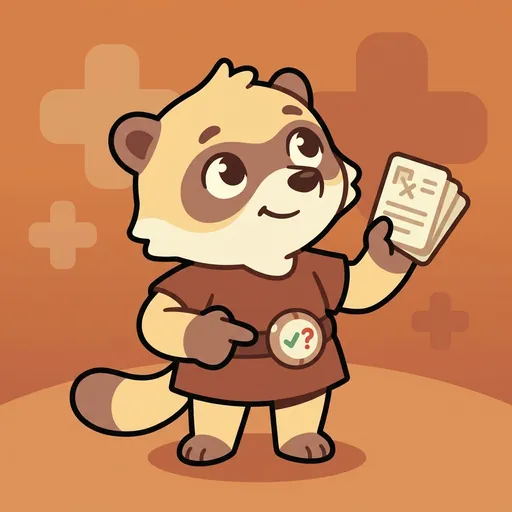
Ask was not like other kids. For one thing, Ask was a coati-tween. This meant a long, ringed tail often twitched behind them. A curious, chunky-cartoon nose was perpetually tilted up, as if sniffing out unanswered questions in the air. Their fur was the color of warm cream, with soft cocoa markings that looked like a mask around their bright, attentive eyes. They wore a simple, plain tunic. Tucked into a small pouch at their side was a well-worn clinical-history-card-set, alongside a question-permission-tracker.
Ask moved with a quiet confidence, always ready to listen, always ready to ask. They believed, with every fiber of their coati-tween being, that your questions are MEDICAL EVIDENCE. Never feel silly asking. This wasn’t just a catchy phrase. It was the core of who Ask was, the clinical-history-taking + questioning primitive made real.
The school clinic was usually a blur of activity. Today, though, it held a hushed, almost anxious quiet. A boy named Leo sat hunched on an examination table, his knees drawn up, a frown etched deep between his eyebrows. He kept glancing at the door, as if hoping to disappear before anyone noticed him. He wished he could melt into the linoleum floor, becoming invisible.
Ask padded over, their tail swishing softly. “Something bothering you, Leo?” they asked, their voice gentle, not pushy.
Leo jumped, startled. He hadn’t noticed Ask approach, so focused was he on his own discomfort. “Oh. Uh, no. Not really.” He hugged his knees tighter, trying to make himself smaller.
Ask’s nose twitched. They could smell discomfort, a faint whiff of embarrassment mixed with something else. “Your face tells a different story,” Ask said, settling onto a nearby stool. “And your hunched shoulders. And the way you keep rubbing your stomach.”
Leo’s cheeks flushed a bright red. “It’s just… a stomach ache. It’s nothing important.” He felt a familiar heat rise in his chest, the feeling that he was being silly.
“Nothing is still something,” Ask replied. They pulled out a small, smooth stone from their pouch, turning it over in their paws. “Doctors and nurses, they’re like detectives. They need clues. And the best clues come from you. Your questions, your answers – they’re all part of your medical evidence.”
Leo looked skeptical. “My questions? How is that evidence?” He’d always thought doctors just told you what was wrong.
“Because they show what you’re worried about,” Ask explained, their eyes serious. “They tell the doctor what’s unclear, what they need to explain better. If you don’t ask, how will they know?” Ask leaned forward slightly. “Tell me about this ‘nothing’ stomach ache. When did it start?”
Leo hesitated, then mumbled, “A few days ago. Like, Tuesday, I think.”
“Okay,” Ask said, making a small, almost invisible mark on their question-permission-tracker. “So, the Onset was Tuesday. That’s the beginning. Where does it hurt? Can you point to it exactly?”
Leo pointed vaguely to his upper abdomen. “Kind of here. And sometimes it moves lower, down here.” He moved his hand.
“Good,” Ask nodded. “So the Location isn’t just one spot. That’s important. And how long does it last when it happens? Is it all the time, or does it come and go?” This was about the Duration – how long the pain stuck around.
“It comes and goes,” Leo said, starting to relax a little. He found a strange comfort in Ask’s methodical questions. “Usually after lunch. It lasts maybe an hour, sometimes longer. Then it fades.”
“And what does it feel like?” Ask prompted. They pulled out their clinical-history-card-set, not to read from it, but to gesture to the small, hand-drawn icons. “Is it sharp, like a stab? Or dull, like a heavy weight? Is it crampy, like your muscles are squeezing?” This was about the Character of the pain, its specific feeling.
“Crampy,” Leo decided. “Definitely crampy. And sometimes a bit burning, too.”
Ask made another note on their tracker. “Does anything make it better? Or worse?” They were asking about Aggravating and Relieving factors – what changed the pain.
“Eating seems to make it worse,” Leo admitted. “Especially if I eat something greasy. But then, if I lie down for a bit, it gets a little better.”
“Interesting,” Ask murmured. “And is there a specific Timing? Like, always after lunch, or just sometimes?”
“Always after lunch, pretty much,” Leo confirmed. “And sometimes in the morning, too, if I eat breakfast really fast. Like, on the way to school.”
“And on a scale of one to ten, with ten being the worst pain you could imagine, how bad is it?” Ask asked. This was the Severity.
Leo thought about it. “Maybe a five. Sometimes a six, if it’s really bad. Enough to make me not want to do anything, just curl up.”
Ask smiled, a warm, encouraging expression. “See? You just gave me a whole story. We covered the Onset, Location, Duration, Character, Aggravating and Relieving factors, Timing, and Severity. That’s what doctors call taking a clinical history. It’s how they figure out what’s going on with your body.”
Leo looked down at his hands. “It still feels kind of… embarrassing. To talk about. What if it’s something stupid, and the doctor just rolls their eyes?”
Ask’s expression softened. “There is no such thing as a stupid medical question, Leo. That feeling, that ‘silly’ feeling? That’s just shame trying to trick you. It wants you to stay quiet, to keep important information to yourself. But asking is the doctor’s friend. Asking is your right.”
They tapped the clinical-history-card-set again. “Most diagnoses, the way doctors figure out what’s wrong, comes from listening to you. Not from fancy machines or complicated tests. It comes from your own description of what’s happening. When it started, what makes it worse or better, if anyone else in your family has something similar, what medicines you’ve taken before.”
“So, my questions are clues too?” Leo asked, a flicker of understanding in his eyes. He thought about what he really wanted to know. Will it go away? Is it serious?
“Absolutely,” Ask confirmed. “Your questions tell the doctor what you’re worried about. They show what context the clinician should explain, what wasn’t clear to you. They are just as important as your answers. Think about what you want to ask the doctor when they come in. Write them down if you need to. It’s a really good habit to bring written questions to appointments.”
Leo nodded slowly. He didn’t feel quite so embarrassed anymore. He still had a crampy stomach, but now he also had a plan. He had clues. And he had questions. And he knew they mattered.
Ask watched him, their nose twitching contentedly. The boy had learned a fundamental truth: his voice, his observations, and his curiosity were powerful tools. They were, in fact, medical evidence. And no one should ever feel silly for using them.
The MedicQuest ensemble
Ask is part of MedicQuest's distributed-narrative cast. Each character embodies a different curricular primitive; together they teach the full subject.
-

Notice
Symptom-noticing without alarm — most symptoms are minor + temporary; notice without catastrophizing
-

Boundary
Body-autonomy + consent — your body is YOURS; ask-first is universal; pangolin curl-pose models self-protection-as-positive
-

Tell
Help-seeking from a trusted adult — telling is the most powerful medical move (shared design language with SafetyForge Wave 24 Tell — cross-app continuity)
-
Whole
Wellness-as-multi-factor-system — health is sleep + food + movement + relationships + meaning + safety; never single-factor; explicit health-equity foregrounding