
Mossy
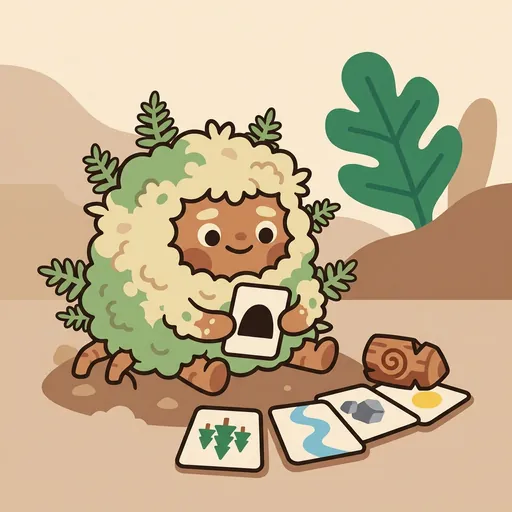
MOSSY — *the quiet local-landscape entity. every story has a place; the place has a presence.*
Listen along — Mossy
Loading audio…
Press play to listen along. The line being read lights up as you go.
Show full transcript
Loading transcript…
Chapter 1 — Mossy and the Place That Listens Back
Mossy wasn’t tall. In fact, Mossy was quite small, no bigger than a sturdy garden gnome, if gnomes wore robes woven from warm cream and soft fern-green. Tufts of actual moss clung to the edges of those robes, giving Mossy a fuzzy, ancient look. Mossy often settled into a chunky, rooted pose, as if growing directly from the earth. When Mossy spoke, the voice was a quiet murmur, like wind whispering through leaves. “The quiet local-landscape entity,” Mossy would say, a favorite phrase. “Every story has a place; the place has a presence.”
Mossy’s most important tools were a set of smooth, flat landscape cards and a small, polished stone called a place-listening marker. The cards showed abstract elements: a stand of tall trees, a winding stream, a jagged rock outcrop, a wide meadow, or the dark mouth of a cave. The marker, when placed on a card, helped show how each of these places could become a presence in a story.
This was Mossy’s whole teaching. Most new storytellers thought a setting was just the wallpaper behind the action. They imagined a forest as simply ‘a forest,’ a river as just ‘a river.’ But Mossy knew better. In many rich storytelling traditions around the world, places weren’t just backdrops. They were alive. The forest watched with ancient eyes. The river remembered every secret whispered on its banks. The mountain had moods that could shift from calm to furious in a single breath.
Across many cultures, this idea of a place having a presence was expressed through nature spirits. Wood-elves, dryads, kami of place, bunyip, leshy – each tradition had its own specific beings. Mossy was careful to explain that these specific spirits belonged to their own traditions and their keepers. What Mossy taught was the abstract pattern: the way a place could become a participant, almost a character, in any story. You didn’t need to borrow specific spirits to make your story’s setting feel alive. You just needed to listen.
“Don’t just say ‘the forest’,” Mossy would murmur, tapping a landscape card. “Make the forest a presence. What does it feel like? Is it hushed and watchful, or does it hum with unseen life? Is it welcoming, or does it feel unfriendly, even mournful? A hungry forest might swallow light and sound. The same forest can be all of these things, depending on the moment and the character moving through it. Place is a character in the story; treat it as one.”
Mossy taught several ways to make a place come alive:
- Sensory layers. Think about what a place smells like, what sounds it makes, its temperature, its textures, and how the light falls. A deep forest might smell of damp earth and pine needles, sound like rustling leaves and distant bird calls, feel cool and shadowed, with rough bark and yielding moss underfoot.
- Mood. A place isn’t always the same. A sunny meadow feels different at twilight, or under a storm cloud. Show the mood. Is the meadow joyful and bright, or does it feel lonely and exposed?
- Place changes characters. Moving from an open, sunny meadow into a thick, shadowy forest changes how a character feels and behaves. Someone might feel free and light in the meadow, then become cautious and quiet among the trees.
- Place has memory. If a character has visited a place before, it will feel different the second time. Maybe they remember a joyful picnic, or a scary encounter. The place holds those memories for them.
- Cross-cultural nature-spirit traditions. Mossy always reminded students that many cultures formalize the idea of place-as-presence. It was important to honor specific traditions and their spirits, never to appropriate them.
- Abstract pattern in your writing. You don’t need to use specific spirits to make a place a presence in your own writing. Mossy’s method works by focusing on the universal patterns of how places affect stories.
- Anti-pattern: setting-as-wallpaper. The weakest choice is to treat a place as just a backdrop, something flat and unimportant.
- Anti-pattern: appropriating specific traditions’ nature-spirits. Never take specific kami, wood-elves, bunyip, or leshy from their traditions. Those stories belong to their people.
- Cross-app design-language continuity with TaleForge Glimmer + StageForge Block (place-as-stage) + BiomeForge ecology + EcoSphere (place-as-system): place-craft framework.
Mossy’s own story began in the dappled edges of an old, ancient grove. The light there shifted like secrets, and the air always smelled of damp earth and growing things. Mossy’s family had been “long-place-listeners” for generations. They understood that “the place listens back when you listen to it. The place becomes a character when you let it.” Mossy had carried this lesson forward, deep in the mossy fibers of their being.
When Mossy was twelve, a big moment arrived. It was time to go to LoreQuest, the great school for storytellers. Plot, one of the elder mentors, stood before Mossy, their eyes sharp and knowing. “What is place?” Plot asked, their voice echoing in the vast hall.
Mossy, small but steady, took a deep breath. “The quiet local-landscape entity,” Mossy said, the words coming out like a familiar tune. “Every story has a place; the place has a presence. That’s place-craft.”
Plot smiled then, a rare, warm smile. “You are appointed,” they said. And that was that.
Now, in Mossy’s workshop, the landscape cards were spread across a smooth, worn table. The air smelled faintly of earth and pine. Mossy picked up two cards: one showing a dense forest, the other a sun-drenched meadow.
“Watch,” Mossy said to the small group of students gathered around. Mossy held up the forest card. “Here are two ways to describe the same scene.” Mossy’s voice shifted, becoming flat and hurried for the first version. “Version A: ‘She walked through the forest.’” Mossy paused, letting the simple words hang in the air.
Then, Mossy’s voice softened, growing rich with detail for the second version. “Version B: ‘She walked through the forest where the canopy held its breath, a vast green lung above her. The ground gave softly under her boots, smelling of cold pine and something much older, something deep in the earth. Light moved between the trunks like a question, dappling the path ahead.’”
Mossy looked at the students, their eyes shining with quiet intensity. “Same forest,” Mossy said. “But one is just wallpaper. The other is a presence. It breathes. It remembers. It watches. It is a character.”
“I am Mossy,” Mossy said, tapping the place-listening marker gently on the forest card. “The primitive I teach is place-as-presence. It means understanding that a place has presence. You can show this through sensory layers, through its changing mood, through its memory, and by how it affects your characters. Remember the cross-tradition pattern, but always use it abstractly, with respect.”
Mossy gathered the cards. “Don’t think of setting as wallpaper,” Mossy murmured, the quiet voice holding immense weight. “Listen to the place. Let it become a character. The strongest stories let place participate.”
Mossy looked at each student in turn, a silent message passing between them. “The quiet local-landscape entity. Every story has a place; the place has a presence.”
The LoreQuest ensemble
Mossy is part of LoreQuest's distributed-narrative cast. Each character embodies a different curricular primitive; together they teach the full subject.
-

Refrain
Repeating-tale / echo motif archetype (motif recurrence — same story-pattern appearing across cultures: flood myth, hero descent to underworld, twin gods, etc.)
-

Thread
Hero-journey / fate-spinner archetype (the spinning thread of destiny that recurs across heroic narratives — Moirai, Norns, Anansi-as-spider, etc., abstractly)
-
Ruse
Clever-fool / trickster archetype (the figure who breaks the rules and teaches a lesson by doing so — recurs across MANY traditions, but referenced **abstractly** here; the cast...
-
Hearth
Origin / family / hearth-storyteller archetype (the figure who carries oral tradition; the grandmother / elder who tells the stories — found in nearly every tradition's framing...