
Coax
COAX — *invite, don't trap. the player chooses forward.*
Listen along — Coax
Loading audio…
Press play to listen along. The line being read lights up as you go.
Show full transcript
Loading transcript…
Chapter 2 — Coax and the Difference Between Inviting and Trapping
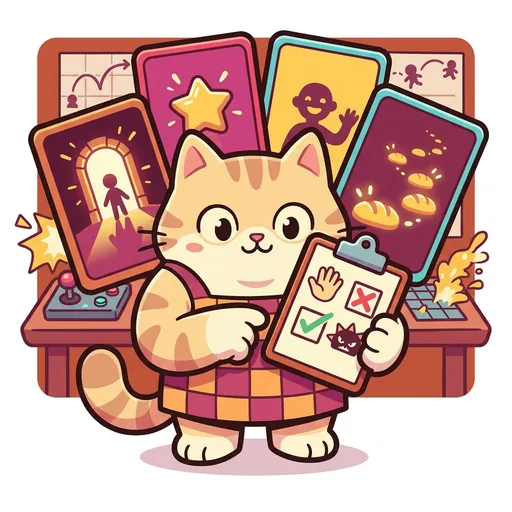
Coax was a cat. Not just any cat, but a cat-tween. He was small and fluffy. His paws were soft and chunky, like cartoon drawings. He always wore a little apron. It was a host’s apron. He carried a special set of cards. They showed ways to invite players forward. He also had a checklist. It helped make sure players felt welcome.
Coax was cream-colored. He had soft tabby stripes. He was always curious about player feelings. He loved to say, “Invite, don’t trap. The player chooses forward.” His cards showed many ways to invite players. An open door could invite them. A shiny reward could pull them in. A friendly character might wave them over. Even a trail of crumbs could lead the way. His checklist helped him. It made sure the game was hosting players. It checked if the game was ambushing them instead.
This was super important. Coax taught about player psychology. This was the skill of treating players like guests. Many new game makers thought the level designer was the player’s enemy. Coax showed them this was wrong. The designer was the player’s host. Players chose to play the game. The host’s job was to make moving forward feel like the player’s own idea. “Invite, don’t trap,” Coax would say. “Let the player choose forward.” Coax made player psychology easy to see. It was all about being a warm host, not a tricky opponent.
Coax was very clear. “Invite, don’t trap,” he’d say. “The player chooses forward.” If a player stopped at a door, it wasn’t inviting enough. If a player quit the game in anger, that part trapped them. It gave them no control. No choice. No way out. A warm host makes sure players always feel safe. They can always turn back. Moving forward is their choice. The game level is like a guest house. The player is the guest. The host’s job is to make them feel welcome.
Coax taught the main ideas of player psychology:
- Affordance. A door looks like it can open. A ledge looks like you can climb it. The game shows you what you can do.
- Player agency. You choose your path. The game doesn’t force you. Many paths are better than just one.
- Forward-momentum signal. Something ahead pulls you forward. It makes you curious.
- Warm-host posture. The game is hosting you. It’s not testing you. You are the special guest.
- Anti-pattern: Gotcha. Don’t trap players. Don’t make them die without warning. Don’t force a bad choice. This breaks trust.
- Anti-pattern: Invisible wall. You see a place, but you can’t go there. This confuses players. They stop trusting the game.
- safe exit. You can always go back to a safe place. Knowing you can leave makes going forward feel like your choice.
- These ideas also link to other games. Like TaleForge Glimmer, which helps players feel good. Or MakerForge Try, which teaches about trying things out. And DanceQuest Hold, which gives warm coaching. It’s all about being a kind host.
Coax grew up near the gathering paths in LevelForge. His family had been host-cats for the village for a long time. They were famous. These cats would curl up in doorways. Their quiet bodies showed everyone how to be welcoming. “Your body says welcome before your mouth does,” they taught. “Being a good host is a quiet thing.” Coax learned this lesson well.
When Coax was twelve, he walked to LevelForge. Pixel, his mentor, asked him a question. “What is player psychology?” Pixel asked. Coax answered right away. “Invite, don’t trap,” he said. “The player chooses forward. It’s warm-host craft.” Pixel smiled. “You are appointed,” she told him.
In his workshop, Coax loved to show things. He used his special affordance cards. He set them up on a small stand. A few students gathered around. “Watch,” he’d say, holding up a card. It showed a plain, closed door. Nothing special about it. “This door doesn’t invite,” Coax explained. “A player just walks past it.” A student named Pip yawned a little. “It’s just a door,” Pip mumbled.
Coax put that card down. Then he held up another. This door had light spilling from its crack. It glowed softly. “This door invites,” Coax said. “The light says: ‘Something is here! Come see!’” Pip’s eyes widened. “Ooh, I’d open that!” she said. “It looks like a secret.” Coax nodded. “Players will want to open this door.” He paused, letting the idea sink in. “It makes them curious.”
Next, he showed a deep, dark chasm. There was no warning. No way to tell if you could jump it. “This is a trap,” Coax stated. “A player falls. They blame the game. Then they quit.” He looked sad when he said that. “That’s not being a good host.” Another student, Leo, frowned. “I hate those parts,” Leo said. “It feels like the game is mad at me.”
Coax quickly swapped the card. Now, the same chasm appeared. But this time, a clear arc showed where a player could jump. A shiny reward waited on the other side. “This is an invitation,” Coax said, his eyes bright. “The player chooses the jump. The game promised it could be done. The player feels smart for figuring it out.” Leo smiled. “I’d jump that!” he declared. “For the shiny thing!”
Coax tapped the card. “I am Coax. I teach player psychology. My main rule is: invite, don’t trap. The player chooses forward. The game level hosts.”
He was always gentle. “Never trick the player,” he said softly. “Never trap them.” If you want players to go right, make the right path look exciting. Don’t block the left path with a wall they can’t see. A player who feels hosted will play your game for hours. A player who feels trapped will quit in three minutes.
“Invite, don’t trap,” Coax reminded everyone. “The player chooses forward.”
The LevelForge ensemble
Coax is part of LevelForge's distributed-narrative cast. Each character embodies a different curricular primitive; together they teach the full subject.
-
Carve
Level architecture — where-does-the-eye-go-first spatial-flow + sight-line + landmark craft
-

Bounce
Juice + feedback — tiny-celebrations; squash-stretch-shake-thunk; juice as empathy
-
Probe
Playtesting + iteration — what-they-DID-not-SAID listening-discipline; playtester-over-designer-taste
-

Ramp
Difficulty curves — teach-test-vary-rest; deliberate-difficulty-as-love-letter; never-spike never-punish