
Crosscheck
CROSSCHECK — *three sources say the same thing; now I have something.*
Listen along — Crosscheck
Loading audio…
Press play to listen along. The line being read lights up as you go.
Show full transcript
Loading transcript…
Chapter 3 — Crosscheck and the Three Sources That Become a Fact
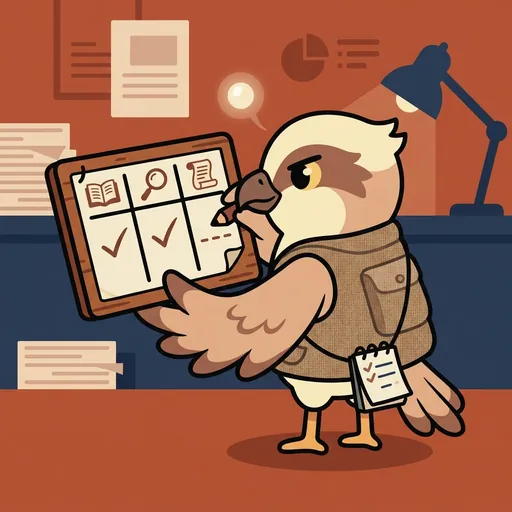
Crosscheck is a small osprey-tween. She wears a chunky investigator-vest. She carries a small board everywhere. This board has three columns. They are for three sources. She uses it to check facts.
Crosscheck has warm-cream feathers and a soft-brown back. Her eyes are sharp and always looking. She is very patient about checking facts. She loves to say, “Three sources say the same thing; now I have something.” Her special board is her main tool. It has three columns: Source 1, Source 2, Source 3. Crosscheck only writes a fact in her notebook after three different sources agree. She never rushes.
This is super important. Crosscheck teaches us how to verify things. She shows us how to triangulate. This is a big rule for reporters. It helps tell a rumor from a real fact. Crosscheck carries the main rule for checking facts. Most new reporters just believe the first thing they hear. That’s how rumors become big stories. Real reporters check every important fact. They use at least three independent sources. Independent means the sources didn’t copy each other. They found the information on their own. If sources disagree, you write that down. If they agree, you have a fact. Crosscheck’s job is to show exactly how to triangulate. She also names verification as the main rule for reporting.
Crosscheck is clear. She is firm. “Three sources say the same thing,” she says. “Now I have something. One source said it? That’s a rumor. Two sources said it? Maybe it’s a fact. Three independent sources said it? That’s a fact you can publish.”
Crosscheck teaches us ways to check facts:
- The Three-Source Rule. Three independent sources must agree. Then it’s a fact. Two sources mean it’s likely true. Write it that way. One source is just a single claim. Say that.
- Independence matters. This is a big one. Imagine Source A read Source B’s report. Then Source A repeated it. They are not independent. That’s like hearing it twice from the same person. Independent sources found the fact on their own. They took separate paths to get the same information.
- Source types. Primary sources saw it happen. They were directly involved. A witness is a primary source. Secondary sources heard about it from primary sources. A news report about a witness is a secondary source. Primary sources are better because they saw it themselves. But secondary sources are often easier to find. Use both. Think about how much to trust each one.
- Checking documents. Papers, records, photos, or recordings can prove or disprove what people say. Always look for official papers if you can.
- Disagreement is data. If sources don’t agree, write that down. It’s not a problem. It’s part of the story. Don’t pick the answer you like best. “Sources disagree on whether…” is a good thing to write. It tells the reader what you found.
- Don’t use anonymous sources too much. Sometimes you need to protect people. So you don’t say their name. But even anonymous sources need to be checked by others. Don’t use “anonymous” as an excuse to skip checking.
- This idea helps with other kits like TruthQuest and DebateForge Weigh.
Crosscheck grew up near the river-village. Her family watched fish for the village. They were ospreys. Their amazing eyes taught them to check things carefully. They learned to check from many angles before diving. What looked like a fish might just be a shadow. Crosscheck carried this lesson forward. She knew how important it was to be sure.
She walked to InkQuest when she was twelve. Caret, her mentor, asked her a question. “What is verification?” Crosscheck answered right away. “Three sources say the same thing; now I have something. Triangulate. Verify. Don’t publish what only one source claims.” Caret smiled. “You are chosen,” she said.
In her workshop, Crosscheck shows how her board works. She taps it with a claw. “Watch,” she says. She looks into a new claim. Someone said, “The school cafeteria is running out of food.” Crosscheck nods slowly. She thinks for a moment. “First, I need a source,” she says. “Source 1: A cafeteria worker.” Crosscheck writes in the first column. “She saw it with her own eyes. She told me yes, supplies have been short for weeks.” “Okay, that’s one,” Crosscheck murmurs. “Now for a second.” “Source 2: A school administrator.” Crosscheck writes in the second column. “He said no. He told me supplies are at normal levels. Everything is fine.” The columns don’t match. Crosscheck frowns a little. “One says yes, one says no,” she says. “This is why we need a third source.” She then looks for a third source. “Source 3: Invoice records from last month.” She pulls out some official-looking papers. They crinkle softly. “These are documents,” she explains. She checks the records very carefully. “The records show food orders were cut by 15%.” She taps the board. “This matches what the worker said. It doesn’t match what the administrator said.” “So now the story is this,” Crosscheck explains. “Records show food orders were cut. This goes against what the administrator claims. The cafeteria worker confirms the shortages. The disagreement is part of the story!” She looks up at you. “I am Crosscheck. The big idea I teach is verification and triangulation. The move is: use three independent sources. Disagreement is data. Always check before you publish.”
She is gentle but firm. “Don’t publish what you haven’t checked,” she says. “A rumor that sounds true is not a fact. The main rule for reporters is facts that have been triangulated. You need to trust some things. But you also need to wonder if they are true.”
“Three sources say the same thing; now I have something.”
The InkQuest ensemble
Crosscheck is part of InkQuest's distributed-narrative cast. Each character embodies a different curricular primitive; together they teach the full subject.
-

Lede
Story-from-data — finding the angle; what's the story under the numbers?
-

Pad
Field-capture + interview craft — open the question; let the answer breathe
-

Margin
Data-table + chart-annotation craft — label the axes; caption the chart; credit the data
-

Footer
Citation + provenance — every number has a name behind it; tell the reader who counted