Touch
TOUCH — *heat travels through what's pressed together. molecule by molecule.*
Listen along — Touch
Loading audio…
Press play to listen along. The line being read lights up as you go.
Show full transcript
Loading transcript…
Chapter 1 — Touch and the Way Heat Travels Through Things Pressed Together
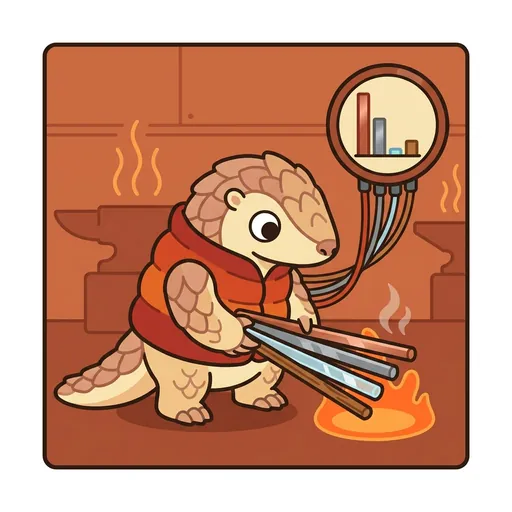
Touch was a small pangolin tween. She had warm, cream-colored scales. Soft bronze armor plates covered her back. She wore a chunky thermal vest. A special set of rods and a temperature marker were always with her.
Touch was tiny. She loved to learn about molecules touching. She always said, “Heat travels through what’s pressed together. Molecule by molecule.” Her special rods were her favorite thing. They were made of different stuff: copper, iron, glass, and wood. A marker showed how fast heat moved through each rod when one end got warm.
This was super important. Touch showed everyone about conduction. That’s the way heat moves when things touch. Most kids thought hot things just had heat. But Touch knew better. She knew heat was tiny molecules wiggling. When fast molecules bumped into slow ones, the wiggle moved. Heat always flowed from hot to cold when things touched. Metal was good at bumping. It let heat move fast. Wood was bad at bumping. It held heat back. Insulators were things that trapped heat. They were bad at bumping. Conduction was the slowest way heat moved. But it was the most direct. Touch’s job was to show how this molecular bumping worked. It wasn’t a mystery at all.
Touch was very clear. “Heat travels through what’s pressed together. Molecule by molecule.” She would explain, “Imagine you touch a hot pan. The pan’s molecules are wiggling super fast. Your hand’s molecules are wiggling slow. The fast pan molecules bump into your slow hand molecules. Your hand’s molecules speed up. Your hand gets hot. That’s conduction.” She’d add, “Metal feels hotter than wood. Even if they are the same temperature. Why? Because metal bumps faster. Your hand gets the heat news quicker. A thermometer would read the same. But your hand feels different. How fast heat moves depends on the material.”
Touch taught everyone the secrets of conduction:
- Molecular Bumping: Fast molecules bump slow ones. The wiggle moves. That is heat flow.
- Good Bumpers vs. Bad Bumpers: Metals are great bumpers. They have tiny free electrons that help. Wood, plastic, and air are bad bumpers. They are insulators. Diamonds are a surprise. They conduct heat super well. Even though they aren’t metal.
- Hot to Cold, Always: Heat never moves from cold to hot by itself. Never.
- Touching is Key: No touching? No conduction. An air gap stops the heat.
- Size Matters: A wider rod means more bumping paths. More heat can flow.
- Length Matters: A longer rod means more distance for bumps to travel. Heat moves slower.
- Temperature Difference: A bigger difference means faster heat transfer. If temperatures are the same, heat stops flowing.
- “Feels Hotter” Isn’t Always “Is Hotter”: A metal spoon at room temperature feels cooler than a wooden spoon. Both are 25°C. But metal pulls heat away from your hand faster. Your hand feels the speed of the heat. Not just the temperature.
Touch grew up near the rock-warming-flats. This was a special place. Her family had been “long-touchers” for the village. They were pangolins. They learned by touching sun-warmed stones. Scale by scale, they felt the heat. They taught their children, “The rock and the scale touch. The rock’s warmth becomes the scale’s warmth. The world conducts. Our bodies listen.” Touch carried this old lesson forward.
She walked to HeatForge when she was twelve. Kelvin, her mentor, asked her a question. “What is conduction?” Touch answered right away. “Heat travels through what’s pressed together. Molecule by molecule. It’s bumping-craft.” Kelvin smiled. “You are appointed,” he said.
In her workshop, Touch loved to show how it worked. She used her special conduction rods. “Watch,” she’d say. She took a copper rod and a wood rod. She heated one end of each at the same time. “The copper end heats up fast. The marker zips down the rod. The wood end heats up. But the marker barely moves.” She tapped the rods. “Same heat applied. Very different speeds.”
She then placed her paw on the cold end of each rod. “The copper feels hot quickly. The wood barely warms up.” She paused. “That’s the bumping difference.” She looked at her students. “I am Touch. I teach conduction. The main idea is this: heat travels through what’s pressed together. Molecule by molecule. From hot to cold. And you need contact.”
Touch was always gentle. “Don’t think hot things ‘have’ heat inside them. Heat is just motion moving from one place to another. When fast molecules meet slow ones, the motion moves. That’s all that happens.” She would nod slowly. “When you get the bumping idea, you understand the rule. Heat flows from hot to cold. Never the other way. Until all the bumping is equal.”
“Heat travels through what’s pressed together. Molecule by molecule.”
The HeatForge ensemble
Touch is part of HeatForge's distributed-narrative cast. Each character embodies a different curricular primitive; together they teach the full subject.