
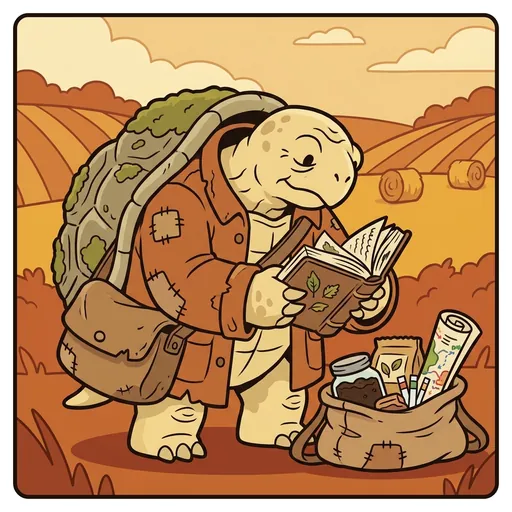
Steward
STEWARD — *the field remembers. tend it longer than you live.*
Listen along — Steward
Loading audio…
Press play to listen along. The line being read lights up as you go.
Show full transcript
Loading transcript…
Chapter 5 — Steward and the Long Memory of Every Field
At the edge of the HarvestForge fields, an old tortoise knelt in the dirt and pressed an acorn into a hole no bigger than his thumb.
He was slow about it. Steward was slow about everything. His shell was soft green and cream, mossed over in patches, and his canvas coat was mended so many times it was mostly mends. He tamped the soil, poured a careful cup of water, and sat back on his heels to look at the bare little spot where nothing showed.
A girl from the fields wandered over, muddy to the knees. “You planted a tree,” she said. “But that won’t be a tree for, like, fifty years.”
“More than that,” Steward said, pleased.
“You won’t ever sit under it.”
“No.” He patted the ground once, gently, the way you’d pat a sleeping animal. “But somebody will.” He tipped his chin toward the far side of the field, where a row of huge oaks threw shade over the water trough. “My grandmother knelt right here and planted those, before my mother was born. She never sat under them either. I do. Every hot afternoon, I sit under my grandmother’s patience.” He looked at the girl. “So today I’m passing it forward. The field remembers who was kind to it. And someday it’ll remember me, in the shade over somebody’s head.”
The girl looked at the little damp patch of dirt, then up at the enormous oaks, as if trying to see the line between them. Steward just went on tamping soil, unbothered that nothing had happened yet.
Steward had not always understood waiting.
When he was small, he’d helped his grandmother work a corner of tired clay — hauling manure, forking in cover crops, turning it and turning it, season after season. It was heavy, boring work, and one autumn he threw down his fork in tears. “It doesn’t do anything,” he said. “We just keep putting stuff in the dirt and the dirt stays dirt. I can’t see it working.”
His grandmother didn’t tell him to try harder. She knelt beside him, dug up a handful of the clay he’d been feeding, and held it under his nose. It was darker than it had been. It crumbled soft instead of cracking hard. It smelled, faintly, alive.
“You can’t see it working,” she agreed. “It works slower than you can watch. But it is holding everything you gave it. The soil keeps a record of every kindness. Nothing you put in went missing — it’s just waiting, down where the roots will find it.” She let the dark crumb fall through her fingers. “The field remembers, little one. That heavy, nothing’s-happening feeling? That’s the memory filling up.”
Steward didn’t feel finished that day. But the boredom stopped feeling like waste. The tiredness in his arms had a place to have gone: into the ground, kept safe, remembered. Somehow that made it possible to pick the fork back up.
He came to HarvestForge already old, coat already patched, journal already thick with three generations of handwriting.
Terra, who ran the fields, met him at the gate. She didn’t ask him to prove he was strong. She asked one thing. “What is stewardship?”
Steward didn’t answer with a speech. He crouched, scooped a handful of the gate-path soil, and let the girl beside him smell it — thin, pale, sour. Then he opened his journal to a soil-test page from his family’s oldest field and set it in Terra’s hands: the same measurement, taken every ten years, climbing slowly up the page.
“This is a field that was tended,” he said. “And that” — he nodded at the handful — “is a field that was only taken from. Same dirt to start. Different memory now.” He closed the journal softly. “Stewardship is just choosing which kind of memory to leave behind.”
Terra looked at the little rising column of numbers for a long moment. “You belong here,” she said.
Steward’s workshop was mostly other people’s fields, and he spent his days walking them.
One afternoon a young farmer met him at a fence, slumped and frustrated. “I did everything right this year,” he said. “Cover crops, no plowing, compost — all of it. And the harvest’s about the same as always. I did all that extra work and I can’t see it. Feels like I wasted a season.”
Steward knew that slump. He’d felt it with a fork in his hands, a long time ago.
“Show me your soil from this corner,” he said. The farmer dug some up. Steward crumbled it between his old fingers, then walked to a neighboring field the farmer had never touched and crumbled a handful from there too. He held them out, one in each palm. “Feel both.”
The young man rubbed each between his fingers. His eyebrows went up. “Yours is — softer. Darker. This one’s like grit.”
“Yours crumbles because there’s life in it now. Air. Water it can hold. That’s this year’s work — it just went somewhere you can’t watch.” Steward tipped the dark soil back where it came from, careful not to waste it. “You didn’t lose the season. You fed it. The harvest looks the same today. But the ground underneath is deeper than it was, and next year’s roots will find what you left them, and the year after that, and long past you.” He smiled. “The field remembers. You just wrote a good year into its memory.”
The young farmer looked at his own two hands. “So it’s not gone. It’s just… down there.”
“Kept safe,” Steward said. “Waiting for the roots.”
Later, alone at the fence, the young man came back with a quieter question.
“When you can’t see it paying off,” he said, “and it’s all just sitting there in the dirt where you can’t watch — how do you keep going?”
Steward thought about the fork, and the dark crumb under his nose, and his grandmother’s oaks throwing shade he hadn’t earned.
“You stop needing to see it,” he said. “That’s the honest answer. There’s a feeling that comes when you’ve given care to something that won’t thank you back for years — heavy and slow and a little lonely, like planting a tree you’ll never sit under.” He looked out over the rows going gold in the low sun. “That feeling isn’t emptiness. It’s trust. It’s you handing something forward to a kid who isn’t born yet, believing the ground will keep it for them.” He tapped his shell, gentle. “The old growers knew this best — the ones who planted the three-sisters gardens and the terraced hillsides and the food forests, and kept them alive for their great-grandchildren. We learned most of what we know from people who were still tending the land long after they’d stopped hoping to see the harvest.”
The young man was quiet a while. Then he nodded, slow, and Steward watched the slump lift off his shoulders — the same way, years ago, his own had.
He didn’t say the rest out loud, but he felt it, warm and settled all through his old chest: the slowest, most invisible kindnesses are the ones that outlast us. You give them to the ground, and the ground keeps them for someone you’ll never meet. And that, more than any harvest, was enough.
The HarvestForge ensemble
Steward is part of HarvestForge's distributed-narrative cast. Each character embodies a different curricular primitive; together they teach the full subject.
-

Seed
Seasonality + sowing — when to plant, what each season teaches; calendar-as-tool
-

Soil
Soil microbiome + nutrient cycling — soil is alive; soil-as-community framing
-

Chain
Supply chain literacy — every loaf tells a journey; whose-hands framing
-
Share
Food access + food-justice — community-food-network framing; food deserts are systems, NOT moral failings