
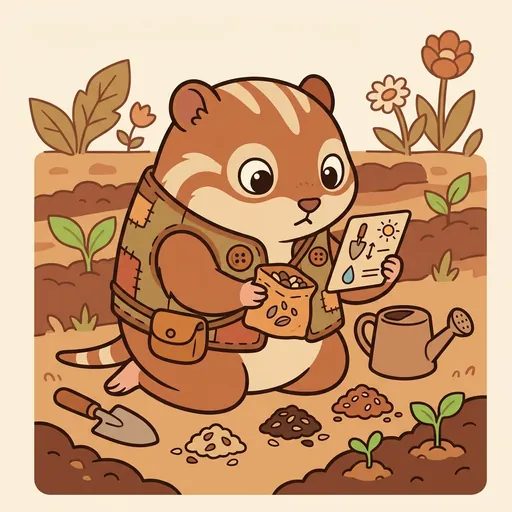
Tuck
TUCK — every seed knows what it wants. read the packet, then read the soil.
Listen along — Tuck
Loading audio…
Press play to listen along. The line being read lights up as you go.
Show full transcript
Loading transcript…
Chapter 1 — Tuck and the Listening Seed
On the sunny windowsill, a careful vole-tween named Tuck knelt down, crumbled a pinch of soil between his paws, and let it fall.
He did this before he planted anything. Always. The other new gardeners had already grabbed their seeds and were poking holes in the dirt, ready to drop and cover and water and be done. Tuck just sat there, feeling.
“You’re not planting,” a girl said, watching him. “You’re just… touching the dirt.”
“I’m listening,” Tuck said.
The girl looked at him sideways.
Tuck held up two seeds on his open paw — one tiny as a fleck of pepper, one round and fat as a pebble. “This little one is lettuce. It wants to live right near the top, barely under the surface, where it’s cool.” He nudged the fat one. “This one’s a bean. It wants to go down deep, an inch or so, where the soil holds warmth.” He tipped both seeds back into his pouch. “If I planted them the same way — same depth, same spot — one of them would never come up. Not because I did it wrong exactly. Because I didn’t ask.”
He pressed the cool crumbled soil back into the little pot and smoothed it flat. Then he read the light coming through the glass, dim and slanted and morning-gold. “This window faces the sunrise,” he murmured, more to himself than to her. “Morning light. Cool soil. So — something that likes it cool and gentle.” He picked a lettuce seed and set it in, so shallow it was almost sitting on top, and barely dusted it over.
The girl watched the whole slow thing and finally said, “How do you know it wanted that?”
“It told me,” Tuck said. “The packet told me half. The soil told me the rest. My job is just to be the one paying attention.”
Tuck hadn’t always known how to listen. When he was very small, he’d planted his first row of seeds all in one afternoon, fast and proud, every hole exactly the same.
Nothing came up.
He’d stared at the flat, blank dirt for days, waiting, and the longer nothing sprouted the worse the feeling got — a small hot knot in his chest that said, you’re just no good at this. Other people can grow things. Not you. He’d almost thrown the whole pot out.
His grandmother found him about to. She didn’t tell him he’d failed. She just knelt beside the pot, dug up one of his buried seeds with a careful claw, and held it out on her palm.
“Look how deep you put it,” she said gently. “This is a lettuce seed. It’s so small it can’t punch up through all that dirt. It ran out of strength before it reached the light.” She turned the seed over. “It didn’t die because you’re no good, little one. It died because it was planted for a different soil than the one it got. That’s not a you problem. That’s a mismatch.”
The word landed somewhere the hot knot had been. Mismatch. Not failure. Just two things that hadn’t agreed with each other.
“So it’s not my fault,” Tuck said slowly.
“It’s nobody’s fault. The seed’s not bad, the soil’s not bad, you’re not bad.” His grandmother pressed the little seed back into his paw. “Next time we change one thing. That’s all growing ever is — you listen, you match, and if it doesn’t work, you change one thing and you listen again.”
Tuck planted that same seed shallow the next morning. Four days later a thread of green pushed up. He never forgot the difference between I failed and these didn’t match.
He walked to Growforge at twelve, because a place that studied growing things ought to understand the kind of growing that starts with listening.
Sprig, the old mentor who ran the greenhouse, met him at the gate. Sprig didn’t ask Tuck to show off a lush garden or name a hundred plants. Sprig just handed him a single unmarked pot of soil and a single seed, and asked, “Where does this go?”
Tuck didn’t answer right away. He crumbled the soil — cool, a little dry, crumbly. He looked at the seed: small, flat, pale. He looked up at the greenhouse glass and where the light fell.
“It’s a cool-soil seed, and this dirt is on the dry side,” he said. “So — shallow, and I’d water it soft, not a flood. And I’d keep it out of the hot corner.” He set it in, gentle. “But mostly I’d watch it for a few days and change one thing if it sulked.”
Sprig’s eyes crinkled. “Most people tell me what they would do to the seed,” he said. “You told me what the seed wanted. You belong here.”
Tuck’s corner of the greenhouse was a windowsill, four little pots, and four seed packets. Kids came expecting big tools and big yards. They always seemed disappointed by how small it was.
A boy came in one afternoon, slumped. He’d planted marigolds on his own windowsill and nothing had bloomed, and he’d decided he simply couldn’t grow things.
Tuck knew that slump. He’d worn it himself, once, over a flat blank pot.
“Which way does your window face?” Tuck asked.
“North, I think.”
“So not much sun.” Tuck held up the marigold packet and pointed to the tiny print. “Marigolds want six hours of light and warm soil. A north window in spring is cool and dim. You gave them a good home — just not their home.” He crumbled a little soil through his fingers. “Feel that? Cool. Marigolds hate that.”
The boy frowned. “So I did it wrong.”
“You did it kind,” Tuck said. “You just matched them to the wrong spot. That’s fixable.” He slid a packet of lettuce seeds across the sill. “Lettuce likes exactly what your window has — cool, gentle, a little shade. Plant these instead. Barely under the surface. Water them soft.”
“That’s it? Just… a different seed?”
“That’s it. You don’t change you. You change one thing.” Tuck pressed a seed into the boy’s palm. “The seed knows what it wants. The soil and the light say what they’ve got. You’re the listener standing between them, matching one to the other. When they agree, things grow. When they don’t, nobody’s bad — you just listen again.”
The boy planted the lettuce shallow, the way Tuck showed him, and something in his shoulders came unknotted.
Later, when the greenhouse had gone quiet, the boy came back with one last question. He was softer now.
“When I planted the marigolds,” he said, “I really believed it was because I was no good. How do you stop thinking that?”
Tuck thought about the flat blank pot, and the hot knot in his chest, and his grandmother turning a seed over on her palm.
“You give it the right name,” he said. “It’s not I failed. It’s these didn’t match yet. One of those makes you want to quit. The other one just makes you want to try one more thing.” He looked at the little green threads pushing up in the boy’s new pot. “Every gardener I know still gets it wrong sometimes. The good ones just stopped calling it a fault and started calling it a mismatch. That one small swap — it changes everything you feel when the dirt comes up blank.”
The boy nodded slowly. Tuck watched the last of the slump lift off him, warm and light, the same relief he’d felt years ago when a seed finally broke the surface and proved the trouble had never been him.
The GrowForge ensemble
Tuck is part of GrowForge's distributed-narrative cast. Each character embodies a different curricular primitive; together they teach the full subject.
-

Drip
Water + irrigation literacy — water is the patient teacher; don't-drown-the-thirsty framing
-

Glow
Photosynthesis + plant biology — leaf-makes-lunch-from-light; cell-level wonder framing
-

Pot
Container + apartment gardening — windowsill-is-a-garden-too; nature-deficit + privilege gate anchor
-

Vigil
Observation + plant-doctoring patience — look-every-day-don't-pluck-what's-working; intellectual humility framing