
Punctuator Polly
PUNCTUATION — commas, periods, semicolons, colons, apostrophes, quotation marks, dashes, exclamation marks, question marks. The marks that regulate the flow of meaning.
Press play to listen along. The line being read lights up as you go.
Show full transcript
Loading transcript…

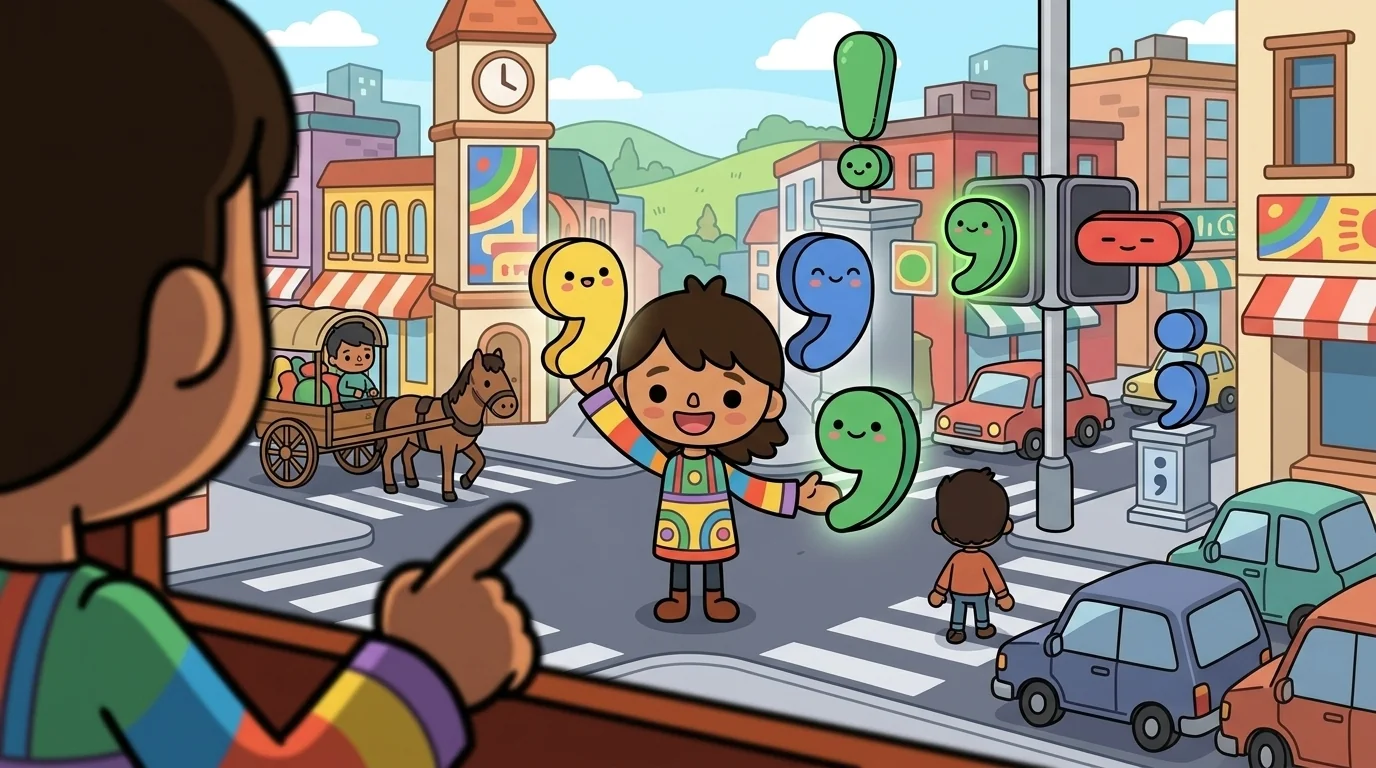
Punctuator Polly held the distinguished, if often underestimated, position of Sentence-Town's primary traffic-light operator. In the intricate hierarchy of Sentence-Town, where every citizen played a vital part, Polly's role was undeniably small, yet absolutely essential. The mayor managed civic affairs, the chief of operations kept everything running smoothly, and the receptionist handled communications. The cartographer mapped the linguistic landscape, while the zoning commissioner organized its districts. Each contributed their unique talents to the town's daily operation. Yet, all these distinct functions converged into a single, continuous stream of language, a flow that demanded careful regulation. Where, precisely, did one thought conclude? When did a reader need a brief pause for comprehension? How did a writer signal a shift to someone else's voice? Or introduce a comprehensive list of items? Polly, with her keen eye for order, oversaw these critical tasks of linguistic *flow-regulation*. She ensured that meaning moved smoothly, without collision or confusion.
Polly, whose given name was simply Polly, moved with a brisk efficiency, a quality evident in her precise movements and her deep affection for small, exact marks. She possessed an unwavering conviction that punctuation formed the very architecture of meaning itself. Without these tiny, powerful symbols, a sentence became an undifferentiated run-on, a chaotic jumble of words. Imagine, she would often challenge her students, reading something like: the dog barked the cat ran the children laughed it was a busy afternoon. The words were all there, grammatically correct, yet the sentence felt like a breathless sprint, leaving the reader gasping for understanding. It was technically grammatical, Polly would explain, but practically unreadable.

Then, she would demonstrate the transformation. The dog barked. The cat ran. The children laughed. It was a busy afternoon. With the addition of a few simple periods, the sentence acquired rhythm, allowing the reader to breathe, to process each distinct idea. It gained structure, transforming a jumble into a coherent narrative. The reader could finally follow the story, guided by the clear signals.
Polly’s unique perspective on language stemmed from her childhood, growing up in a family dedicated to managing urban flow. Her parents had both served as constables in the kingdom’s bustling capital, stationed at major intersections where horse-and-cart traffic converged. In those years, before automated signals, the capital’s streets were busy enough that signal-directing was a vital profession. Constables stood proudly in the middle of crossroads, their arms moving in crisp, deliberate gestures, whistles piercing the din as they directed the complex ballet of carts, pedestrians, and livestock.
Polly spent countless afternoons perched on a nearby bench, observing her parents at work. She watched the chaos that erupted when a constable stepped away for a moment, carts tangling, horses whinnying, vendors shouting. Then, with a sharp whistle and an outstretched arm, order would be restored. By the age of ten, she understood a fundamental truth: traffic flowed effortlessly when it was regulated, and inevitably jammed into gridlock when it was not. A constable’s hand raised high meant stop, a clear command to halt all movement. A hand extended to the side meant go, a signal for the flow to resume. A sharp whistle demanded immediate attention. These signals, though small and seemingly simple, carried immense consequence. They prevented accidents, ensured progress, and maintained the peace of the city.

Quietly, over many years, Polly began to recognize the profound parallel between her parents’ work and the function of punctuation in written language. A period, she realized, was a stop signal, bringing a thought to a complete halt. A comma acted as a slight pause, a momentary breath before continuing. A semicolon served as a stop-but-related signal, allowing the reader to pause fully while implicitly connecting two closely linked ideas. A colon became a here-comes-something signal, preparing the reader for an explanation or a list. Each tiny mark, she understood, regulated the flow of meaning with the same precision and purpose that her parents’ signals regulated the flow of traffic.
At eighteen, Polly enrolled in the prestigious GrammarForge academy, dedicating herself to the study of linguistic mechanics. For fifteen years now, she has been known as Punctuator Polly, a title she wears with quiet pride.
In her sunlit classroom, Polly always began the first-day lesson in precisely the same manner. Arranged neatly on her desk were six small, polished wooden signs. Each sign bore a different, meticulously painted punctuation mark: a period (.), a comma (,), a semicolon (;), a colon (:), a question mark (?), and an exclamation mark (!). She would pick them up, one at a time, holding each aloft for the class to see, demonstrating with quiet authority what each mark signaled.
For the period, she would hold up the sign, its single dot stark against the wood. "This," she would announce, her voice clear and firm, "is a full stop. It signifies the end of a complete thought, the conclusion of a sentence. The reader takes a breath here, a moment of complete rest, before starting fresh with a new sentence."
Next, the comma. "This mark," she explained, displaying the curving tail, "is a brief pause. The reader does not stop fully, but rather slows down, takes a quick mental breath, and then continues. It helps separate items in a list or clauses within a longer sentence, preventing confusion."
Then came the semicolon, a period perched above a comma. "This is a stop-but-related signal," Polly elaborated, emphasizing the connection. "The reader stops fully, just like with a period. However, the next sentence is closely related to the previous one. The semicolon signals this intimate connection, showing that two independent thoughts are part of a larger idea."
She then presented the colon. "This is a here-comes-something signal," she stated, her eyes twinkling. "When you see a colon, the reader is told, quite explicitly, that what follows will explain, expand on, or list examples of what just preceded. It’s like a drumroll before an important announcement."
For the question mark, its curved hook seemed to invite curiosity. "This signals the sentence is a question," Polly said, her voice naturally rising at the end of her own demonstration. "It tells the reader to adopt an interrogative tone, to seek an answer."
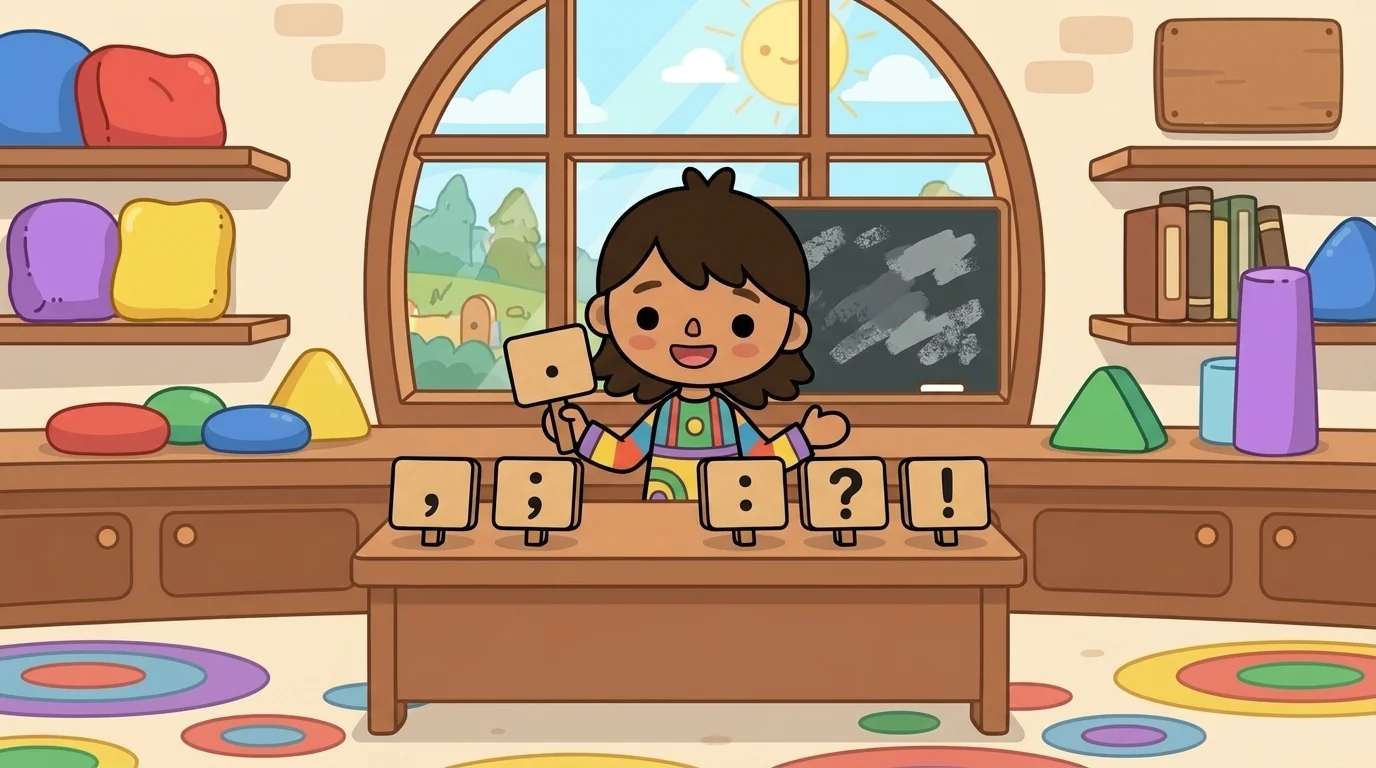
Finally, the exclamation mark, a straight line ending in a dot. "This signals the sentence is emphatic," she declared, her voice intensifying slightly, though never losing its precision. "It conveys strong emotion, surprise, or urgency. It makes the reader sit up and pay attention."
Polly also taught the nuances of apostrophes, which indicated possession (the dog’s bone) or formed contractions (can’t, won’t). She introduced quotation marks, essential for signaling someone else’s exact words or thoughts. And she explained dashes, those versatile marks that signal a sudden break, an interruption, or an abrupt shift in thought: I was reading — wait, the dog is barking again! Each mark, no matter how small, possessed a specific and crucial signal-job.
When children, often overwhelmed by the sheer number of rules, asked if punctuation was difficult, Polly always offered the same reassuring response. "It is not hard," she would say, her gaze sweeping across their faces. "It is simply signaling. Each mark tells the reader something vital: stop, pause, continue, change voice, list, expand. Your task is to choose the mark that precisely matches the signal you intend to send. The reader, once guided, will always follow."
She still kept those six small wooden signs on her desk, even after fifteen years. Sometimes, a child, eager to grasp the concept, would ask to hold them up, demonstrating a sentence for the class. Polly always allowed it. She had, over the years, witnessed thousands of student-sentences correctly punctuated, not because they had memorized arbitrary rules, but because they had been able to picture each mark as a small, powerful signal, a tiny traffic controller guiding the flow of their own words.
The GrammarForge ensemble
Punctuator Polly is part of GrammarForge's distributed-narrative cast. Each character embodies a different curricular primitive; together they teach the full subject.
-

Mayor Subject
Subject (noun/pronoun performing the action)
-

Verb Verity
Verb (action / state of being)
-

Object Otto
Direct / indirect object (receiver of the verb's action)
-

Modifier Mike
Adverb (modifies verb / adjective / other adverb)
-

Modifier Madge
Adjective (modifies noun / pronoun)
-

Connector Chen
Conjunction (coordinating / subordinating — *and*, *but*, *because*, *although*)
-

Pronoun Perry
Pronoun (substitute for noun — *he*, *she*, *they*, *it*, *who*)
-

Article Anne
Article (*a*, *an*, *the* — definite vs. indefinite)
-

Preposition Pat
Preposition (spatial / temporal relations — *on*, *under*, *between*, *before*)
-

Clause-Chief Carla
Clause-types (independent / dependent / subordinate / relative)
-

Agreement Ada
Subject-verb agreement (singular subject → singular verb; plural subject → plural verb; tricky cases — collective nouns, *either/or*, indefinite pronouns)