
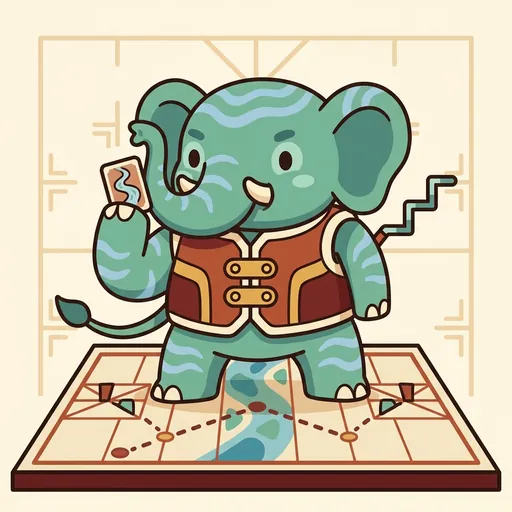
Elephant Wei
WEI — the elephant moves two steps diagonal — but never crosses the river.
Listen along — Elephant Wei
Loading audio…
Press play to listen along. The line being read lights up as you go.
Show full transcript
Loading transcript…
Chapter 2 — Elephant Wei and the River She Never Crosses
The board was two halves and one river, and Elephant Wei loved her half of it.
She was small for an elephant-tween, jade-grey with soft blue stripes, and she was standing right where she always stood — a couple of squares out from the General, in the calm middle of the home side. Across the painted river, chaos was happening. Knight Lu was leaping. Soldier Jin was inching forward, chin up, brave and tiny. Somewhere a cannon went off with a sound like a dropped pot.
Wei did not go over there. She took two steps, on the diagonal, and settled onto a fresh square.
A young piece skittered up beside her, breathless from watching the fight. “Aren’t you going to do something? The action’s all over there!”
“I’m doing something,” Wei said. “I moved to that square.” She pointed a stubby trunk at the empty diagonal behind them. “Now nothing sneaks in this way.”
The young piece squinted at the river. “But you could cross, right? Just once? To help?”
“No,” said Wei, and she said it warmly, the way you’d tell someone a fact about the weather. “I move two steps, always diagonal, and I never cross the river. That’s not a punishment. That’s me.” She watched Soldier Jin advance one more square, safely, because the whole home side behind him was quiet and covered. “See how Jin can be that brave? It’s because someone’s minding the back. That’s my two steps. That’s the whole job.”
Wei had not always been proud of her two steps.
When she was very small, she’d watched the horse-pieces gallop and the chariots go thundering the entire length of the board, and she had felt something hot and unfair go through her. She’d tried it. She’d marched herself right up to the river’s edge, lifted a foot, and — stopped. She couldn’t. The river simply wasn’t hers to cross. She’d stood there with one foot in the air, feeling like the smallest, most useless thing on the whole battlefield.
An older elephant found her like that. Not a general, not a hero — just a steady old piece who’d guarded the same corner for a long, long time.
“You’re standing at the river again,” the old one said. Not scolding. Just noticing.
“Everyone else gets to go everywhere,” Wei said, and her voice wobbled. “I only get two little steps. I always have to stay home.”
The old elephant sat down beside her, which took a while. “You know what happens to the side whose elephant doesn’t stay home?”
Wei shook her head.
“It falls. Every time. The attackers rush out, and there’s nothing behind them, and the whole thing collapses from the back.” The old one looked across the water, calm. “You’re not stuck at home, little one. You’re the reason home is still standing. That’s not a smaller job. That’s the one everybody’s counting on and nobody’s watching.”
Wei didn’t feel proud that day. But she stopped trying to lift her foot over the river. The stuck feeling had a different shape now — less like a cage, more like a post she’d been given to hold.
She walked to Generalstale at twelve, because a place that studied strategy ought to understand the pieces who stayed.
General Mei, the old mentor, met her where the board began. She didn’t ask Wei to charge anything. She asked one thing. “Show me what you protect.”
Wei didn’t answer in words. She walked two diagonal steps and set herself square in front of an empty spot near where a General would sit. Then she pointed her trunk — one line, then another — tracing the two exact squares an attacker would have to pass to reach that spot. Both were now behind her.
“You didn’t take a single enemy piece,” General Mei said, testing her.
“I don’t need to,” Wei said. “I closed the doors. Now the ones who do take pieces can go all the way out and not look back — because I’ve got the back.” She tapped the floor with one foot. “Home stays home.”
General Mei looked at the two covered squares for a long moment. “Elephants don’t apologize for their nature,” she said. “You belong here.”
Wei’s corner of the academy was quiet, which suited her, until the afternoon a frustrated young piece came stomping in.
“I’m the worst piece on my team,” he announced, and flopped down. “I can only move diagonal, and only two, and I can’t even go help. Everyone else is out there. I just sit.”
Wei knew that flop. She’d flopped exactly like it, at the river’s edge, years ago.
“Come here,” she said. She set out a little practice board. “Put your General there.” He did. “Now — I’m going to be the enemy. I’m coming for your General from this diagonal.” She crept a marker toward the corner. “Who stops me?”
The boy looked. His galloping pieces were all far away, on offense. ”…Nobody. They all ran off to attack.”
“So your General dies, and you lose, even though you were winning everywhere else.” She let that sit. “Now put yourself on the board. Two steps, diagonal, home side.”
He placed his own elephant-piece. Suddenly the marker’s path was blocked — his two steps sat right across the road to the General.
“Try to get me through,” Wei said.
He couldn’t. Every angle she tried, the elephant was already there.
“You didn’t chase me. You didn’t cross anything,” Wei said. “You just stood in the right home square, and now your General can breathe, and all your brave far-off pieces can stay brave.” She smiled. “That’s not sitting. That’s the reason the rest of them get to run. The board needs the ones who go — and it needs the ones who hold. You’re a holder. Say it like it’s good news, because it is.”
The boy moved his elephant two more diagonal steps, testing it, and something in his shoulders came unclenched.
Later, when the board was still, he came back with a smaller question.
“When everyone’s off fighting,” he said, “and you’re just standing here covering squares nobody’s even attacking yet… doesn’t it feel like nothing?”
Wei thought about the river’s edge. About the hot, unfair feeling, and the old elephant sitting down slow beside her.
“It feels steady,” she said. “That’s the honest word. There’s this quiet, watching, both-feet-planted feeling — like being the one who stays up a little later so everyone else can sleep. It’s not nothing. It’s the opposite of nothing. It’s the whole home leaning its weight on your two small steps, and you holding.” She looked out toward the painted river she would never cross, and she wasn’t sad about it, not even a little. “You don’t have to go everywhere to matter. Sometimes the bravest thing on the whole board is the one who stays.”
The boy nodded, slow, and Wei watched the stuck feeling lift off him — the same way, years ago, hers had finally set her feet down light instead of trapped.
The GeneralsTale ensemble
Elephant Wei is part of GeneralsTale's distributed-narrative cast. Each character embodies a different curricular primitive; together they teach the full subject.
-

General Zhang
Decisive command — clear orders, clear outcomes
-

Knight Lu
Knight-jump tactical maneuver
-

Soldier Jin
Forward-advancing infantry — pawn structure
-

Chariot Che
The chariot — straight-line power that sweeps the whole open file
-
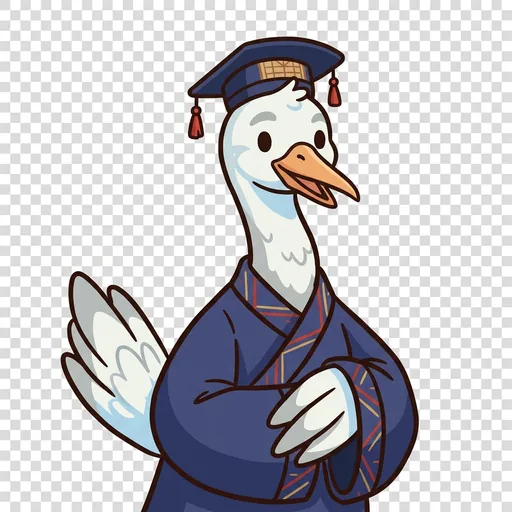
Advisor Shi
The advisor — palace-bound diagonal guard who never leaves the General
-

Marshal Shuai
The General piece — the calm center the whole game protects
-
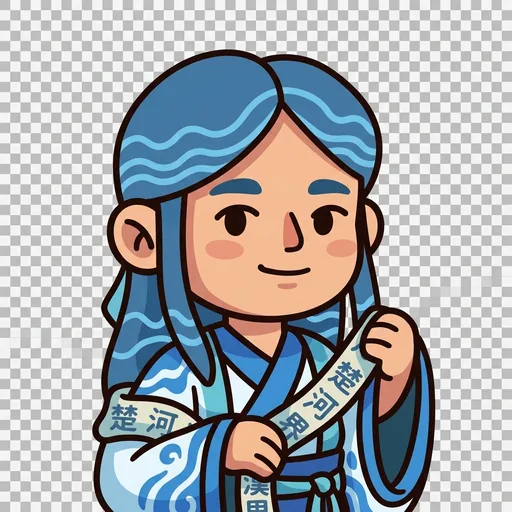
River Chu
The central river — the boundary that divides the board and transforms soldiers who cross it
-
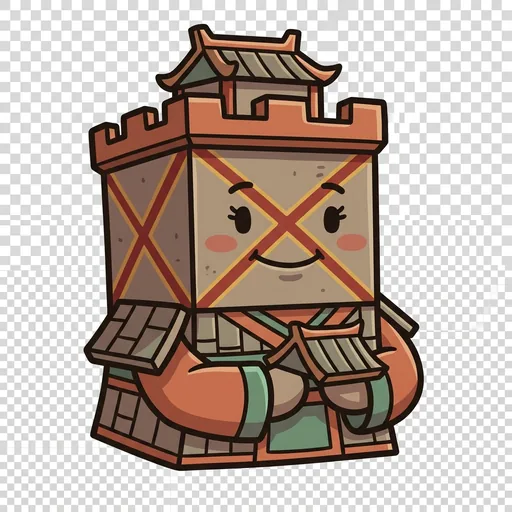
Palace Gong
The palace — the fortress home that shelters the General and advisors
-

Sightline
The flying-General rule — the watcher of the invisible line between the two Generals