Trace
TRACE — *follow the trait through generations. lineage is data.*
Listen along — Trace
Loading audio…
Press play to listen along. The line being read lights up as you go.
Show full transcript
Loading transcript…
Chapter 4 — Trace and the Path of Inheritance Across Time
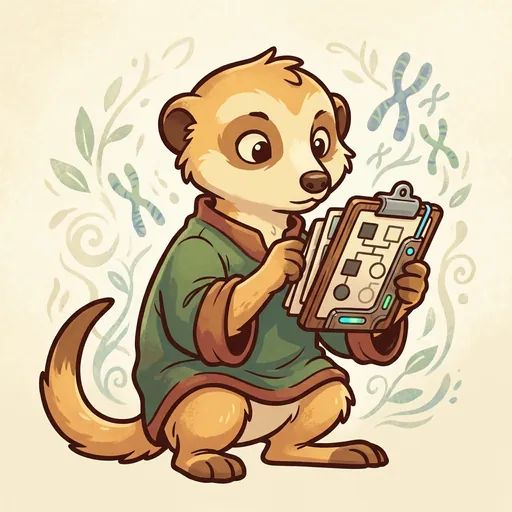
The air in Lab 7 always smelled faintly of ozone and old paper. Trace didn’t mind it. She liked the quiet hum of the equipment and the way the fluorescent lights made everything feel important. She was small, even for her age, with fur the color of warm cream, tipped with soft amber. It seemed to glow as she bent over the long, stainless-steel table.
Her chunky lab tunic, a hand-me-down from a much taller student, hung loosely on her, giving her the look of a very serious, very focused meerkat. Her amber eyes, usually wide with observation, were narrowed in concentration. Spread before her were dozens of small, laminated cards. Each one was a miniature, tangled family tree, a grid of squares and circles connected by thin, precise lines. These were her tools, her lineage tracker, and she handled them with the reverence of an archaeologist unearthing ancient scrolls.
A sudden, loud clatter from the doorway made Trace jump. Jax, all elbows and boisterous energy, had just dropped a stack of heavy textbooks. He grinned, unrepentant. “Still playing with your family trees, Trace?”
Trace sighed, a tiny puff of air escaping her nose. She didn’t look up immediately. Her attention was fixed on aligning a particularly tricky card, making sure the symbols matched perfectly. “It’s not playing, Jax,” she said, her voice quiet but firm. “It’s following the trait through generations.” She finally met his gaze, her amber eyes steady. “Lineage is data.”
Jax sauntered closer, peering at the cards. “Data about who’s related to who? My grandma could tell you that without all these fancy charts.” He picked up a card, turning it over carelessly.
Trace gently took it back, smoothing the corner. “It’s more precise than that. It’s about understanding how things are passed down. For example, why some traits, like a specific type of curly hair, might skip a generation, then show up again in a grandchild.”
She picked up a different card, holding it up. “See these symbols? They’re universal. Squares are for males, circles for females. A filled-in shape means that person has the specific trait we’re studying. A line connects parents to children, showing the path of inheritance.” She tapped the card. “This is pedigree analysis. It’s the method we use to trace a particular trait across multiple generations of a family. It’s like being a detective, but for genes.”
She slid another card forward, a complex one with many generations. “Look at this family, the Oakharts. The trait, a harmless but distinctive freckle pattern, appears in every generation. See how it goes from parent to child, without skipping anyone? That’s typical of autosomal dominant inheritance. It means you only need one copy of the gene from either parent to show the trait.”
She swapped it for a simpler chart. “Now, the Millers. Here, the trait—a specific kind of color blindness—disappears for a generation, then pops up again in the grandchildren. That’s autosomal recessive. You need two copies of the gene, one from each parent, to show the trait. If you only have one, you’re a ‘carrier,’ meaning you carry the gene but don’t show the trait yourself.”
Jax leaned in, genuinely intrigued now. “So, like, if my dad has blue eyes, but my mom has brown, and I have brown, but my sister has blue… that’s recessive?”
Trace nodded, a small, encouraging smile. “You’re starting to get it. Blue eyes are often recessive. Brown eyes are usually dominant. It’s all about these patterns.”
She pulled out two more complex charts, showing different families. “Then there are more intricate patterns. Like X-linked traits, which are carried on the X chromosome. These often affect males more if the trait is recessive, because males only have one X chromosome. If that X carries the recessive trait, they show it. Females have two X chromosomes, so they have a ‘backup’ if one carries a recessive trait.”
She pointed to another chart. “And mitochondrial inheritance, which is passed down only from mothers to all their children, no matter their gender. The father’s mitochondrial DNA isn’t passed on.” She paused, letting the information settle. “These different patterns are called inheritance modes. They tell us exactly how a trait travels through a family.”
Jax ran a hand through his hair. “Okay, so it’s like a super detailed family medical history. But… isn’t that kind of personal? What if someone finds out something they didn’t want to know?”
Trace’s amber eyes grew serious. “It is personal, Jax. Very personal. That’s why we handle these charts, and any genetic information, with extreme care. It’s called ‘HIGH CARE.’ When we discuss genetics, respecting privacy isn’t just a rule, it’s fundamental to our work. We never share details without explicit permission.”
She tapped a blank space on one of her cards, indicating an unknown ancestor. “Sometimes, lineage research can uncover complicated truths. Things like adoptions, or donor conceptions, or even when someone’s social father isn’t their biological father. These are sensitive situations.” Her voice was firm, but gentle. “Our job is to understand the data, to follow the scientific path of inheritance. It’s not our place to make judgments about people’s lives or their families. Lineage is data. It’s never a moral category.” She looked directly at Jax. “It’s about the science of how life passes on, not about who’s ‘right’ or ‘wrong’ or ‘normal’.” She reflected for a moment. The truth of a family tree could be a tangled thing, beautiful and complex, but also fragile.
Trace carefully stacked the cards, securing them with a soft elastic band. “This kind of tracking helps in so many different fields. Not just for medical traits. Think about how ChronoQuest uses similar methods to trace historical families and their migrations, or how OriginForge uses it to understand how traits carry through entire populations over centuries.”
Jax whistled softly. “So it’s not just about your great-aunt Mildred’s unusually large earlobes, then.”
Trace allowed herself a small, dry smile. “Not just that, no. Though even great-aunt Mildred’s earlobes could tell us something interesting about her lineage.”
She picked up her personal lineage tracker, a sleek device that projected a small, shimmering holographic family tree above her palm. “My name is Trace,” she stated, her voice clear. “What I teach is lineage. The core move is to follow traits across generations. A pedigree reveals the inheritance mode. And always remember,” she said, looking directly at Jax, her amber eyes holding his, “lineage is data, not a moral category.”
The GeneForge ensemble
Trace is part of GeneForge's distributed-narrative cast. Each character embodies a different curricular primitive; together they teach the full subject.