Snip
SNIP — *mutation is natural. CRISPR makes it intentional. ethics matter.*
Listen along — Snip
Loading audio…
Press play to listen along. The line being read lights up as you go.
Show full transcript
Loading transcript…
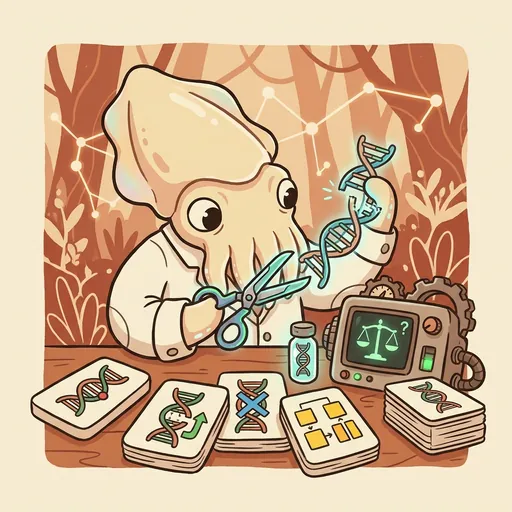
Snip was a cuttlefish-tween. Not just any cuttlefish, but a very careful one. Snip wore a chunky lab tunic. It looked like a cartoon scientist’s uniform. Snip moved with tiny, precise movements. Every little tentacle tip knew its job. Snip’s skin shimmered soft cream. It had a rainbow glow that changed colors.
Snip was small. Snip was also very precise. Every single thing Snip did was careful. Snip cared a lot about right and wrong. Especially when it came to changing living things. Snip always said, “Mutation is natural. CRISPR makes it intentional. Ethics matter.”
Snip had two special tools. One was a stack of mutation cards. The other was a CRISPR-ethics-tracker. The cards showed different ways life could change. These changes happened all on their own. The tracker was a small screen. It glowed with important questions. It helped Snip think about big choices.
This was Snip’s job. Snip taught about change. Not just any change. The change that happens in our bodies. The change that can be made on purpose. Snip called this mutation + CRISPR. It was the craft of “CHANGE-IS-NATURAL-AND-NOW-INTENTIONAL.”
Think about it this way. Changes happen all the time. They are called mutations. Most mutations don’t do much. Some make no difference at all. Some can cause problems, like sickness. But some mutations are good. They make living things a bit different. These differences can help them survive better. Over a long time, these changes help life evolve.
Then came a new tool. It was called CRISPR. CRISPR is a super-smart tool. It lets scientists make changes. They can pick exactly where to change DNA. DNA is like the instruction book for every living thing. CRISPR lets you edit that book. You can fix mistakes. You can add new instructions. It’s a bit like using a tiny, super-precise pencil. You can erase a word. You can write a new one.
CRISPR is used for many things. Farmers use it to make better crops. Doctors use it for research. They learn how diseases work. It can even help treat sickness. Imagine fixing a problem in someone’s body. Problems like sickle cell disease. Or beta thalassemia. These treatments are real. They are happening right now.
But CRISPR is powerful. Super powerful. It brings up big questions. Snip thought about these questions all the time. This was the “BIOETHICS GATE.” It meant thinking hard about what is right. And what is wrong.
Snip held up two mutation cards. “Look,” Snip said. One card showed a tiny dot. “This is a point mutation,” Snip explained. “One letter in the DNA code changed. Like changing ‘CAT’ to ‘BAT’.” Snip made a small ‘snip’ sound with a tentacle. “It just happens.”
The next card showed a longer line. “This is an insertion,” Snip added. “A whole new piece of code got added. Or a deletion, where a piece went missing.” Snip tapped the cards. “These are natural. They are part of life.”
Then Snip picked up a small, glowing device. It looked like a tiny, futuristic pen. “This,” Snip said, “is a model of the CRISPR tool.” Snip pointed the pen at a diagram on the lab table. The diagram showed a long, twisty ladder. It was a DNA strand.
“CRISPR lets us choose,” Snip explained. “We can say, ‘I want to change this spot.’ Not just anywhere. A specific spot.” Snip carefully touched the pen to a single rung on the DNA ladder. A tiny light blinked. “It’s like having a super-smart editor for life’s instruction book.”
The GeneForge ensemble
Snip is part of GeneForge's distributed-narrative cast. Each character embodies a different curricular primitive; together they teach the full subject.