Bead
BEAD — *gene is a discrete unit on the necklace of inheritance.*
Listen along — Bead
Loading audio…
Press play to listen along. The line being read lights up as you go.
Show full transcript
Loading transcript…
Chapter 1 — Bead and the Discrete Units on the Necklace of Inheritance
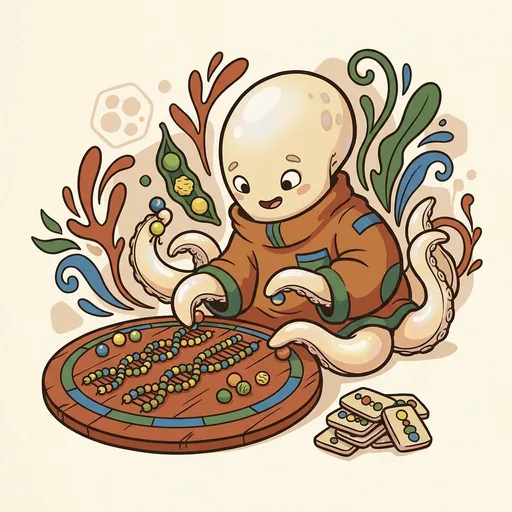
Bead was a creature of quiet precision. Their eight pearly tentacles, the color of warm cream, moved with an almost silent grace. Little iridescent flecks shimmered on their soft skin. Bead wore a chunky lab tunic, the fabric stiff but comforting. It was a practical uniform for someone who spent so much time arranging tiny things.
Today, Bead was setting up the genetics station in the BioForge lab. The air hummed with the soft whir of various machines. Most of the other students were still arriving, chattering loudly by the nutrient vats. But Bead preferred the calm of an empty room. It let them focus on the discrete units that made up life itself.
On the polished workbench, Bead carefully spread out a collection of small, colorful cards. Each card featured a single, intricately drawn bead. Some beads were smooth and round, others bumpy or striped. Next to the cards sat a device Bead called a “chromosome-tracker.” It looked like a miniature loom, strung with fine, glowing threads. Each thread held a long, shimmering line of tiny, colored lights. The glowing threads weren’t just decorative. They pulsed with information. Each light, a gene, could be highlighted, its specific function displayed on a small screen. It showed how genes were arranged, not randomly, but in a precise order, like notes on a musical score.
Bead picked up one of the threads from the tracker. It was long and delicate, like a strand of pearls. “See this?” Bead murmured, mostly to themselves. Their voice was soft, a gentle rustle. “This is a chromosome. Think of it as a necklace.” They held it up, letting the lights twinkle. “And each of these glowing lights? Each one is a gene.”
A new student, a human girl named Lena, poked her head into the lab. She had bright, curious eyes. “What’s a gene, exactly?” she asked, stepping inside. Her voice was a little loud for the quiet space.
Bead didn’t flinch. They simply turned, their pearly eyes meeting Lena’s. “A gene,” Bead explained, “is a discrete unit. It’s like a single bead on this necklace. Each bead holds a specific instruction.” Bead gestured to the glowing thread. “It tells your body how to do something. Or how to be something.”
Lena walked closer, peering at the chromosome-tracker. “Like what kind of instruction?”
“Well,” Bead said, carefully selecting two gene-bead-cards. One showed a tall, green pea. The other, a short, green pea. “Take Mendel’s pea plants, for example. The monk Gregor Mendel studied them a long time ago. He figured out how traits were passed down.”
Bead laid the two cards side by side. “One gene tells the pea plant to grow tall. Another gene tells it to grow short.” They tapped each card with a delicate tentacle. “These are different versions of the same gene. We call these versions alleles.”
Lena nodded slowly. “So, like, tall or short is an allele?”
“Exactly,” Bead confirmed. “They are different alleles for the ‘height’ gene. And here’s the important part: each gene always sits in the same spot on the chromosome. That spot, that specific place on the necklace, is called a locus.” Bead pointed to a particular glowing light on the thread. “The ‘height’ gene for a pea plant will always be found at this locus.”
Bead picked up a small magnifying glass and showed Lena the detail on one of the gene-bead-cards. “Humans have about twenty thousand genes. They are all arranged on twenty-three pairs of chromosomes. Each one is a tiny instruction, a specific bead.”
Lena’s eyes widened. “Twenty thousand? That’s a lot of beads.”
“It is,” Bead agreed, a hint of satisfaction in their soft voice. “And each one is important. Each one is inherited from your parents. It’s the foundation of everything.” Bead carefully placed the pea plant cards back into their designated slots. Their movements were methodical, almost ritualistic. The precision was not just for organization. It was a reflection of the order they saw in the genetic code itself.
Bead then pointed to a small, holographic display on the tracker. It showed a field of glowing crops. “Understanding these units helps us with things like HarvestForge Soil,” Bead explained. “We can understand why some crops grow better, or resist diseases. It’s all about the genes they inherited.” A different display flickered, showing a diagram of human body systems. “It also helps us understand BioForge body-systems. How our hearts beat, how our lungs breathe. Every function has its genetic instructions.”
Lena imagined her own body, a vast collection of these tiny, precise instructions. Every hair color, every freckle, every way her muscles moved – all coded in these discrete units. It was incredible, and a little overwhelming. But Bead made it feel manageable, like a puzzle waiting to be solved. She looked at the chromosome-tracker again, no longer seeing just pretty lights. Now she saw a universe of information, carefully strung together.
The GeneForge ensemble
Bead is part of GeneForge's distributed-narrative cast. Each character embodies a different curricular primitive; together they teach the full subject.