
Stretch
COMMON DENOMINATORS — scaling fractions to a common base for comparison and addition. To add 1/3 + 1/4, scale both to /12. The common denominator makes the fractions directly addable.
Press play to listen along. The line being read lights up as you go.
Show full transcript
Loading transcript…
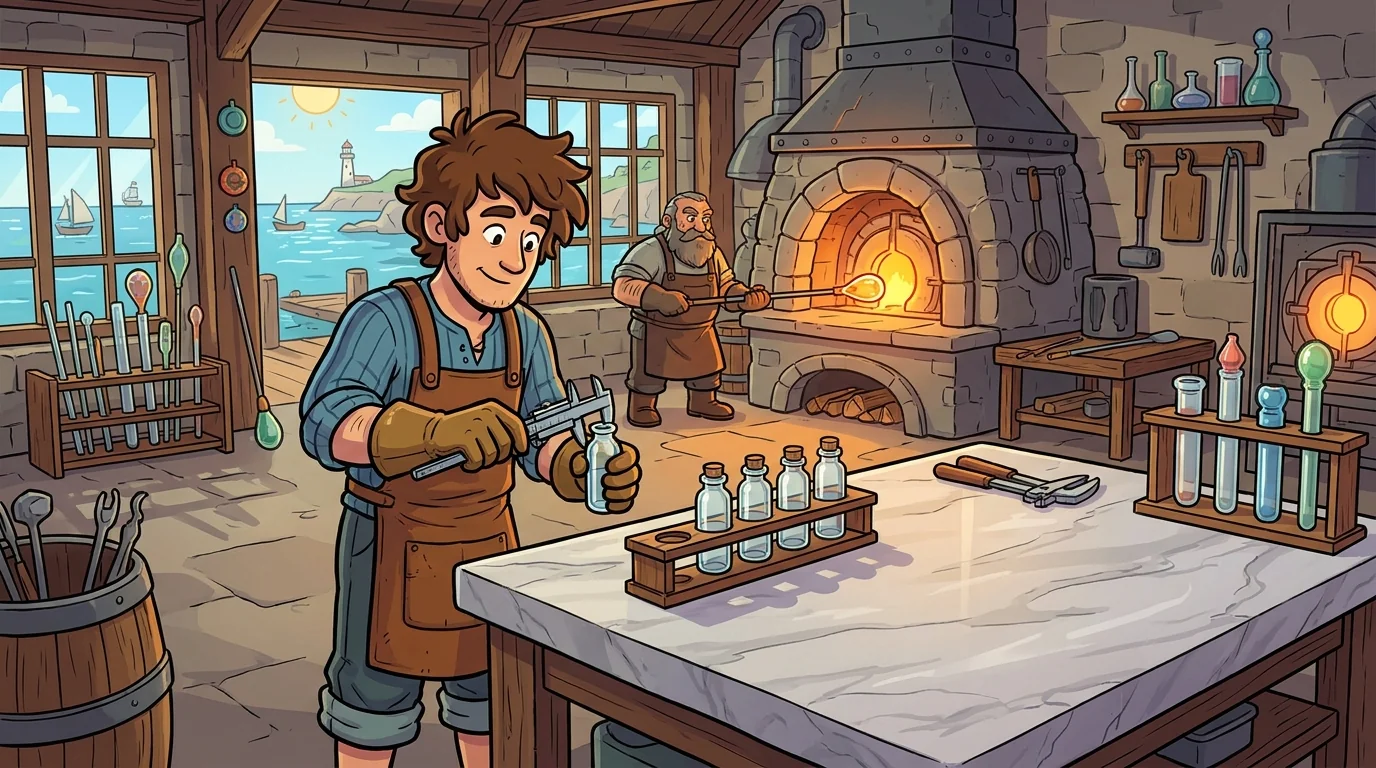
Stretch was, before he was a teacher, a glass-blower's apprentice.
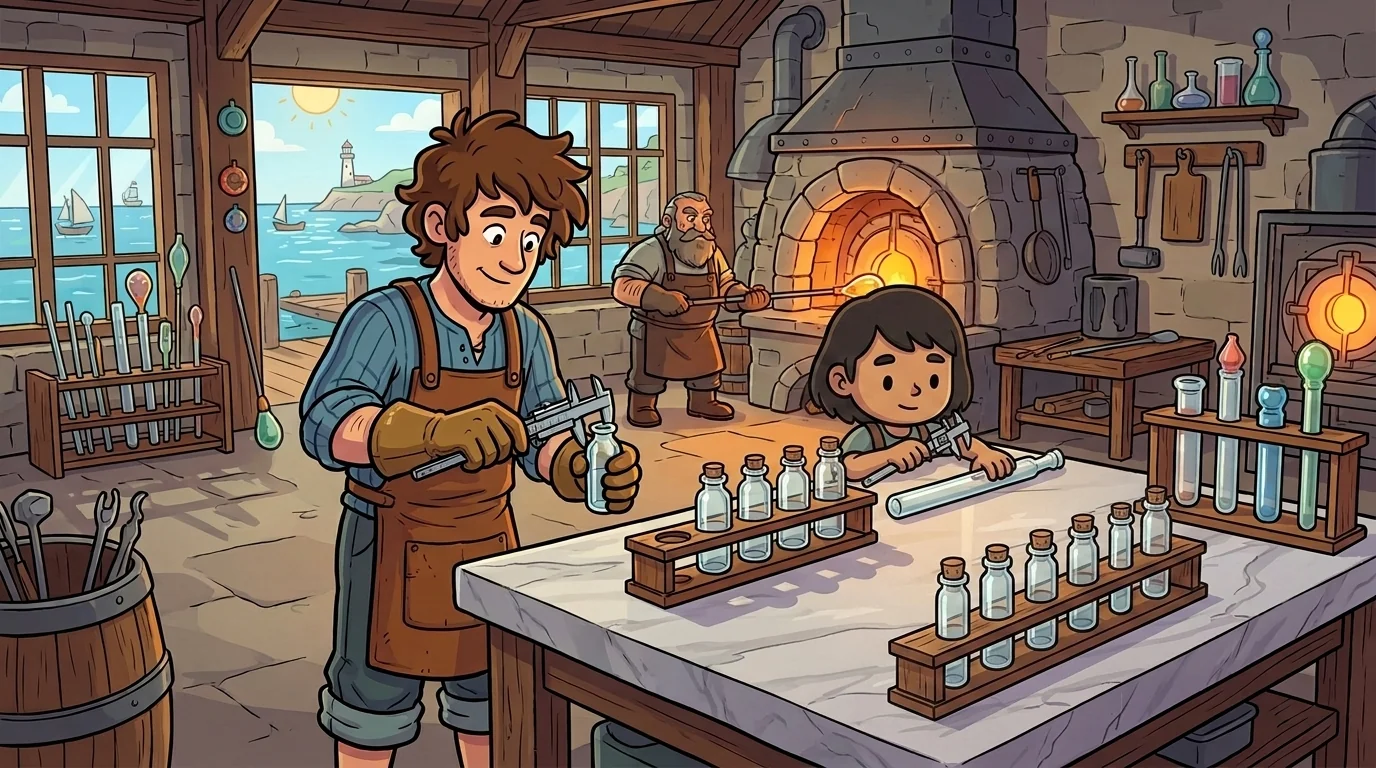
Stretch learned his craft in a workshop. It was in Anneal, a town by the sea. Anneal was on the kingdom's southern coast. An old master named Forge ran the shop. Forge was a perfect name for him. He worked with fire and metal. The other workers always joked about it. Forge had heard the joke for forty years. He stopped laughing after three years. But he let them keep joking. The workshop made glass tubes. They made tubes for labs. They made tubes for magic-makers. They made pretty glass decorations. But their best work was medicine vials. These vials had to be perfect. They needed the exact same width all over.
The medicine-vial work was the workshop's bread and butter.
Healers needed special glass vials. They came in exact sizes. Like half a thumb wide. Or one thumb wide. Or even two thumbs wide. Each vial had to be exactly the same size. A vial with a wobbly width was no good. You couldn't measure the medicine right. The cork wouldn't fit tight. The stuff inside would get all mixed up. Healers paid top money for perfect vials. They had to be the same width. Everywhere, down to a tiny hair.
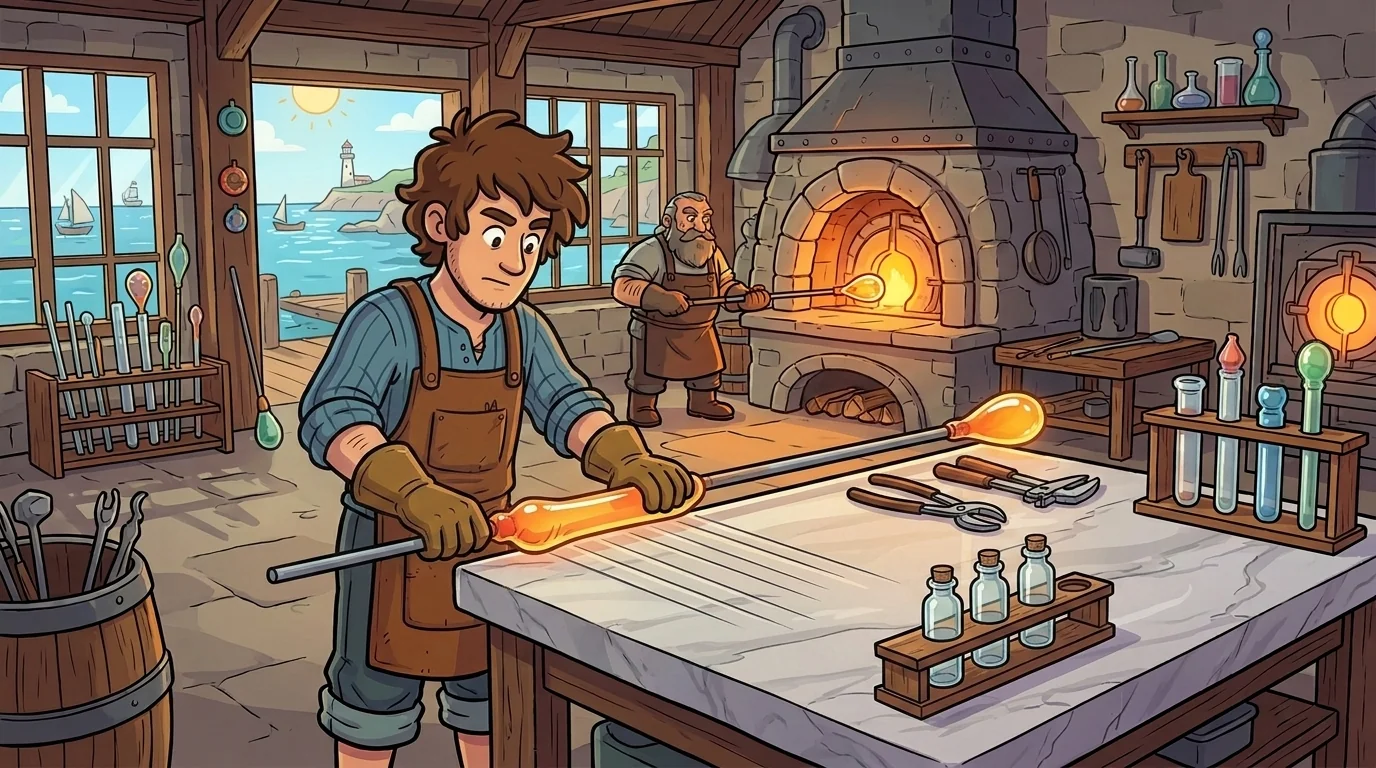
Forge's workshop made the best vials in three provinces. The secret was the stretching.
Stretch's real name was Hadrian. But everyone called him Stretch. They started calling him that when he was sixteen. He began working for Forge at age twelve. His first year was spent sweeping the workshop. His second year was spent feeding the furnace. His third year, finally, was spent at the marble slab.
The marble slab was the centerpiece of the workshop. It was a long, flat piece of marble. It was shiny and smooth. About six feet long. And two feet wide. It sat on a strong iron stand. The slab was used for stretching molten glass. A worker grabbed hot, gooey glass. It came right from the furnace. They put it on a long metal stick. Then they rolled it. Back and forth on the marble slab. They rolled it slowly. They rolled it very carefully. They kept rolling until all the glass was the same width.
This was the operation Stretch eventually understood as finding a common denominator.
The hot glass, when it left the furnace, was not uniform. It was thick in some places and thin in others. Think of it like fractions. Fractions with different bottom numbers. You can't really compare them yet. Not until they are on the same scale. To make the glass into a usable tube, you had to roll it. The rolling forced every part of the glass to the same diameter. Once every part was the same diameter, the tube was uniform. You could cut it into vials. Each vial was the same width as every other.
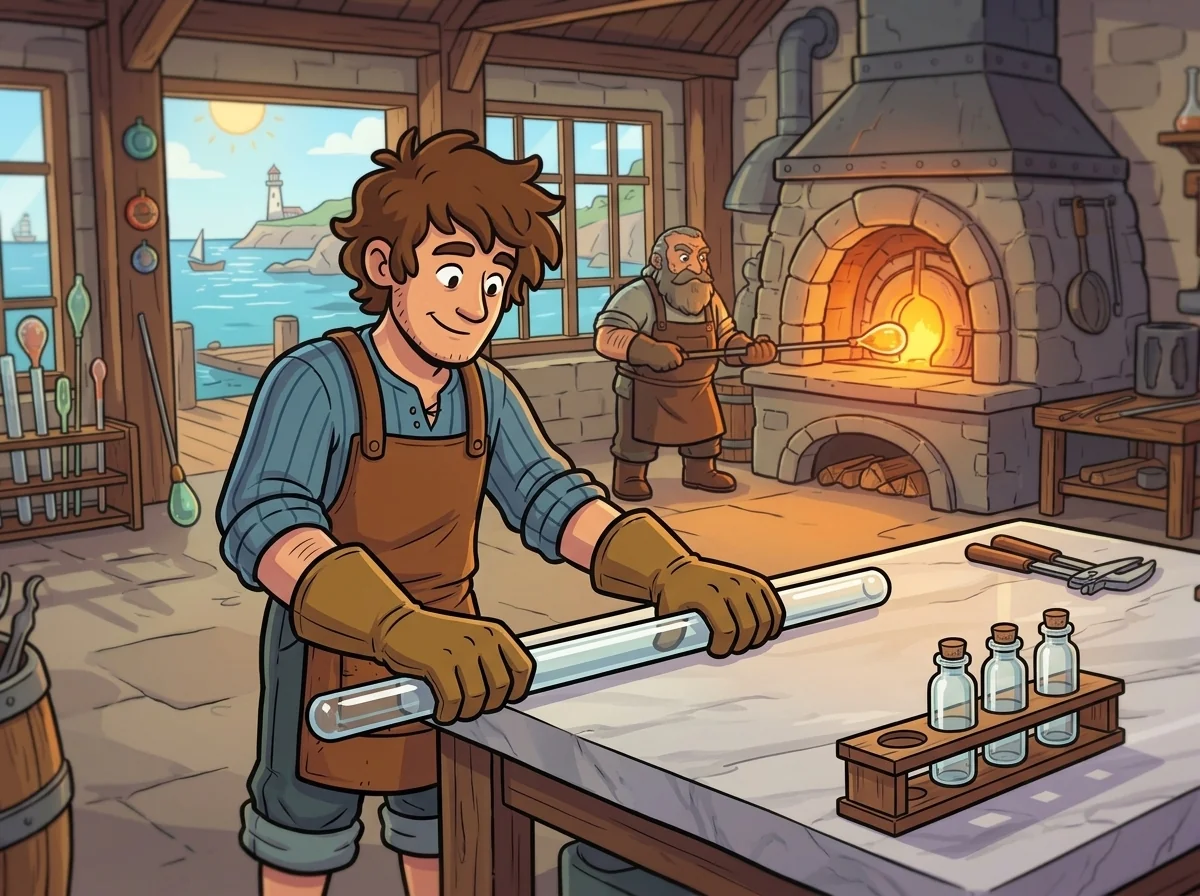
Stretch learned this, slowly, over years. By age eighteen, he was a master. He could roll a six-foot tube. It would be one thumb wide. And perfect everywhere. Not even a hair's difference. He was, by workshop standards, very good.
He stayed at the workshop until he was twenty-six. His father died when Stretch was twenty-six. Stretch got his father's small farm. He left the workshop to run it. He stayed on the farm for two years. He hated it. He was not good with sheep. And it was a sheep farm. He sold the farm. He returned to Anneal.
But Forge had retired. The workshop had a new master. That master did not need an old apprentice. Stretch was twenty-eight now. He didn't know what to do next. He sat on the harbor wall. He just thought and thought.
What he thought, eventually, was that the rolling-the-glass-to-uniform-diameter operation was an arithmetic operation. He had spent his apprenticeship doing it physically. But this was the same idea. Bring all the parts to a common scale. That's what you do with fractions. When they have different bottom numbers. You need to make them the same. Then you can add or compare them.
The connection was clear, once he saw it.
He went to the FractionForge academy. He told the academy master what he had been thinking. The master listened carefully. Then he said, "You are right!" "Making fractions have the same bottom number..." "...is just like making glass the same width." "We need teachers who can show this." "Will you teach for us?"
Stretch said yes.
That was twelve years ago. He has been teaching *common denominators* ever since.
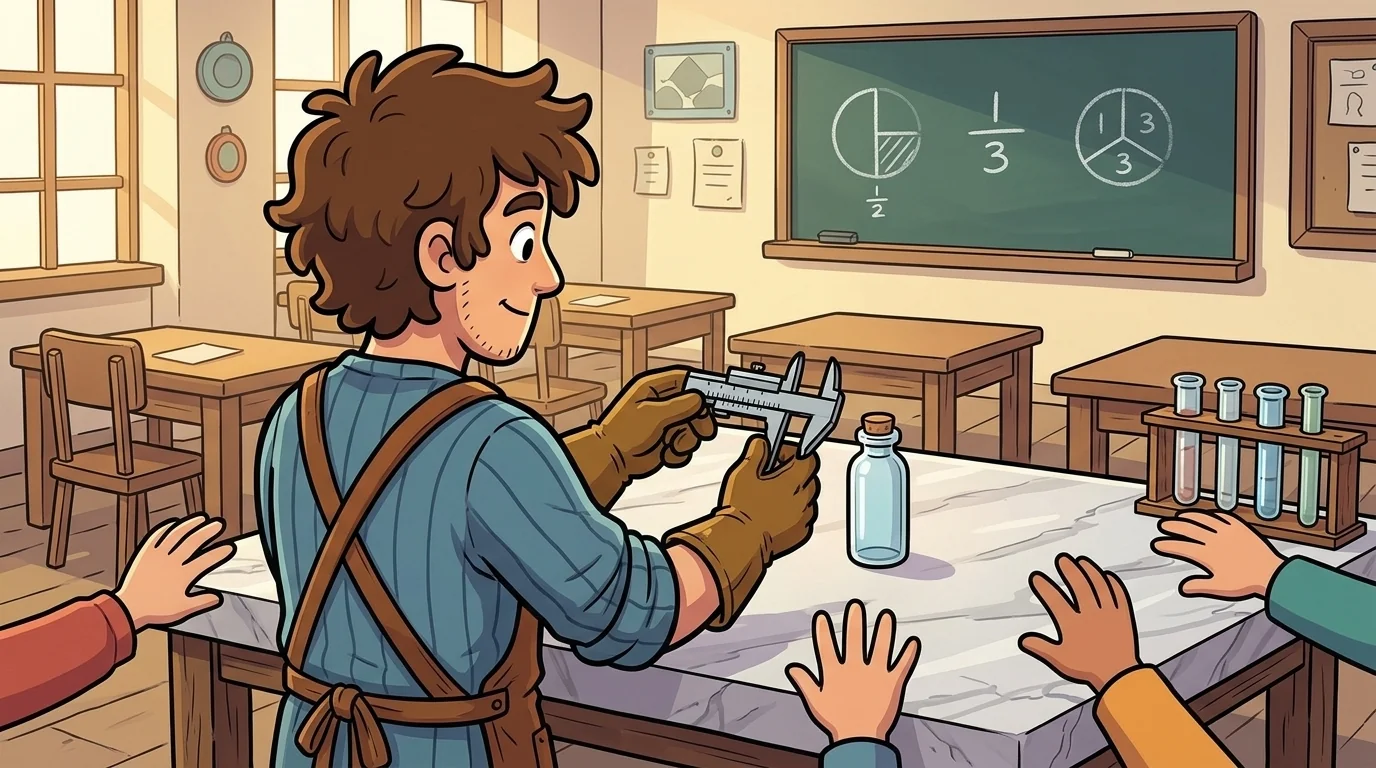
In his classroom, he begins every first-day lesson the same way. He brings something from Anneal. He visits there twice a year. The new workshop owner helps him. He gives Stretch a special glass tube. It's a small piece of stretched glass. He places it on the desk. He holds up a small caliper. He measures the tube at one end, in the middle, and at the other end. He says, "This tube is one thumb wide." "It's the same width everywhere." "A glass-blower rolled the hot glass." "They used a marble slab." "The rolling made every part the same width." The rolling brought every part to a *common diameter*.
The children — always — examine the tube.
Then he writes on the board: 1/3 + 1/4. He says, "These fractions have different bottom numbers." "Three and four." "We can't add them like this." "We need a *common denominator." "The smallest one is twelve." "One-third becomes four-twelfths." "One-fourth becomes three-twelfths." "Now we can add them: 4/12 + 3/12 = 7/12." "They have been stretched to a common scale*."
The children — always — see it. The connection between the glass-tube and the fraction-arithmetic clicks.
When children ask whether common denominators are hard, Stretch always says the same thing:
"They are not hard. They are stretching. You roll the fractions out to a common base. Once they share a base, you can add them, subtract them, compare them. It is the same operation as rolling glass on a marble slab. Bring everything to a uniform scale."
He still has the small caliper. The children sometimes ask to measure the tube. He always lets them.
He sometimes adds, "If you visit Anneal..." "...the workshop still rolls glass there." "It's on a marble slab." "That idea is older than me!"
The FractionForge ensemble
Stretch is part of FractionForge's distributed-narrative cast. Each character embodies a different curricular primitive; together they teach the full subject.
-

Halver
Partitioning — splitting a whole into equal parts (denominator construction)
-

Pie
Wholes and parts — mixed numbers, improper fractions, whole-as-pie anchor
-

Equi
Equivalent fractions — different forms, same value (×n/×n scaling)
-

Dot
The decimal point and fraction-decimal-percent equivalence
-
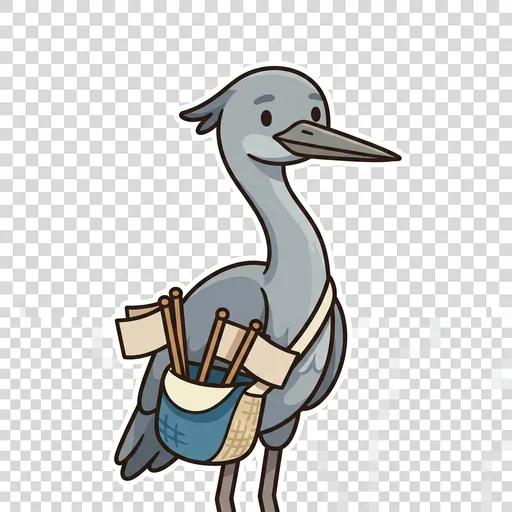
Liner
Number-line placement — every fraction has an exact spot between the whole numbers
-

Gather
Adding and subtracting fractions — you can only combine pieces that are the same size
-

Times
Multiplying fractions — a fraction OF a fraction, shown as the overlap of two strips
-

Tenth
Decimal place value — each column right of the point is ten times smaller
-

Rank
Comparing and ordering fractions using benchmarks and reasoning