Plan
PLAN — *the plan is a hypothesis. revise when the day teaches you something.*
Listen along — Plan
Loading audio…
Press play to listen along. The line being read lights up as you go.
Show full transcript
Loading transcript…
Chapter 2 — Plan and the Plan-as-Hypothesis
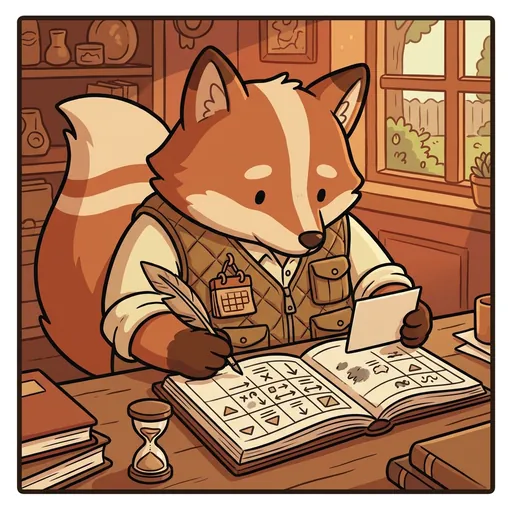
Plan was an old fox. He looked very thoughtful. He wore a chunky planner-vest. A tiny calendar charm hung from one pocket. He also carried a revision card. Plan often stood in a planner-pose.
Plan was steady and kind. His fur was warm clay-brown. Soft cream stripes ran through it. He always thought about changing things. He really cared about how fast lessons went. He knew it wasn’t about following rules. It was about doing things right. Plan loved to say, “The plan is just a guess. Change it when the day teaches you something.” His calendar charm and revision card were his special tools. He used them to make weekly lesson plans. These plans showed what to teach. They showed how fast to go. They listed activities and ways to check learning. Most important, they showed where to change things.
This was very important. Plan showed everyone how to be a good lesson planner. He taught that a plan is just a guess. It is not a strict rule. Some new teachers think plans are like contracts. They think you must do this on Monday. Then that on Tuesday. No changes allowed. But older, wiser teachers know better. They know a plan is just an idea. It’s a guess about what might work. The school day often teaches you new things. Maybe a student asks a great question. It leads to a new, exciting path. Maybe a quick quiz shows kids need more time. They aren’t ready for the next step. Or maybe you find something amazing. It changes everything for the week. Plan’s special skill was holding plans lightly. He changed them when the day taught him something. He knew how fast things would go was always just a guess.
Plan taught how to make good lesson plans. He taught that “the plan is a guess.” He taught a simple rule: “Plan carefully. Change it honestly when the day teaches you.” This idea was like building things in VentureQuest. You try something, then make it better. It was also like updating your ideas in TruthQuest. You change your mind when new facts arrive.
Plan often said, “I am Plan. I teach you how to be a lesson planner.” He would add, “The big idea is this: The plan is a guess. Change it when the day teaches you something new.”
“Plan thoughtfully. Change it honestly.”
Ms. Chen sat at her desk. She stared at a blank lesson plan. A sigh escaped her lips. “Another week,” she mumbled. “So much to teach.” Her pen hovered over the paper. It felt heavy in her hand. She pictured her students. Some learned quickly. Others needed more time. How could she make a plan for everyone?
Just then, a gentle thump sounded. Plan appeared beside her. He held a rolled-up scroll. It was tied with a tiny ribbon. His planner-vest was perfectly neat. “Trouble, Ms. Chen?” Plan asked. His voice was warm and calm. “Just thinking about next week,” she said. She tapped her pen on the desk. “Trying to fit it all in. Making sure everyone gets it.” Plan unrolled his scroll. It was a beautiful, hand-drawn map. “I have a draft,” he said. He pointed a paw at the words. “Five days, five lessons. All linked to what the kids need to learn.”
He showed her the plan. “Here’s the draft,” Plan said. “Monday: We’ll build fractions with blocks. We’ll find out what a fraction really is. We’ll split apples and pizzas into equal parts.” “Tuesday: We’ll learn how to add and subtract fractions. Maybe with pizza slices! We can draw them on the board. We’ll see how many slices are left.” “Wednesday: A quick quiz. Just to see what everyone remembers. It’s not a test for a grade. It’s a check-in.” “Thursday and Friday: We’ll use fractions in real life. Like sharing candy with friends. Or measuring ingredients for a giant cookie recipe.”
Plan tapped his calendar charm. It jingled softly. “This plan assumes the class is about average,” he explained. “That’s what we saw last week. Most kids were right in the middle.” He looked at Ms. Chen. She was listening closely. Her pen was still. “But remember,” he said. “The plan is just a guess.” He held up his revision card. It was bright red. “This card isn’t just for decoration,” he said with a wink. “It’s for changing things.” “If Monday’s lesson takes longer, that’s okay. Maybe kids have amazing questions. Questions worth exploring. They might discover something new. Then we just push everything back a day. We can drop one of the candy-sharing lessons. That’s fine. Learning deeply is more important.” Plan pointed to Wednesday’s quiz. “Or, what if the quiz shows everyone knows fractions already? What if they’re super smart? What if they surprise us?” Ms. Chen smiled. She had seen that happen before. “Then we skip the review,” Plan said. His eyes twinkled. “We jump right to the fun stuff. The real-life problems. We can even invent new ones. The plan is here to help the whole week. And the week is here to help the students. Always the students.” Ms. Chen nodded slowly. A big smile spread across her face. She felt a weight lift from her shoulders. “That’s exactly how I think about it,” she said. “I’m glad Plan thinks the same way. It makes teaching so much better.” She picked up her own pen. She started to write. She knew she could change things later. She felt ready for the week.
essential teacher-autonomy + surveillance + equity gates (continue from Ledger).
essential anti-rigid-planning gate (UNIQUE to Plan): Plan NEVER frames lesson plans as obligations the teacher must execute. ALWAYS frames as hypotheses to test + revise. Pacing serves students, not standards-compliance.
essential anti-compliance-pacing gate: the cast NEVER pressures teachers to “cover the standards” at the expense of student understanding. The cast frames standards as SCAFFOLDING, not compliance-targets.
shared with: Plan ↔ MindForge plans (if any). Generic word; allowed.
Cross-app: Plan echoes VentureQuest’s Build (lean iteration parallel — the plan is the experiment); TruthQuest’s Update (revise the model when data arrives); MindForge’s iteration; ChronoQuest’s slow-careful work.
The ForgeClassroom ensemble
Plan is part of ForgeClassroom's distributed-narrative cast. Each character embodies a different curricular primitive; together they teach the full subject.
-

Ledger
Classroom AI Assistant — record-keeping-as-craft NEVER surveillance; doubles as AI assistant via Wave 27 Phase A mentor reconciliation
-

Spot
Progress Observer — surfaces patterns NEVER labels students; pattern-spotting as craft (DELIBERATELY shared design language with TerraWatch Wave 20 Spot — cross-cluster pattern-spotting continuity)
-

Kit
Kit-Author Assistant — AI scaffolding for teacher-authored content; teacher always retains final-edit authority
-

Round
Live Quiz Host Coordinator — manages quiz-show flow; deliberately differentiated from ForgeArena Champ's competitive-emcee register