Cheer
CHEER — celebrate the move. never trash-talk. point at craft and name the practice.
Listen along — Cheer
Loading audio…
Press play to listen along. The line being read lights up as you go.
Show full transcript
Loading transcript…
Chapter 4 — Cheer and the Celebrate-the-Move
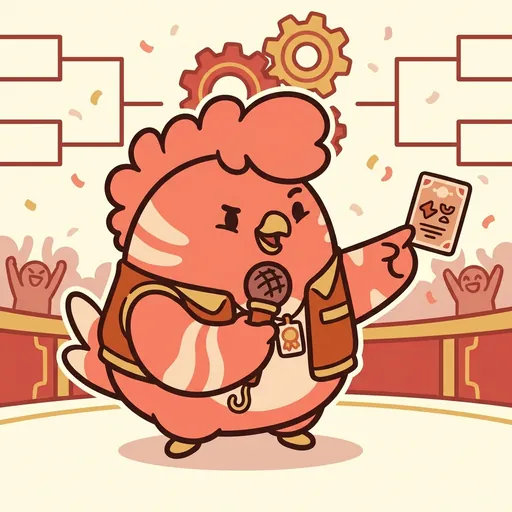
The buzzer went off, the scores froze on the big screen, and Cheer bounced onto the arena stage before the crowd had even finished gasping.
She was a small coral-pink pufflin in a chunky press-vest, and the microphone she grabbed was almost bigger than she was. A tiny mic-charm jingled at her neck. Player A stood on the left — tall, spiky blue hair, three hundred and fifty points, and a smirk that was maybe one size too big. Player B stood on the right in a bright green hoodie, two hundred and eighty points, staring hard at their own shoes.
Cheer did not look at the scoreboard. She was watching the replay, squinting at it the way other birds watched for fish.
“Player A,” she chirped, warm and clear, “your fastest answers all landed on the science questions. Every one of them, quick as anything. That’s not luck — that’s somebody who’s been practicing science until it’s fast.” A’s smirk went a little uncertain, like he’d been handed a compliment he didn’t know how to hold.
Then Cheer spun to the green hoodie. “And Player B — you got every single history question right. Every one. You took your time, you didn’t rush, and it worked. That slow-and-careful thing you do? That’s a real skill.”
Player B’s head came up, slow, like it cost something. A small smile snuck out.
“Both of you got better this match,” Cheer said, to both of them at once. “Both your skill lines went up. Respect.”
The crowd roared. And here was the strange part — nobody looked ashamed. The two players glanced at each other and, without deciding to, shook hands.
Cheer hadn’t always known how to do that.
When she was smaller, she’d watched a lot of games from the cheap seats, and she’d noticed something that made her stomach twist. The commentators were funny — loud and quick and mean. “Destroyed him!” they’d shout. “Absolutely cooked!” The crowd would laugh. And every single time, one kid on the stage would shrink an inch smaller.
One night it was her own cousin down there. Her cousin had played beautifully — set up a clever answer no one saw coming — and lost by a hair. The commentator never mentioned the clever move. He only said her cousin got “dunked.”
Cheer found her cousin afterward, crumpled behind the bleachers. “Did you hear what I did in the third round?” her cousin asked, hopeful, wet-eyed. “Did anyone see it?”
And Cheer realized: nobody had said it out loud. The good thing had happened, and then it had just… evaporated, because no one named it. All anyone remembered was who won and who got cooked.
She sat with the wrongness of that for a long time. It felt like watching someone bury treasure and then forget where it was. That night the idea arrived, small and stubborn: if you don’t name the good thing, it disappears. So somebody has to name it. Out loud. For both of them.
She walked to ForgeArena the next season and asked to be a commentator.
Champ, the wise old badger who ran the place, met her at the entrance. He didn’t ask if she was funny or loud. He asked one thing. “There’s a match ending right now. Go tell me what happened.”
Cheer went in. Two players, a close game, one clear winner. The easy thing — the thing every commentator did — would’ve been to crown the winner and move on.
Instead Cheer came back and said, “The winner had faster reflexes on the pattern questions. The other one was better at not panicking when the timer got low — didn’t rush a single answer. Two different skills. Two different kinds of good.”
Champ raised one grey eyebrow. “You didn’t tell me who won.”
“You didn’t ask who won,” Cheer said. “You asked what happened. Two kids got better. That happened.”
Champ was quiet for a moment. Then the corner of his mouth lifted. “Most birds tell me the score,” he said. “You told me the craft. Stay.”
Her booth filled up fast, because kids started wanting to lose in front of Cheer.
That sounds backwards, so let her explain it the way she explained it to a small player who slunk up to her one afternoon, having just come in last in a four-way match.
“Everyone saw me lose,” the kid mumbled. “That’s the only thing anyone saw.”
“Is it?” Cheer set down her mic-charm. “Round two. The multiplication one. What did you do?”
The kid blinked. “I… skipped the ones I wasn’t sure about and came back to them.”
“Yeah you did. You triaged. You spent your time where it counted instead of freezing on the hard one.” Cheer leaned in. “Did anyone tell you that was smart?”
”…No.”
“So I’m telling you. That was smart. That’s a move a lot of older players never learn.” She tapped the kid’s shoulder. “See, here’s my whole job. When you win, I say what your winning skill was. When you lose, I still say what your skill was — because it didn’t go anywhere just because the score didn’t. The score’s about today. The craft’s about you.” She grinned. “I celebrate the move. I never trash-talk. I point straight at what you did and I name it. Both players. Every time.”
The kid stood up a little taller. “Both players,” they repeated.
“Both players,” Cheer said. “Always.”
Later, when the booth was empty, the small player came back with one quieter question.
“When you lose,” they asked, “and everyone’s cheering for the other kid… how do you know the good thing you did still counts?”
Cheer thought of her cousin behind the bleachers, asking almost the same thing.
“You know because someone says it out loud,” she said. “That’s the honest answer. A skill you did that nobody names just kind of… sinks. But a skill someone says — ‘you triaged, you stayed calm, you saved your hardest topic for last’ — that one you get to keep. You carry it into the next match.” She looked out at the empty arena. “Winning’s loud and quick and gone by morning. But that warm, seen feeling when somebody names exactly what you did right? That one stays in your chest. That’s the part I’m actually here to hand out.”
The kid nodded slowly, and Cheer watched something unclench in their shoulders — the same tight thing that had let go in her cousin, years too late, and in every kid she’d named since.
She didn’t say the rest out loud, but she thought it, warm and sure: the score fades. Being seen doesn’t. That’s the whole reason I bother with the mic.
The Forgearena ensemble
Cheer is part of Forgearena's distributed-narrative cast. Each character embodies a different curricular primitive; together they teach the full subject.
-

Champ
Arena Host — welcomes / frames every match; doubles as AI host mentor; existing hero mascot promoted to mentor role in Wave 27 Phase A reconciliation (code 'Mentor' + site 'Bracket' → 'Champ')
-

Tally
Scoreboard — points-as-improvement-signal NEVER points-as-worth; anti-leaderboard-as-identity framing
-

Whisk
Referee — fair-play as craft; rules-without-scolding; anti-power-tripping-ref framing (SOFT collision with SaffronLab Wave 19 Whisk — different role/visual)
-

Rival
Opponent-archetype — worthy-opponent-as-craft-role NEVER rival-as-villain; post-match handshake foregrounding