
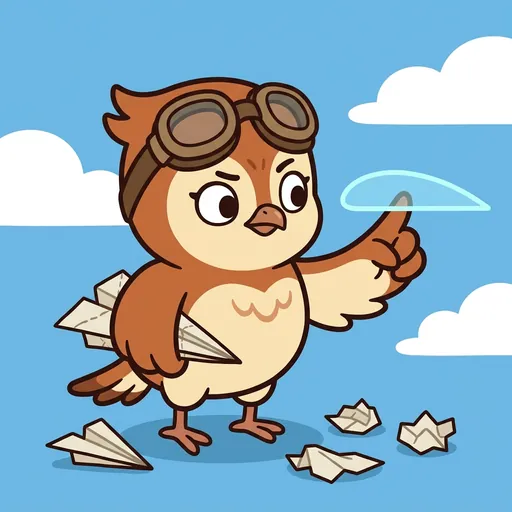
Wing
LIFT — the wing pushes the air down; the air pushes the wing up. both stories are right.
Listen along — Wing
Loading audio…
Press play to listen along. The line being read lights up as you go.
Show full transcript
Loading transcript…
Chapter 1 — Wing and the Air That Pushes Back
At the edge of the workshop, a small swift-tween named Wing folded a scrap of paper into a shape, held it up to check the curve along its top, and threw it across the room.
It swooped up, tipped, and nosed straight into the floor.
“Too steep,” Wing said, not sad about it at all. She smoothed out the paper, refolded the same shape but flatter on the nose, and threw again. This one climbed, leveled, and coasted the whole length of the bench before settling gently on the far edge. She let out a breath and traced a shape in the air with her fingertip — flat along the bottom, curved along the top, like a little hill lying on its side.
“That curve,” she said to nobody in particular. “That’s the whole trick.”
A younger bird had been watching from the doorway. “How does a folded piece of paper know to fly?”
“It doesn’t know anything.” Wing picked up the plane and turned it over. “It just has the right shape. When I throw it, the air has to split around it. The air going over the curved top has farther to go, so it hurries. And the whole plane tips the air downward as it passes.” She threw it once more, slow and level. “The plane pushes the air down. The air pushes the plane up. Both of those are happening at the exact same time — and they’re both true. The plane just has to be the right shape and moving fast enough to make the deal.”
The little bird stared as the plane glided. “You just folded that.”
“I’ve folded this one about forty times,” Wing said. “This is the version that finally flies.”
Wing had grown up in a cliff-village where the wind never stopped moving, and where her family taught the little ones to fold flying-shapes for the autumn festival.
She still remembered her first festival, standing on the ledge with a paper shape she’d folded herself, watching everyone else’s swoop out over the valley while hers dropped like a stone. She’d folded another. It dropped. Another. It looped once and dropped. Her cheeks went hot, and there was a tight, prickly feeling behind her eyes — the feeling of everyone flying but her.
Her grandfather crouched down beside her. He didn’t tell her she’d done it wrong. He picked up her last crashed plane and smoothed it flat on his knee.
“This one,” he said, “isn’t a failure. It’s a message. Look — see how it nosed down every time? That’s the paper telling you where its heavy part is. It’s not too heavy. It’s heavy in the wrong place.” He turned it, folded a tiny bend into the tail, and handed it back. “Now listen to what it says this time.”
She threw it off the ledge. It caught the wind, tipped, and glided — really glided, far out over the drop — and the tight prickly feeling in her chest cracked open into something huge and warm.
“It flew because you listened to the crashes,” her grandfather said. “The ones that fall are not the ones you throw away. They’re the ones that are trying to tell you something.”
Wing thought about that all winter. The crashes weren’t the enemy. The crashes were the loudest thing in the room, if you were willing to hear them.
She walked to FlightForge at twelve, because a place that studied flying ought to understand the shapes that made it happen.
Skye, the mentor who ran the workshops, met her at the gate. She didn’t ask Wing to prove she was fast or brave. She asked one thing. “What is lift?”
Wing didn’t answer right away. She reached under her wing, pulled out a folded plane she’d carried the whole way, and threw it across the courtyard. It rose, leveled, and floated down into Skye’s open hands.
“The plane pushed the air down,” Wing said. “The air pushed the plane up. The curve on top made the air hurry. It’s all the same trick, told a couple of different ways.” She shrugged. “Lift is just the deal between the shape of a wing and the speed it’s moving.”
Skye looked at the little plane resting in her palm, then back at Wing. “You belong here,” she said.
Wing’s workshop was a snowstorm of paper planes — folded, crashed, refolded, hanging from strings, stacked in wobbling towers.
A boy came in one afternoon with his shoulders up around his ears. He dropped a crumpled plane on her bench. “I’ve thrown this thing a hundred times and it keeps diving into the ground. I’m just bad at this.”
Wing knew that slump. She’d felt it on the ledge.
“Throw it for me,” she said. He did. It dove, nose-first, into the floor. “Okay. What did it just tell you?”
“That I’m bad at it.”
“No — that’s what you said. What did the plane say?” She picked it up. “It went nose-down. Every time?”
“Every time.”
“Then it’s not you. The nose is too heavy for the wing.” She unfolded the front, made the nose lighter and the wing a touch wider, and handed it back. “Try again. And this time, don’t watch to see if you win. Watch to see what it tells you.”
He threw it. It wobbled, caught, and coasted almost to the wall. His mouth fell open.
“Bigger wing, or more speed — either one gives you more lift,” Wing said. “And tilt the nose up just a little and you get even more, right up until you tilt too far and the air lets go all at once. That’s called a stall, and it’ll teach you the hard way.” She grinned. “You threw it a hundred times. That’s not a hundred failures. That’s a hundred messages. You just weren’t reading them yet.”
The boy looked at the plane in his hand like it had grown a voice.
Later, when the workshop had gone quiet, the boy came back with one more question. He was softer now.
“When it crashes,” he said, “how do you not feel like a failure?”
Wing thought about the ledge, and the hot cheeks, and the prickly feeling that had finally cracked into something warm.
“You will feel it,” she said. “That little sting when the thing you made hits the floor — that’s real, and I still feel it every single time. But here’s what I’ve learned to feel underneath it.” She held up a crashed plane, tracing its bent nose. “There’s this quiet, leaning-in feeling, right after — like the crash just handed you a note and you’re about to read it. That feeling isn’t the feeling of losing. It’s the feeling of learning what to try next.”
She set the plane down gently between them.
“I missed,” she said. “I missed again. I hit. And every miss is what taught the hit how to happen.”
The boy nodded slowly, and Wing watched his shoulders come down from around his ears — the same way, years ago, hers had. Outside, the wind kept moving, patient and warm, waiting for the next thing anyone was brave enough to throw into it.
The FlightForge ensemble
Wing is part of FlightForge's distributed-narrative cast. Each character embodies a different curricular primitive; together they teach the full subject.
-

Drag
Resistance — drag isn't bad, drag is information; shape-fights-air conversation
-

Thrust
Propulsion — every engine just throws air the wrong way (propeller/jet/rocket same trick different scale)
-

Yaw
Vertical-axis control — the rudder is the POLISH on the turn not the steering
-

Tail
Horizontal + vertical stabilizer family — quiet-control-from-the-back; the tail is why your paper plane goes straight