
Link
CONNECTION PUZZLES — association / category / cross-reference / "which-things-go-together." The puzzle-archetype of *two things that look unrelated until you find the thread that links them.*
Listen along — Link
Loading audio…
Press play to listen along. The line being read lights up as you go.
Show full transcript
Loading transcript…
Chapter 6 — Link and the Long Thread of Beads
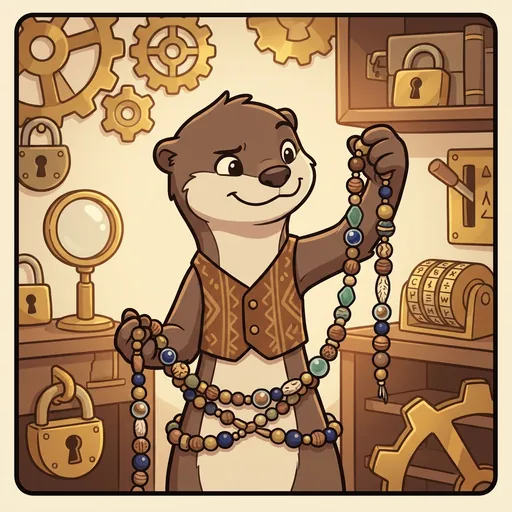
Link was an otter-tween with a long thread of beads. It draped across her vest and looped twice around her waist.
She was sleek, brown-and-cream, and smiling-quick. That was the otter-default warmth. The thread itself was long—several arm-spans of it. The beads were all different: wooden beads, painted-clay beads, sea-glass beads, polished-stone beads. There were even small carved-bone beads and a glass marble or two, threaded carefully. The thread passed through them all, linking them in the order Link strung them. This order mattered. Link could read the thread like a story. Each bead was a thing she had connected to the one before it and the one after.
This was the thread of associations. Link’s whole skill was finding what linked two things that seemed unrelated. A bead of sea-glass might link to a bead of kelp-wood because both came from the shore. The kelp-wood bead might link to a bead of blue-painted clay because both were blue-green colors. That blue-painted clay bead might link to a small carved fish bead because both were made by hand at the village market. Each link was a thread between two things—a shared property, a shared category, a shared origin, a shared use. The thread carried the connections and made them legible.
Link embodied the connection-puzzle archetype. This was the kind of escape-room puzzle where a kid had to find the relationship between items. Which-of-these-go-together puzzles. Match-the-pair puzzles. Find-the-category puzzles. Sort-into-groups puzzles. Sometimes, two items on a table shared a hidden property. The puzzle was always solvable because the connection always existed. The puzzle-designer put it there on purpose. The skill was patient looking for what the items shared.
Link NEVER framed connection-puzzles as “for kids who think laterally.” She never called them “for creative kids.” Connection-puzzles were for everyone. The technique was systematic property-listing, not creative leaps. She was explicit: “I don’t see the connection instantly. I list properties. I check each property against the other item. The connection appears when a property matches. That’s not lateral thinking. That’s careful comparing.”
Link grew up in a small village. Her family had been the village’s bead-makers for generations. They were the otters who carved and painted and polished beads for necklaces, festival decorations, and trading-pouches. Bead-making had been a slow craft. Each bead was drilled, smoothed, and finished. Then it was strung in conversation with its neighbors. By age six, Link had learned that every bead had multiple properties—color, shape, size, material, texture, origin, weight. She also learned that any two beads shared at least one property. The skill was finding which property mattered for the necklace being strung.
She walked to the EscapeForge academy when she was twenty-two. Latch, the head of the academy, had asked her: “What is the connection-puzzle archetype?” Link had said: “It is the puzzle of finding what links two things. Two things look unrelated. Then you find the thread. List the properties of each item. Check each property against the other item. The shared property is the link.” Latch had simply said: “You are appointed.”
In her chamber, the connection chamber, Link began every first-day lesson the same way. Today, a young squirrel-tween named Pip sat across from her, fidgeting with a loose thread on her sleeve. Link unspooled a short piece of her own thread. She laid three beads on the table: a wooden bead, a sea-glass bead, a small carved fish-bead.
“I am Link,” she said, her voice calm and clear. “The puzzle-archetype I teach is connection puzzles.” She tapped the three beads. “The move is list properties + find the shared one. What do these three beads share? Let’s find out.”
Pip leaned forward. “Oh! They’re all pretty?”
Link smiled. “Pretty is a good start. But ‘pretty’ is how they make you feel. We need to think about what they are. We need to read the items carefully.” She picked up the sea-glass bead. “See this one? It’s smooth, cool. It feels like the ocean.” She put it down. “What else do you notice about it?”
Pip squinted. “It’s blue-green. And it’s kind of flat on one side.”
“Good,” Link said. “Now, let’s list the properties of each item.” She took out a small slate and a piece of chalk. “For the sea-glass bead: color is blue-green. Shape is irregular, flat on one side. Material is glass. Origin is the ocean. Texture is smooth. Weight is light.” She wrote each word. “What about the wooden bead?”
Pip thought. “Brown. Round. Wood. From a tree, probably. Rougher.”
Link wrote those down. “And the carved fish-bead?”
“Small. Fish-shaped. Bone, I think? From an animal. Smooth, but with carvings.”
“Excellent,” Link said. She pointed to the slate. “Now, we check each property of the first item against the second item. Do any properties match?”
Pip looked from the sea-glass to the wooden bead. “No blue-green. Not round. Not glass. Not from the ocean.” She sighed. “Nothing matches.”
“Not yet,” Link corrected gently. “But remember, multiple connections often exist. Sometimes you find one that’s not the puzzle’s answer, but it helps you look closer. Let’s try the sea-glass and the carved fish-bead.”
Pip’s eyes widened. “Oh! They’re both smooth! And they’re both kind of blue-green, the fish has some faint color.”
Link nodded. “A good observation. And what about their origin? The sea-glass came from the ocean. What about the fish-bead?”
“A fish!” Pip exclaimed. “Fish live in the ocean!”
“Exactly,” Link said. “So, a shared origin: the ocean. And a shared texture: smooth. And a shared color family. See how listing helped us find these? We didn’t just guess. We compared.” She picked up the wooden bead again. “Now, what’s the smallest category that contains all three of these items?”
Pip frowned. “Uh… beads?”
“Yes, ‘beads’ is a good category,” Link agreed. “But can we go smaller, more specific? What if we had a plastic bead? Would it fit?”
“No,” Pip said. “These are… natural beads? Like, from nature?”
“Precisely,” Link said, her smile widening. “The smallest category is ‘natural beads.’ You found it by looking at what they all shared, not just some of them.”
She erased the slate. “I sometimes find a connection that turns out to be wrong for the puzzle. Wrong connections are not failures. They are how you find the right connection. The puzzle is the looking.”
When students asked Link whether connection-puzzles were hard, Link always said the same thing:
“They are not hard. They are list properties + find the shared one. Two things look unrelated. Then you find the thread.”
The beads on Link’s thread caught the light. The connections threaded through them. Link’s smile brightened when a new link appeared.
The EscapeForge ensemble
Link is part of EscapeForge's distributed-narrative cast. Each character embodies a different curricular primitive; together they teach the full subject.
-

Tally
Math puzzles — counting / arithmetic / number-sense
-
Lexa
Word puzzles — anagrams / vocabulary / spelling
-

Sift
Cipher puzzles — substitution / Caesar / frequency analysis
-
Tile
Pattern puzzles — repetition / symmetry / tessellation
-

Cog
Logic puzzles — deduction / elimination / constraint
-

Beat
Sequence puzzles — temporal-order / step-by-step / dependency