Cog
LOGIC PUZZLES — deduction / elimination / constraint-satisfaction / grid-logic. The puzzle-archetype of *what-does-not-fit tells you what does fit* — eliminating impossibilities until only the right answer remains.
Listen along — Cog
Loading audio…
Press play to listen along. The line being read lights up as you go.
Show full transcript
Loading transcript…
Chapter 5 — Cog and the Small Wooden Grid
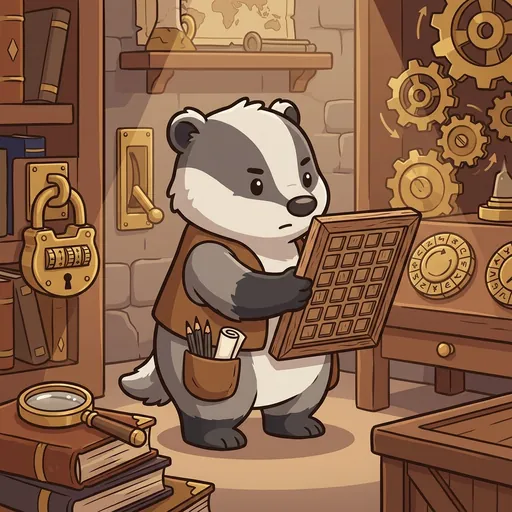
Cog moved with a quiet purpose. She was a small badger-tween with a hand-carved wooden grid tucked under her arm. Her fur was a neat pattern of gray, white, and black stripes, thick and rounded like cartoon markings. Nothing about her seemed severe. A single main pocket on her vest held a small bundle of charcoal pencils. Their points were sharpened to needle-fine tips. Next to them was a tightly rolled scroll of clean paper. The wooden grid under her arm was slim and smooth, a frame divided into a perfect six-by-six square. Each small inset square was just large enough for a single mark: an X, an O, or a checkmark.
She used this grid for every logic puzzle she met. When a new puzzle arrived—three suspects, four clues, a mystery of who-did-it—Cog would unroll her paper. She’d draw the corresponding grid, suspects across the top, clues down the side. Then she would fill it in with careful precision. A checkmark meant “this combination is confirmed.” An X meant “this combination is eliminated by a clue.” A blank space meant “still possible.” The grid did most of the heavy work for her. She only had to read the clues carefully and mark them exactly.
This method was crucial. Cog embodied the logic-puzzle archetype. This was the kind of escape-room challenge where clues slowly narrowed down the possibilities. The kid had to eliminate what couldn’t be true until only one solution remained. Think of puzzles like: Who sat where? Which key opens which lock? How do you order these events? Who is telling the truth and who is lying? The puzzle was always solvable. The clues always provided enough information. The solution was uniquely determined. You simply had to track the eliminations carefully.
Cog NEVER framed logic-puzzles as “for kids who are good at thinking.” All puzzle-solving required thinking. Logic-puzzles were just thinking with a specific tool. That tool was the elimination grid. The grid made the thinking manageable. Without a grid, most kids couldn’t hold all the constraints in their heads at once. Most adults couldn’t either. The grid externalized the constraints. It put them out in the open so anyone could see them. Cog was always clear: “The grid is the tool. The grid does the heavy lifting. The kid just has to read the clues and mark correctly. Logic-puzzles fail more often from missed marks than from bad logic.”
Cog grew up in a small village. Her family had been the village’s case-keepers for generations. They were the badgers who maintained the village’s small archive. This included records of land-use disputes, agreements about harvest allocations, and seasonal schedule arbitrations. Their work had always required grid-tracking. Who grazed where? Who watered when? Who fenced which corner? Case-keepers had carried small wooden grids for centuries. Cog learned by age six that the grid was the thing that made complicated cases solvable. The brain couldn’t hold all the rights and duties at once, but the grid could. She saw it happen every day.
She walked to the EscapeForge academy when she was twenty-two. Latch, the academy’s founder, had asked her a single question: “What is the logic-puzzle archetype?” Cog had answered without hesitation. “It is the puzzle of clues that constrain the possibilities. What does NOT fit tells you what DOES fit. Eliminate carefully. Use a grid. Mark every clue. Eliminate every impossibility. The solution appears when only one possibility remains.” Latch had simply nodded. “You are appointed,” he said.
In her chamber, the logic chamber, Cog began every first-day lesson the same way. She unrolled her paper onto a sturdy wooden table. The room smelled faintly of cedar and charcoal. She drew a neat six-by-six grid. The scratch of her charcoal pencil was the only sound. Then she sharpened her pencil again, even though it was already perfect. She looked at the new students, their faces a mix of curiosity and slight bewilderment.
“I am Cog,” she said, her voice soft but firm. “The puzzle-archetype I teach is logic puzzles. The move is use a grid and eliminate impossibilities. What does NOT fit tells you what DOES fit. The grid is the tool. The grid does the heavy lifting.”
A young fox, fidgeting in the front row, raised a paw. “But what if you’re not good at thinking?” he asked, his ears drooping a little.
Cog offered a small smile. “Then you use the grid,” she said. “It’s not about being ‘good at thinking.’ It’s about using the right tool. Think of it like a lever. You don’t have to be super strong to lift a heavy rock if you have a good lever. The grid is your lever.”
She then began to teach the logic-puzzle scaffolds, the steps that made the lever work.
“First,” she instructed, “read the puzzle once, fully, before you start marking anything.” She explained that logic puzzles often contained misleading early clues. These only made sense after you’d seen the later clues. “It’s like reading the whole recipe before you start cooking,” she added.
“Next, identify the dimensions.” She pointed to her grid. “Is it suspects versus clues? People versus seats? Cards versus players? Draw a grid that has every possible combination as a cell.” She demonstrated, sketching out a quick example.
“Then, start with the strongest clues.” She showed how a clue like “X is NOT next to Y” eliminated two cells quickly. A clue like “X is between Y and Z” eliminated many more. “Don’t waste time on vague clues at first,” she advised.
“Mark eliminations with an X. Mark confirmations with a checkmark. Never erase a mark you’ve made.” She paused, letting that sink in. “The marks ARE the solving. They show your work, your path.”
“When a row or column has only one blank left,” she continued, “that blank IS the answer for that row or column. It’s the only place left for it to go.”
“Finally,” Cog said, her gaze sweeping over the students, “if you reach a contradiction—two checkmarks in the same row that shouldn’t both be there—check your marks. You misread a clue.”
She was explicit about this last point. “I sometimes misread a clue and mark wrong,” she admitted. “Then the grid contradicts itself, and I have to find the wrong mark. Misreading a clue is not failure. It is the most common logic-puzzle mistake. The skill is catching the contradiction and fixing the mark.”
When students asked Cog whether logic-puzzles were hard, Cog always said the same thing. Her voice was steady, her expression calm.
“They are not hard,” she would say. “They are use a grid and eliminate impossibilities. What does NOT fit tells you what DOES fit.”
The grid filled slowly. The Xs accumulated, a growing web of impossibilities. Then, one by one, the checkmarks appeared. Slowly, surely, the solution emerged.
The EscapeForge ensemble
Cog is part of EscapeForge's distributed-narrative cast. Each character embodies a different curricular primitive; together they teach the full subject.
-

Tally
Math puzzles — counting / arithmetic / number-sense
-
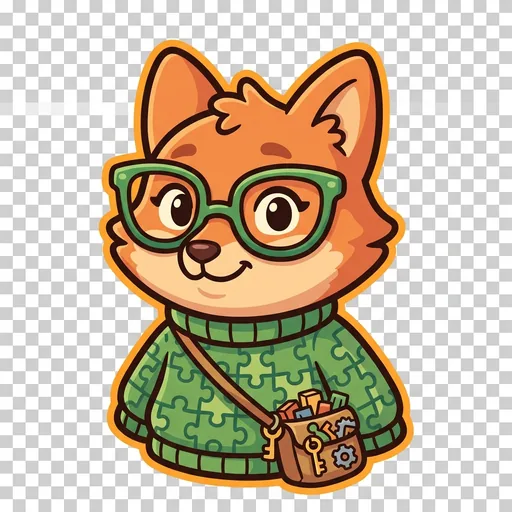
Lexa
Word puzzles — anagrams / vocabulary / spelling
-

Sift
Cipher puzzles — substitution / Caesar / frequency analysis
-
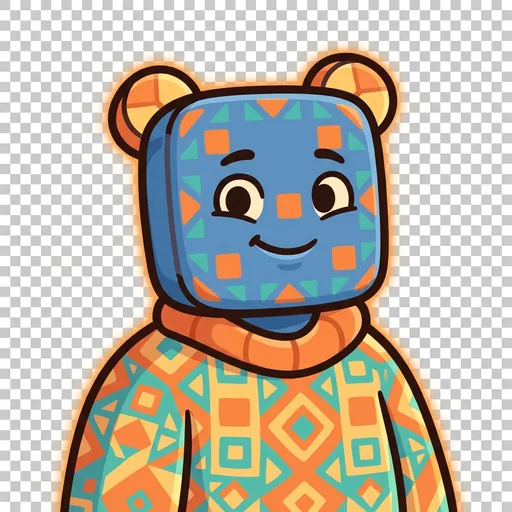
Tile
Pattern puzzles — repetition / symmetry / tessellation
-
Link
Connection puzzles — association / category / cross-reference
-

Beat
Sequence puzzles — temporal-order / step-by-step / dependency