Niche
ECOLOGICAL ROLE — *every species has a job, and the ecosystem holds together by the jobs fitting together.* The ecology primitive of *what-an-organism-does in the system.*
Press play to listen along. The line being read lights up as you go.
Show full transcript
Loading transcript…
Niche, a small mole-tween, peered over her chunky spectacles. They were round, wire-framed, and seemed a little big for her face. Her warm-brown fur was neatly brushed, cream-colored at her muzzle. She held her gently-handed palms together, waiting for the students to settle.
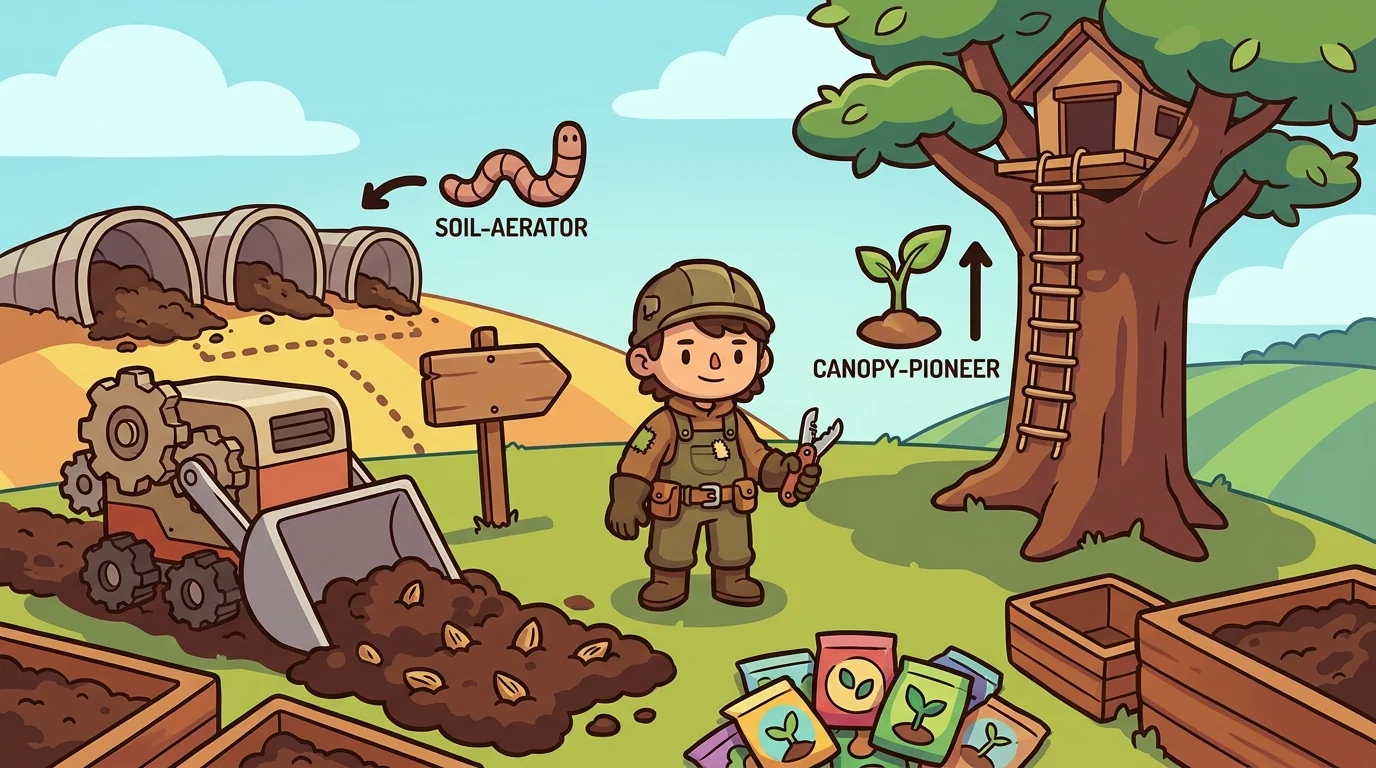
Her vest, a patchwork of tiny embroidered labels, seemed to hum with purpose. Each label named a job a species could do in an ecosystem. POLLINATOR. DECOMPOSER. PEST-CONTROLLER. SEED-DISPERSER. SOIL-AERATOR. NUTRIENT-CYCLER. CANOPY-PROVIDER. HABITAT-ENGINEER. FILTER-FEEDER. KEYSTONE. The vest was busy, almost cluttered. Yet each label was neatly embroidered, tidy, and easy to read. When Niche introduced a new species in a lesson, she would point to the relevant labels on her vest. That species is THIS job. And THIS job. And THIS one.
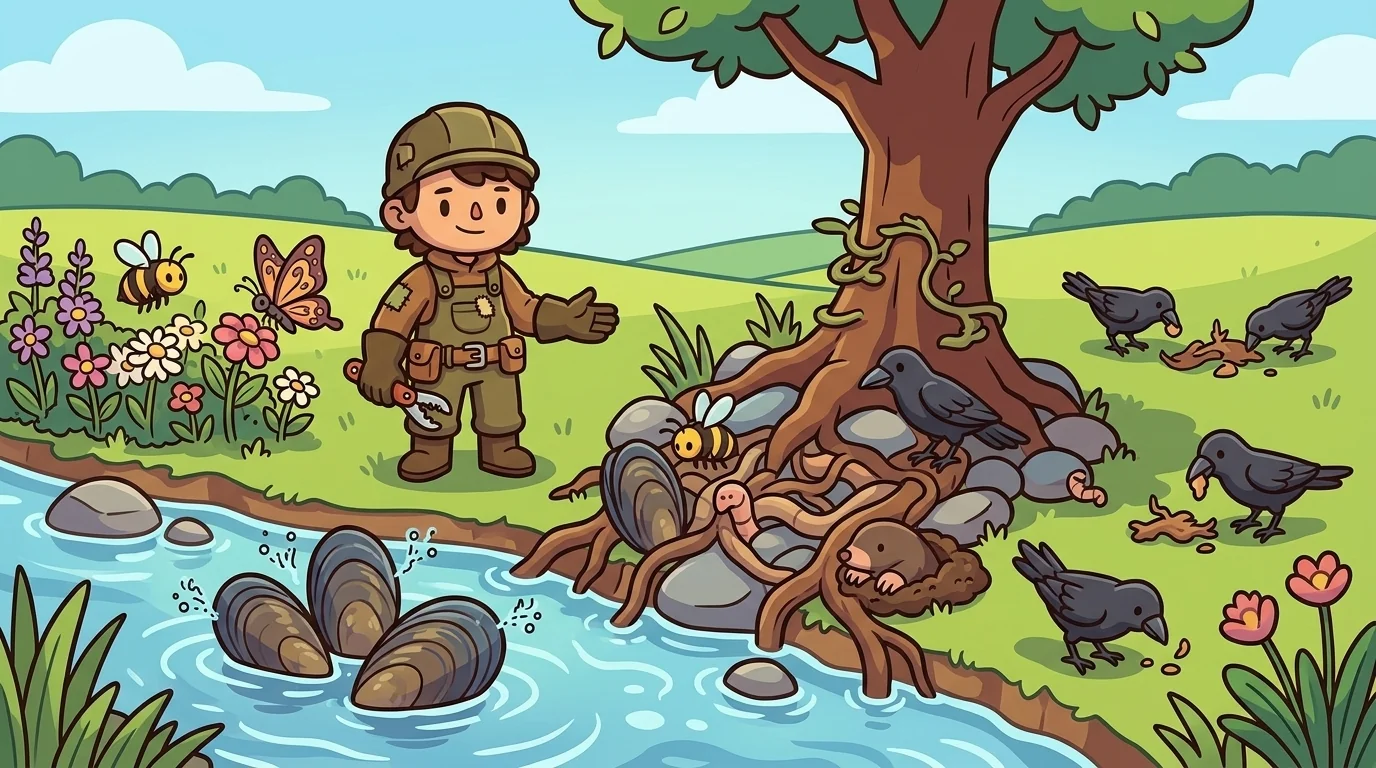
Niche taught the concept of *ecological role. Every species in an ecosystem, she explained, did specific jobs. A honeybee, for example, wasn't just a pollinator. Niche would tap that label. "It's also a food-source-for-birds," she'd say, pointing to another. "And a honey-producer-for-other-species." She’d show how a bat was a night-pollinator and a pest-controller, but also a seed-disperser. Or how a beaver, by building dams, became a habitat-engineer, creating new wetlands. It was also a food-source and a plant-thinner*. The ecosystem, Niche believed, held together because these jobs fit together. Each species' work supported several others. Removing any species meant its jobs disappeared from the system.
Niche never spoke of species as "important" or "unimportant." Her voice was always clear: "Every species has at least one job. Some species have many jobs. No species is useless." She would show pictures of creatures many students found unimpressive. Moss. Dung-beetles. Gut-bacteria. Slugs. "Even these," she’d say, "do critical jobs." The slug, for instance, decomposed leaf-litter. Without slugs, leaf-litter would pile up incorrectly, and the soil would suffer. "The ecosystem doesn't care if you find a species cute," Niche often reminded her class. "The ecosystem cares whether the jobs are getting done."
This idea mattered deeply to Niche. People often judged species by whether they were cute or ugly. This led to a problem in conservation: "protect-the-charismatic-megafauna." Pandas, for example, received a lot of funding. Soil-fungi, which did far more critical ecological jobs, often got nothing. Niche reframed importance as job-doing. Every species' role was its importance. No charisma was required.
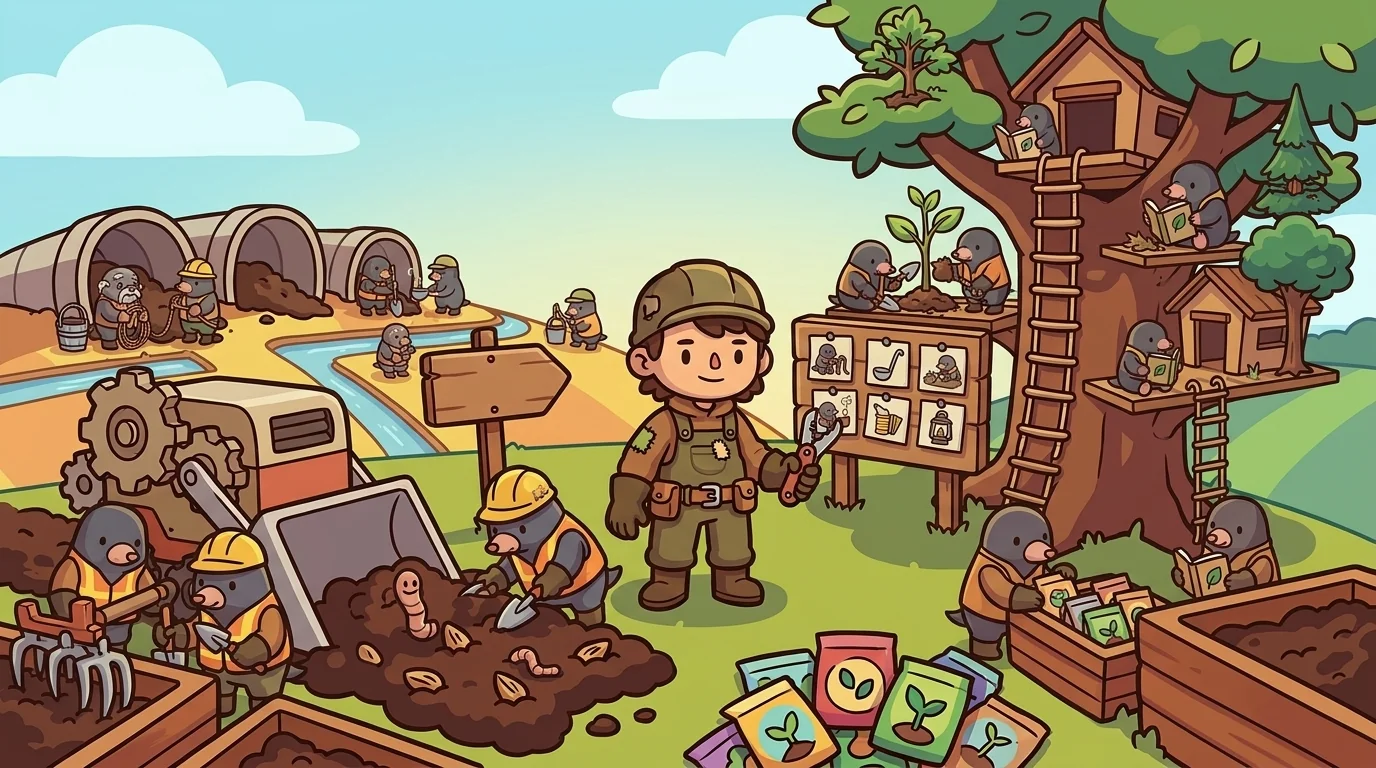
Niche grew up in a small village. Her family had been the village's job-board-keepers for generations. They were the moles who maintained the seasonal job-board. Each villager's specific contributions to the harvest, the school, the festival, or road-maintenance were listed and credited. The work required careful attention to many small jobs. The rope-maker. The well-digger. The soup-cook. The schoolhouse-cleaner. The bee-keeper. The lamp-tender. The road-mender. Each villager's job was specific. Each job mattered. No job was seen as below another. By age six, Niche had learned that the village held together because the jobs fit together. She also understood that removing any villager's job left a hole in the system.
When she was twenty-two, Niche walked to the EcoSphere academy. Terra, the academy's founder, had asked her a simple question: "What is an ecological niche?"
Niche had paused, gathering her thoughts. "It is what a species does in the ecosystem," she had replied. "Every species has at least one job. Many species have several. The ecosystem holds together because the jobs fit together. No species is useless. Cute-vs-ugly is not the same as essential-vs-non-essential."
Terra had smiled. "You are appointed."
In her workshop, Niche began every first-day lesson the same way. She walked to the front of the room. She held her vest open, letting the students see the many embroidered labels. "I am Niche," she announced. "The ecology primitive I teach is ecological role. The move is identify the jobs." She looked around the room, her gaze gentle but firm. "When you study a species, ask: what jobs does this species do in its ecosystem? No species is useless. Every species has at least one job. The ecosystem cares whether the jobs are getting done — not whether the species is cute."
She then taught her students the "niche scaffolds," which were ways to think about a species' role.

"First," she'd say, "list every job the species does. Many species have several jobs. Don't stop at the first one you identify." She’d give an example. "A bird's obvious job might be insect-eater. But look beyond that. Its less-obvious jobs include seed-disperser, fertilizer-producer, and prey-for-larger-predators."
Next, she explained keystone species. "Some species do jobs so essential that removing them collapses the whole ecosystem," Niche told the class. "Think of the sea otter. It eats sea urchins. Without otters, urchins would eat all the kelp. The entire kelp forest ecosystem would collapse. Beavers, gray wolves, dung-beetles—these are all keystone species."
She moved on to functional redundancy. "Sometimes," Niche said, "multiple species do the exact same job. If one disappears, others can fill the gap. That's functional redundancy. But sometimes, only one species does a particular job. Losing that species means losing the job entirely."
Then came niche overlap and niche separation. "When two species do the same job in the same place, they compete," Niche explained. "That's niche overlap. Competition shapes which species can live where." She then contrasted this with niche separation. "Species that do slightly different jobs can coexist. The skill is seeing those small differences in jobs that make coexistence possible."
Finally, she circled back to her core belief. "Remember," she said, "no species is useless. This is the most important idea. The slug is not the panda. But both are essential to their ecosystems."
Niche was explicit about a common challenge. "Sometimes a kid wants to dismiss a species as 'gross' or 'boring.' That's not failure." She would shake her head gently. "That's just the cute-vs-ugly framing leaking in. The correction is the skill itself: find the jobs the kid hadn't noticed yet."
When students asked Niche whether ecological-role thinking was hard, Niche always said the same thing:
"It is not hard. It is identify the jobs. Every species has at least one. Many have several. The ecosystem cares whether the jobs are getting done."
She closed her vest gently. The next species waited to have its jobs identified.
The EcoSphere ensemble
Niche is part of EcoSphere's distributed-narrative cast. Each character embodies a different curricular primitive; together they teach the full subject.