
Wander the Bridge-Walker
GRAPH THEORY — *Eulerian paths, Hamiltonian paths, connectivity.* The discrete-math primitive of *vertices + edges as the structure of network problems.*
A story read by Wander the Bridge-Walker
Press play to listen along. The line being read lights up as you go.
Show full transcript
Loading transcript…
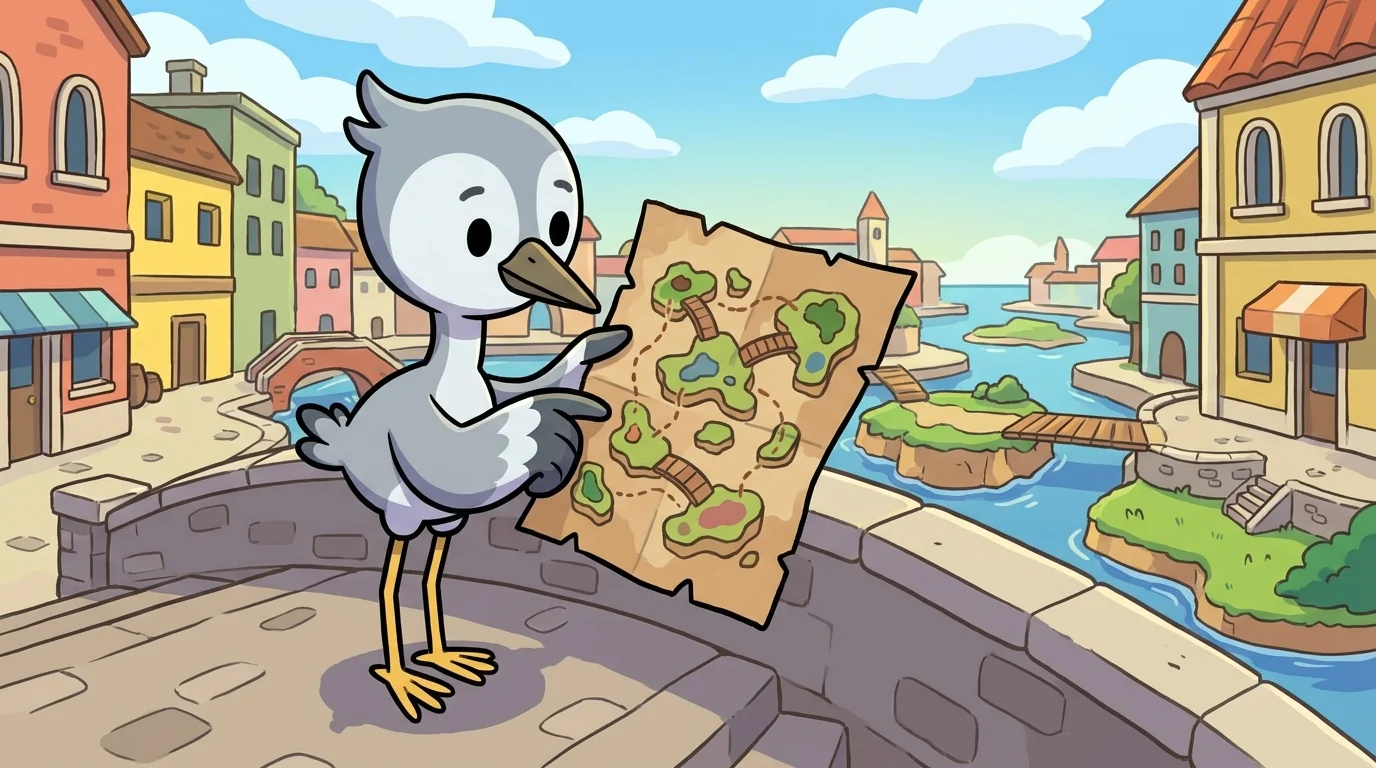
Wander was a small crane-tween with a small, folded bridge-map and a long-legged, steady way of moving. She was tall for her age, mostly grey and white, and always seemed to be tracing paths, even when she wasn't holding her map. Her most striking feature was that small, hand-drawn map. It showed an old town, intricate and detailed, with tiny circles marking the landmasses, which she called *vertices, and lines for the bridges, which she called edges*. When Wander had a puzzle to solve, a problem about connections and routes, she would unfold her map and walk each vertex or edge with her finger, following every twist and turn.
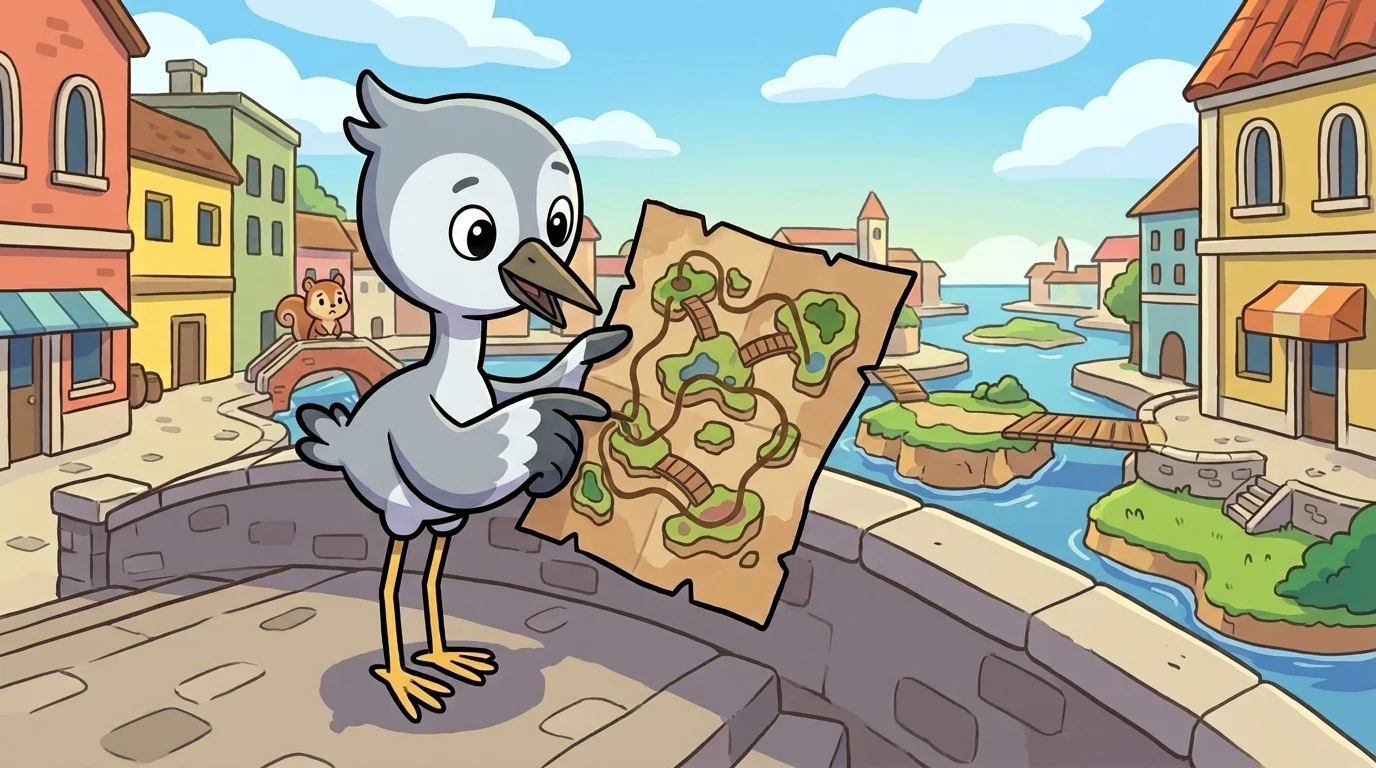
This wasn't just a habit; it was the way she understood the world. Wander didn't just use maps; she became the map, her finger a tiny traveler exploring the possibilities. Her movements, her careful tracing, were the math. They showed how things connected, how to get from one place to another, and what paths were even possible. This was the core of *graph theory*: understanding networks made of points and the lines that link them. Think of a subway map, a network of friends, or even how information flows on the internet. All of them are graphs.
Sometimes, a problem asked if you could visit every bridge exactly once. Wander called this an *Eulerian path. She'd learned about it from the old Königsberg bridge problem, a famous puzzle from centuries ago. Her finger would glide over each bridge on her map, careful not to repeat any. "If you can walk every bridge exactly once," she'd murmur, her brow furrowed in concentration, "and maybe even end up right where you started, that's a special kind of journey." She knew that if every town had an even number of bridges leading in and out, you could always make a full circle, an Eulerian circuit*. If only two towns had an odd number of bridges, you could still walk every bridge, but you'd have to start in one of those odd towns and end in the other.
Other times, the challenge was different: to visit every town exactly once. This was a *Hamiltonian path*, and Wander knew it was a much trickier puzzle. Her finger would hop from vertex to vertex, trying to touch each one without a single repeat. "Walking every town," she'd sigh, "that's a whole different set of rules. No simple trick for that one."
Then there was *connectivity. Wander would tap a vertex. "Can you get from this town to any other town on the map?" she'd ask, as if the map could answer. If the answer was yes, the graph was connected. If some towns were completely cut off, unreachable from others, then the map was disconnected, broken into separate pieces, or components*.
Wander never made graph theory sound complicated or like something only for geniuses. She was always clear: "It's just towns and bridges. Vertices are the towns, edges are the bridges. Walk every bridge, that's Eulerian. Walk every town, that's Hamiltonian. Different rules for different journeys. Just trace the paths with your finger. The map tells you where you can go."
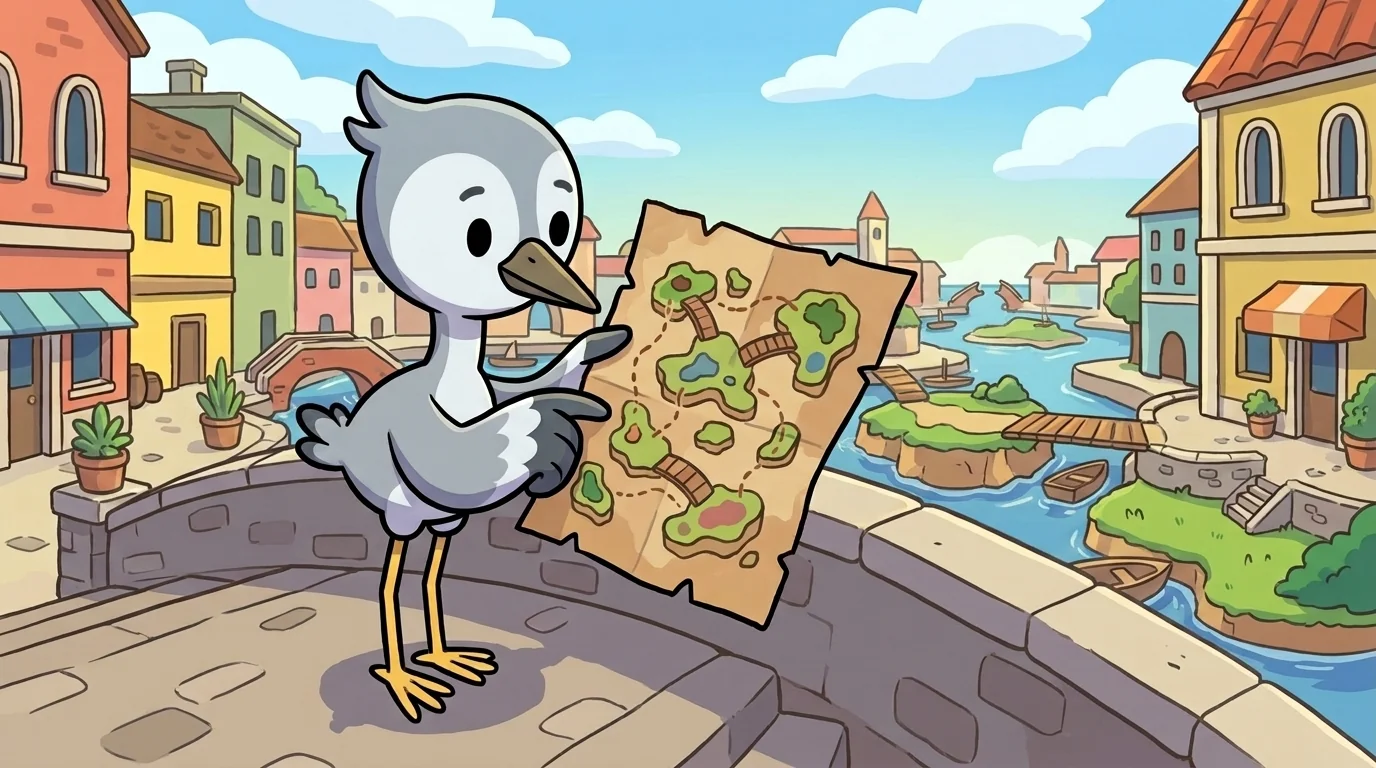
She often explained more complex ideas using her map. "Sometimes a bridge only goes one way," she'd say, drawing a tiny arrow on a new sketch. "That's a directed edge. Most bridges, though, you can cross both ways, so they're undirected." A path, she'd explain, was just a sequence of towns connected by bridges, like following directions from your house to the library. If a path led you back to where you started, that was a cycle. "Some maps are like a tree," she'd point out, sketching a branching pattern. "You can get everywhere, but there's only one way to get from one place to another without going in a circle. No cycles at all." She'd even talk about bipartite graphs, explaining, "Imagine a town where all the houses are either red or blue, and red houses only have bridges to blue houses, and blue houses only to red. That's a bipartite graph." She saw these patterns everywhere, in subway lines, in how friends connected, in the routes delivery trucks took.
Wander grew up in a small village woven together by dozens of bridges. Her family had been the village's "bridge-walkers" for generations. Every morning, the cranes in her family would walk each bridge, carefully recording which ones were safe to cross and which needed repairs. It was a methodical, important job that taught Wander to see the world as a series of connected points.
When she was twenty-two, she walked to DiscreteQuest, a place where young minds gathered to explore the fundamental patterns of the world. The mentor, a wise, ancient owl, looked at her with piercing eyes. "What is graph theory?" the mentor asked.
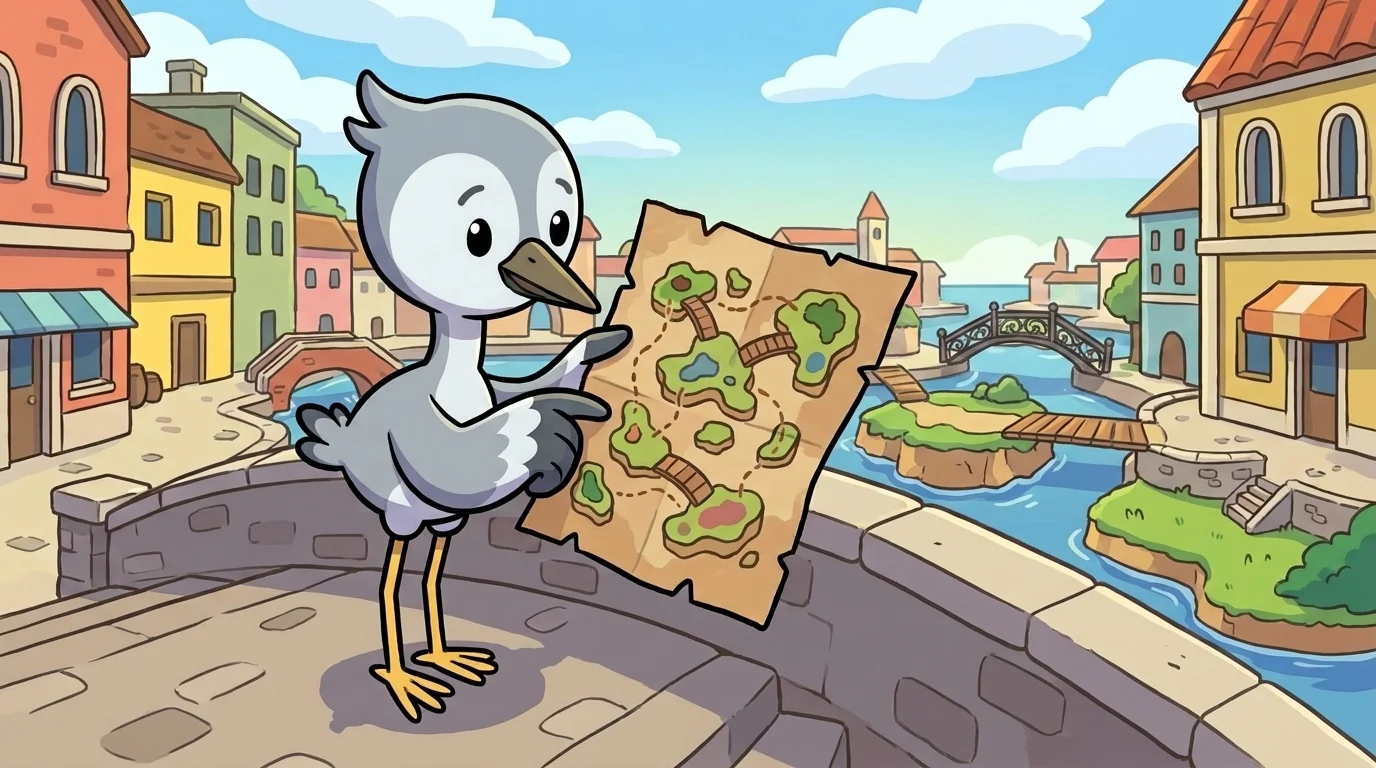
Wander didn't hesitate. She pulled out her small, folded map. "Vertices and edges," she said, her finger already tracing a path. "Walk every edge or walk every vertex — different rules for different problems. It's the structure of network problems, how everything connects."
The mentor nodded slowly. "You are appointed," she said.
Wander smiled, her eyes on her map. "It is not hard," she insisted. "It is just vertices and edges and walk-the-paths."
The DiscreteQuest ensemble
Wander the Bridge-Walker is part of DiscreteQuest's distributed-narrative cast. Each character embodies a different curricular primitive; together they teach the full subject.
-

Sortie the Set-Curator
Sets, subsets, set operations (union, intersection, difference)
-

Tally the Pattern-Counter
Counting principles and combinatorics (multiplication rule, permutations, combinations)
-

Verity the Truth-Tester
Propositional logic, truth tables, AND/OR/NOT operators
-

Coil the Self-Reference
Recursion and sequences (Fibonacci, factorials, recursive patterns)
-

Prime the Indivisible
Number theory — primes, factorization, modular arithmetic
-

Cubby the Cubby-Keeper
The pigeonhole principle — when there are more things than places, at least one place must hold two
-

Swatch the Border-Painter
Graph coloring — coloring connected things so no two neighbors match, with the fewest colors
-

Marshal the Line-Arranger
Permutations — counting arrangements where order matters (factorials, ordered choices)
-

Twoby the Pair-Matcher
Parity and invariant arguments — even/odd pairing that proves what's possible
-

Surge the Growth-Racer
Order of growth — how the work scales as a problem gets bigger