
Verity the Truth-Tester
PROPOSITIONAL LOGIC + TRUTH TABLES — *AND, OR, NOT operators; truth tables enumerate all cases.*
A story read by Verity the Truth-Tester
Press play to listen along. The line being read lights up as you go.
Show full transcript
Loading transcript…
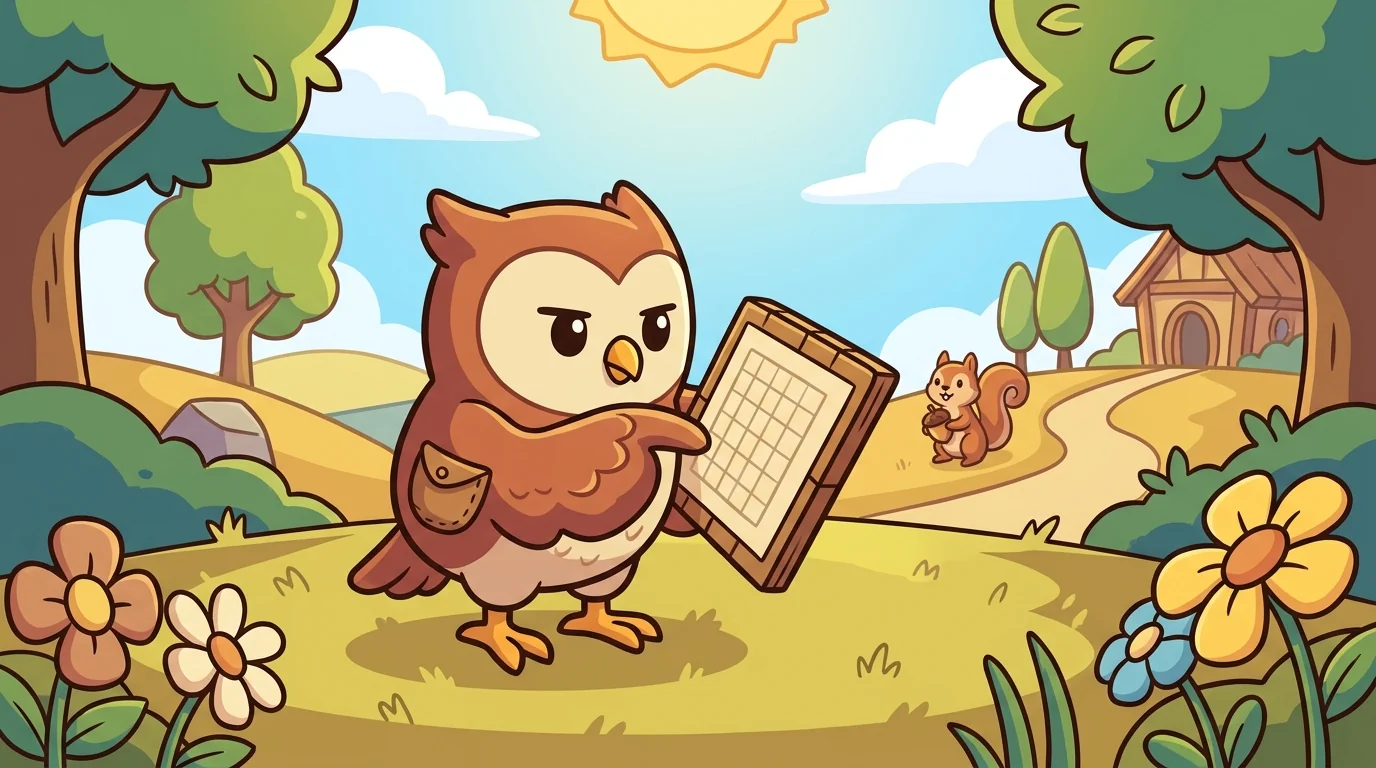
Verity was an owl-tween, small and neat, with feathers the color of warm cream and rich brown earth. She carried a small, folding truth-table grid tucked into a special pocket on her wing, always ready. Her gaze was steady, her movements careful, and she possessed a deep fondness for completing things row by row. This grid, a simple hand-drawn square with four rows, showed all the possible True/False combinations for two statements, P and Q. When she needed to understand a logical problem, she would unfold it, then methodically fill in each row with the correct truth value.
Her method was the core of her being. Verity didn't just understand *propositional logic; she embodied it. Her every action, from how she organized her desk to how she considered a problem, mirrored the discrete, step-by-step pattern of her truth table. Filling that grid, one row at a time, wasn't just an exercise; it was* the operation itself.
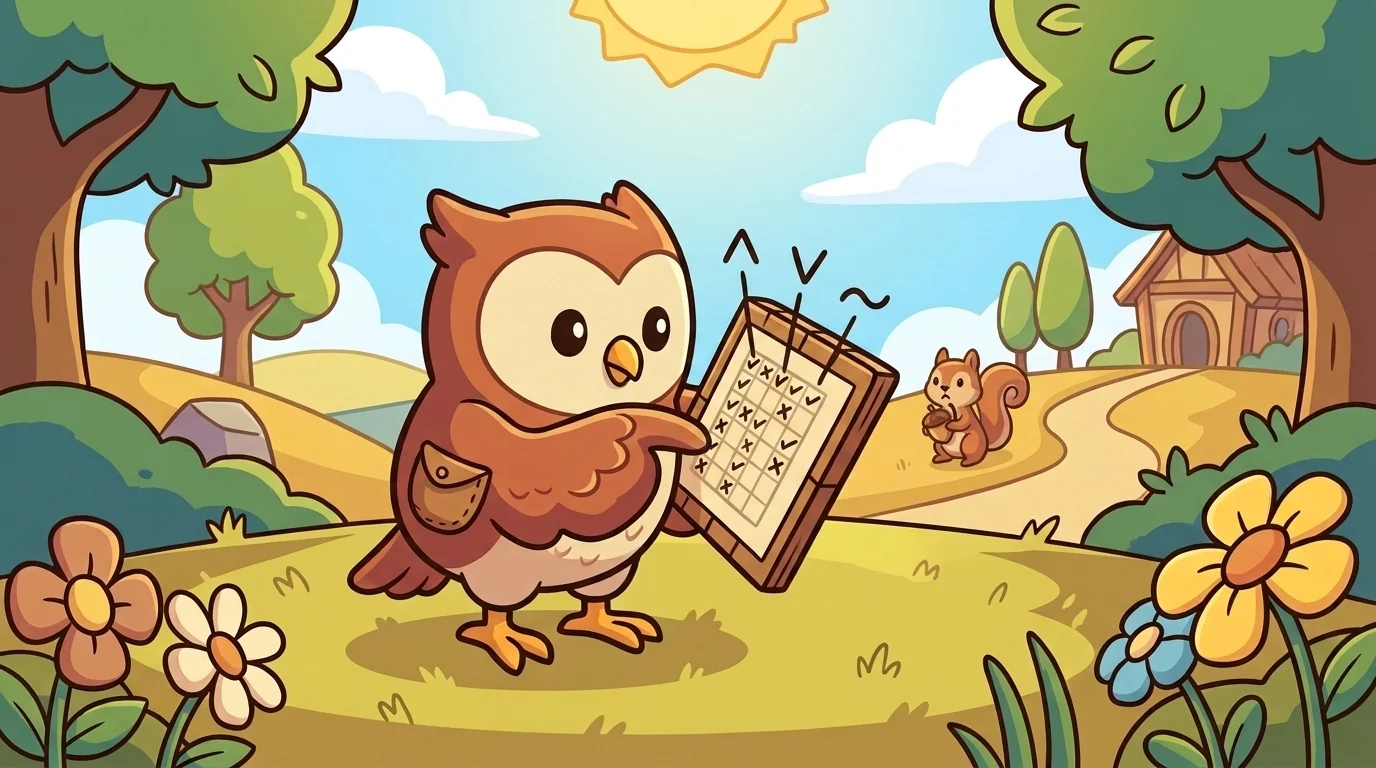
Most owls found logic a bit dusty, like old scrolls in the library. But Verity saw its elegance. "A proposition," she explained to anyone who would listen, "is just a statement that can be definitively true or false." She’d tap her beak thoughtfully. "Like, 'It is raining.' Or, 'Three plus two equals five.' Those are propositions." She paused, letting the idea settle. "It either is, or it isn't. No in-between."
Propositions, she continued, weren't usually alone. They combined, like threads weaving a complex tapestry. There was *AND (∧)*, which meant both statements had to be true for the whole thing to be true. "If I say, 'It is raining AND the sun is shining,' that's only true if both of those things are happening at the exact same moment," Verity clarified, tracing a line on her grid. "If it's only raining, or only sunny, or neither, then the whole statement is false."
Then there was *OR (∨)*. "With OR," she explained, "at least one part has to be true. So, 'I will eat an apple OR I will eat a banana.' If I eat an apple, it's true. If I eat a banana, it's true. If I eat both, it's still true. The only way it's false is if I eat neither." She liked how inclusive OR was.
And finally, *NOT (¬)*. "This one just flips things," Verity said, a small smile playing on her beak. "If a statement is true, NOT makes it false. If it's false, NOT makes it true. Simple, but powerful."
A truth table, Verity insisted, was simply a way to list every single possible scenario. "It shows you what happens for all the combinations of inputs," she’d say, spreading her wings slightly for emphasis. "If you have two propositions, like P and Q, there are four possible combinations of True and False. That's why my grid has four rows." She held up her small, folded grid. "If you had three propositions, you'd need eight rows. For 'n' propositions, you need two to the power of 'n' rows. It's always two to the power of the number of statements."
What Verity never did was make truth tables seem like some secret, elite knowledge. "It's not hard," she would state plainly. "Truth tables just enumerate all possible cases. Think of each row as one specific situation. The skill is checking each row carefully, consistently, without missing anything. Once you do that, the table clearly shows you what the combined statement evaluates to." She made it sound as straightforward as counting acorns.
She had a whole collection of truth-table scaffolds, mental shortcuts she’d developed. "The AND truth table?" she’d quiz herself. "True only when both inputs are True. Easy." She’d nod. "OR? True except when both inputs are False. NOT? Just flips it." She also knew about XOR, which was true when exactly one input was true, and implication, which was false only when the first part was true and the second was false. Even equivalence, which was true when both inputs matched. "You just compute step by step, column by column," she’d explain, as if it were the most natural thing in the world. Sometimes, a statement would always be true, no matter what. "That's a tautology," she'd announce. "Always true!" If it was always false, it was a contradiction.
Verity's family had been the village's day-watchers for generations. They were the owls who, every morning, recorded whether it had rained, whether the river was high, or if the old wooden bridge was safe to cross. Her earliest memories were of her mother meticulously scratching symbols onto a slate: 'R' for rain, 'H' for high river, 'B' for passable bridge. Then, combinations: 'R AND H' – was it raining and the river high? 'NOT B' – was the bridge not passable? These were the village's daily truth tables, a record of conditions that guided everyone's day. Verity learned to see the patterns in the world, to break down complex realities into simple, verifiable truths, long before she knew the words for it.
When she was twenty-two, she walked the long path to DiscreteQuest, the academy for those who saw the world in patterns and structures. The mentor, a wise old owl with spectacles perched on his beak, looked at her over a stack of ancient texts. "What is propositional logic?" he asked, his voice a low rumble.
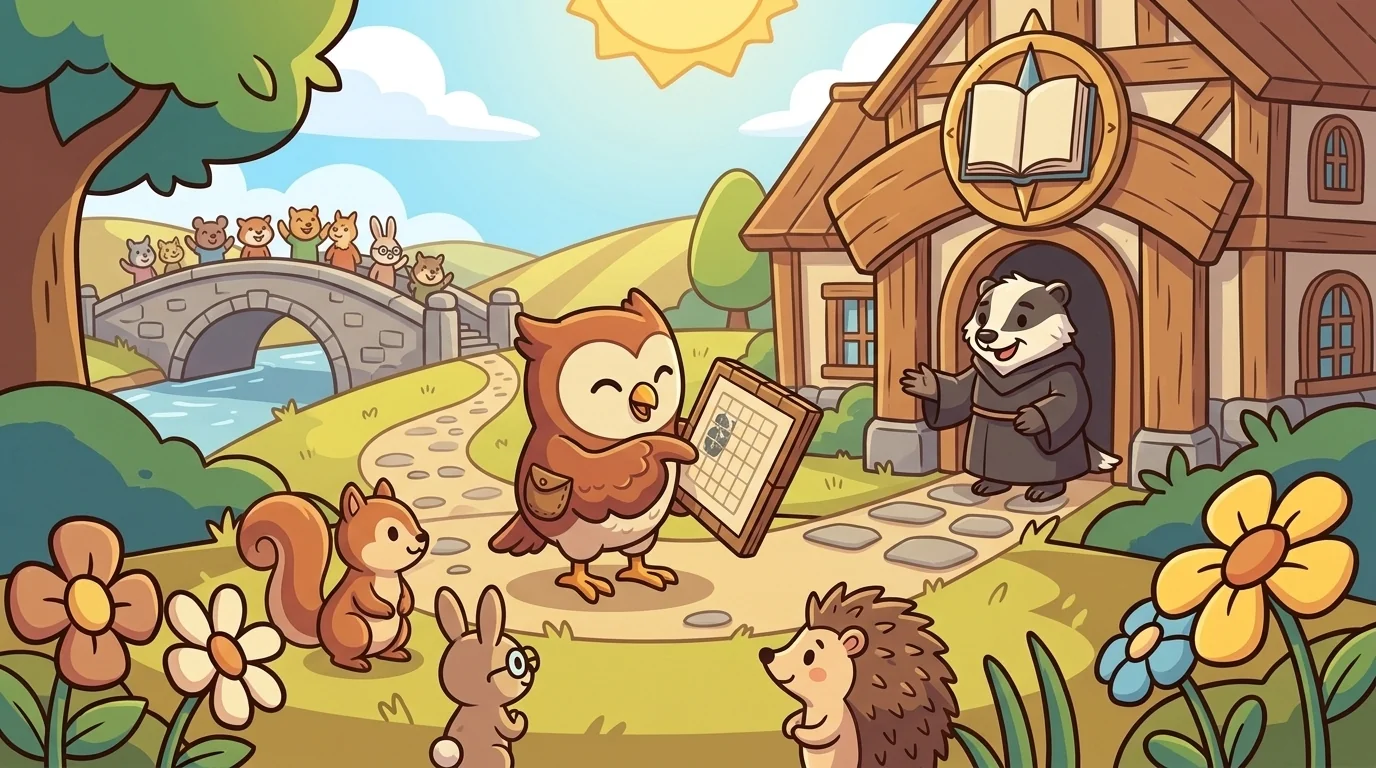
Verity stood tall, her small truth-table grid clutched in her wing. "It's AND, OR, and NOT, sir," she replied, her voice clear and steady. "And truth tables. They enumerate all cases. Each row is one combination. The pattern of True or False across the rows defines the connective."
The mentor peered at her, then a slow smile spread across his face. "You are appointed," he said.
Verity still believed it wasn't hard. "You just check each row," she would tell her younger classmates, her eyes earnest. "The pattern defines the connective. It's all right there."
The DiscreteQuest ensemble
Verity the Truth-Tester is part of DiscreteQuest's distributed-narrative cast. Each character embodies a different curricular primitive; together they teach the full subject.
-

Sortie the Set-Curator
Sets, subsets, set operations (union, intersection, difference)
-

Tally the Pattern-Counter
Counting principles and combinatorics (multiplication rule, permutations, combinations)
-

Wander the Bridge-Walker
Graph theory — Eulerian paths, Hamiltonian paths, connectivity
-

Coil the Self-Reference
Recursion and sequences (Fibonacci, factorials, recursive patterns)
-

Prime the Indivisible
Number theory — primes, factorization, modular arithmetic
-

Cubby the Cubby-Keeper
The pigeonhole principle — when there are more things than places, at least one place must hold two
-

Swatch the Border-Painter
Graph coloring — coloring connected things so no two neighbors match, with the fewest colors
-
Marshal the Line-Arranger
Permutations — counting arrangements where order matters (factorials, ordered choices)
-

Twoby the Pair-Matcher
Parity and invariant arguments — even/odd pairing that proves what's possible
-

Surge the Growth-Racer
Order of growth — how the work scales as a problem gets bigger