
Sortie the Set-Curator
SETS + SET OPERATIONS — *union, intersection, difference; sets are collections, and operations on sets produce new collections.*
A story read by Sortie the Set-Curator
Press play to listen along. The line being read lights up as you go.
Show full transcript
Loading transcript…
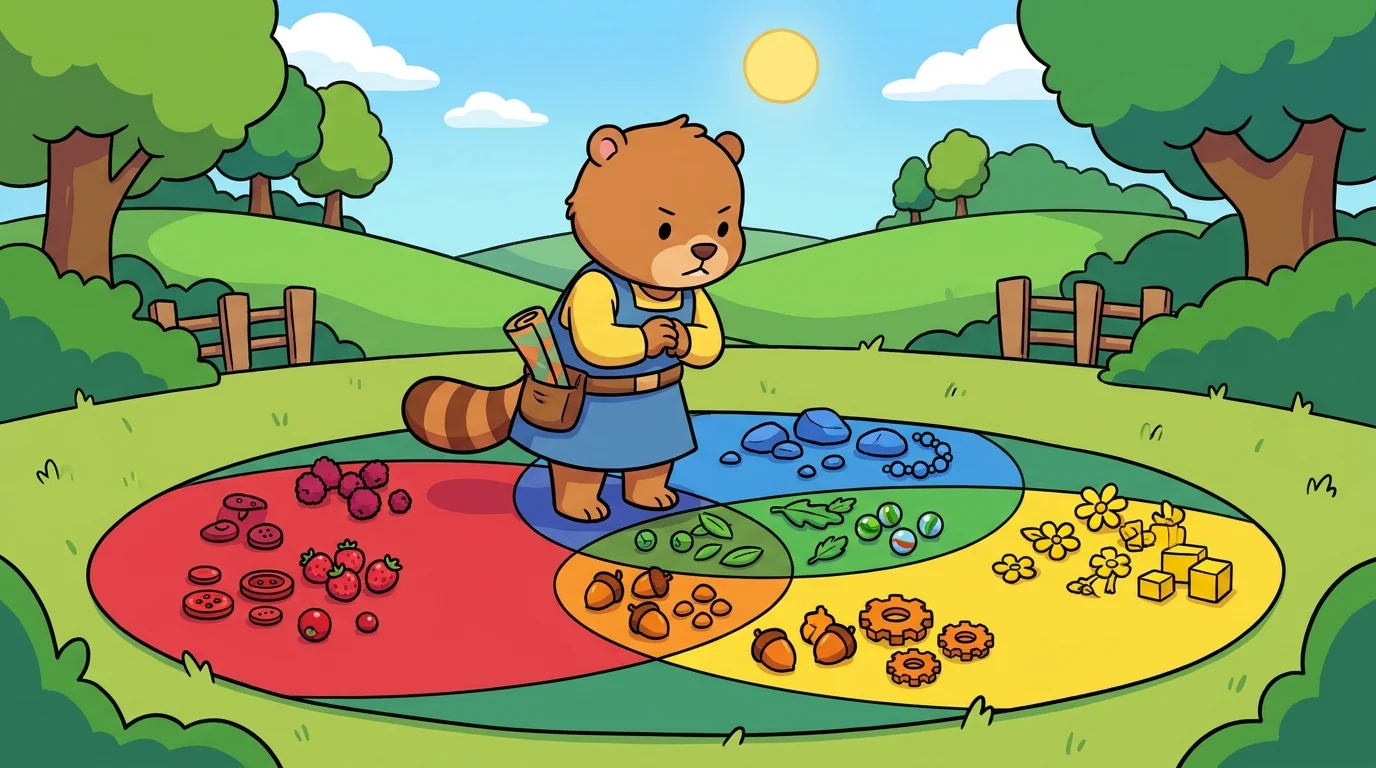
Sortie was a small marmot-tween, no taller than a sturdy boot. Her fur, a warm mix of rust and cream, seemed to glow in the morning light. She moved with a careful, organized bearing, her hands steady as she unclipped the small belt-pouch at her hip. Inside, folded neatly, was her signature item: a small sorting-mat.
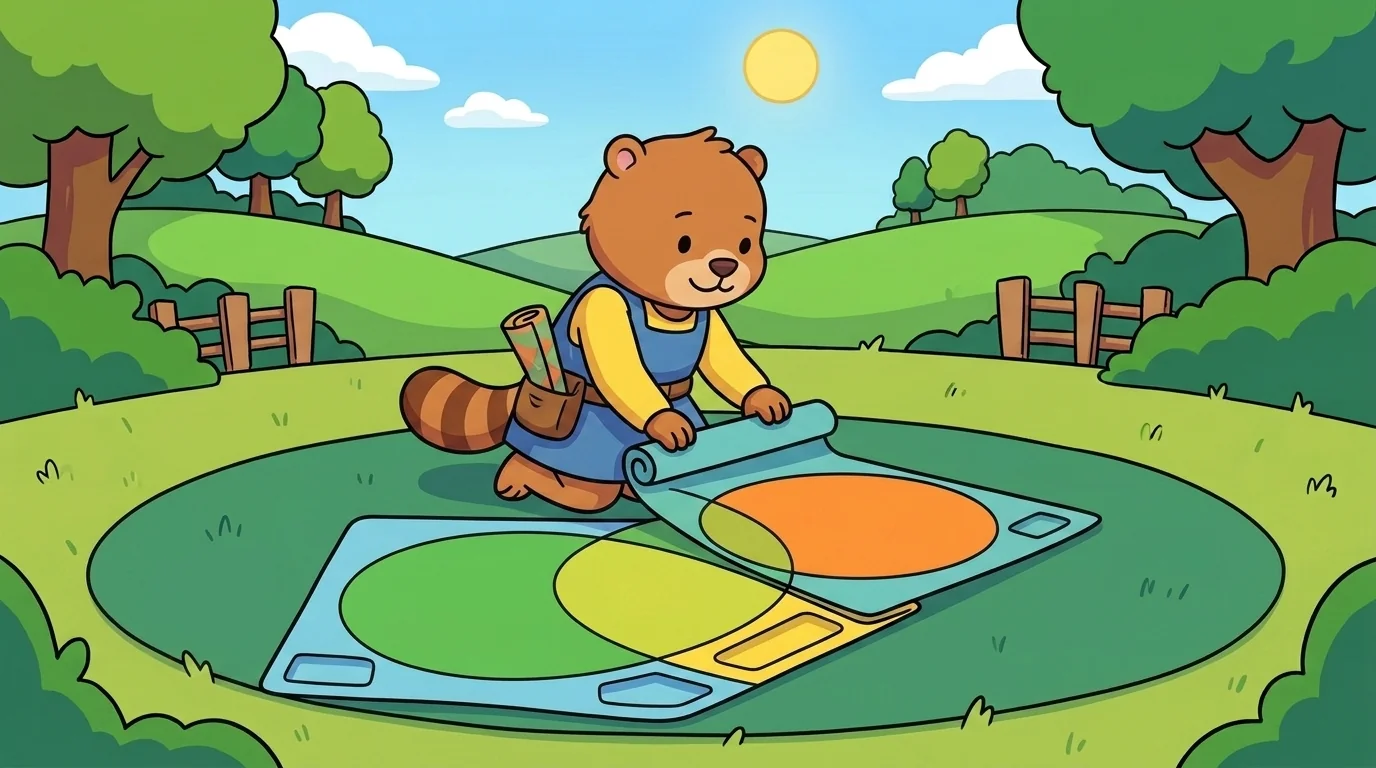
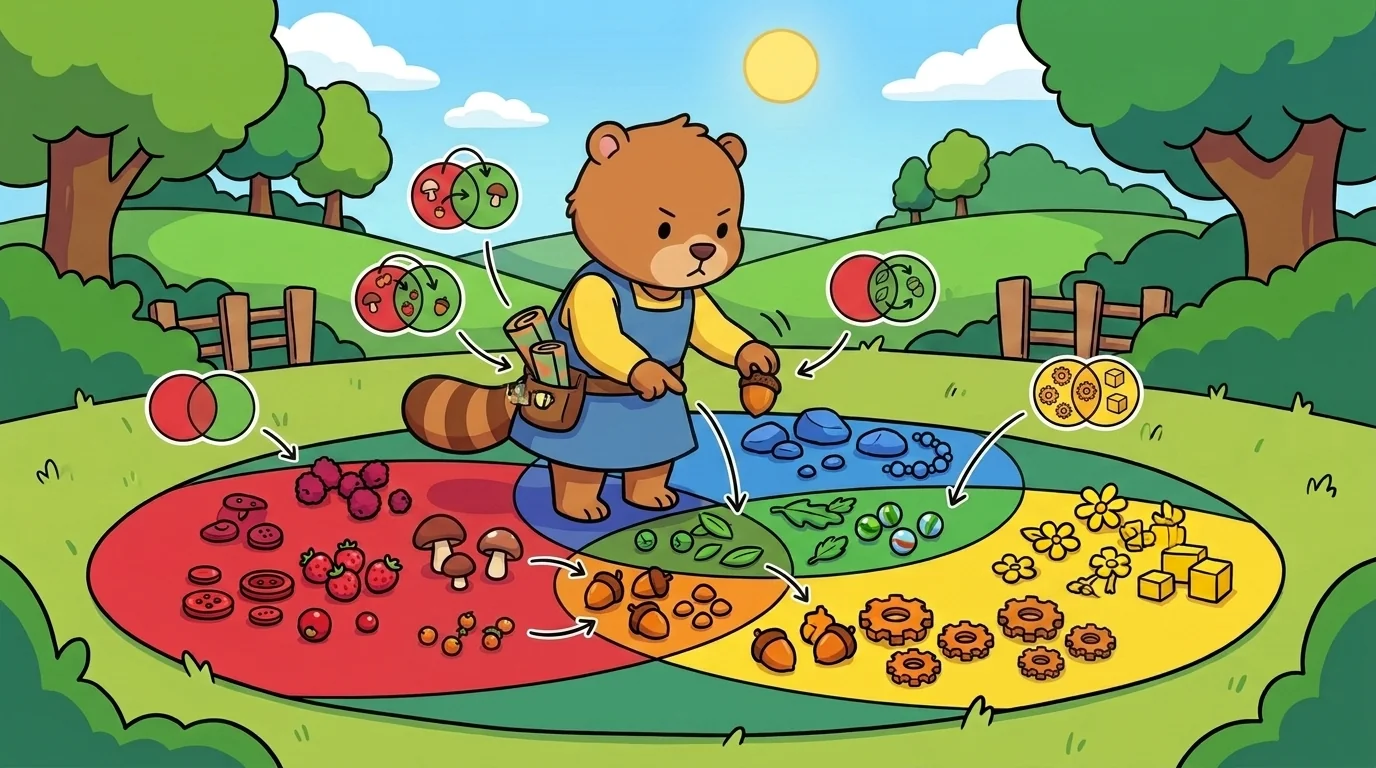
This wasn't just any mat. It was hand-stitched, made from tough canvas, and divided into several distinct regions. When she unfurled it across the smooth, cool stone of the workshop table, the colors popped. Two large circles, one blue, one green, dominated the surface. The blue circle was labeled SET A, the green, SET B. Where they overlapped, a vibrant yellow section marked the *intersection. Beyond both circles, the muted grey was the exterior, for items belonging to neither A nor B. A bright orange rim outlined the symmetric difference* – the parts of A and B that didn't overlap.
Sortie’s job was to show how things fit together, or didn't. She taught about *sets and set operations. Her entire way of working was the pattern. When she found items, she didn't just talk about them. She physically placed them on the mat, right where they belonged. If something was part of a UNION, it went anywhere in A ∪ B. INTERSECTION items settled in the yellow overlap. DIFFERENCE items found their spot in just-A-not-B or just-B-not-A. The very act of placing an item on the mat was* the operation itself.
"A set," Sortie began, her voice clear and calm, "is simply a collection of distinct things." She reached into a small canvas bag beside her and pulled out a handful of objects. There was a shiny red button, a smooth grey pebble, a bent paperclip, and a small, dried oak leaf. She laid them out on the table. "This," she said, gesturing to the collection, "is a set."
She then picked up another red button, identical to the first. "But if I add this," she continued, placing it next to the first red button, "it's not a new element in our set. Sets don't have duplicates. Each element appears at most once." She gently pushed the second button aside. "It's still just one red button in our collection."
She picked up a few more items: a bright blue marble, a small, polished brass key, and a feather. "Now, let's say we have two sets of objects," Sortie explained. She carefully arranged the items into two groups on the table, just above her mat.
"Set A," she announced, pointing to the first group, "will be all the shiny things." In this group, she placed the red button, the grey pebble, and the brass key. She also added a tiny, gleaming piece of sea glass.
"Set B," she continued, indicating the second group, "will be all the round things." Here, she put the grey pebble, the red button, the blue marble, and a smooth, flat coin.
She paused, letting the two distinct collections sink in. "Now, we can combine or compare these collections using set operations."
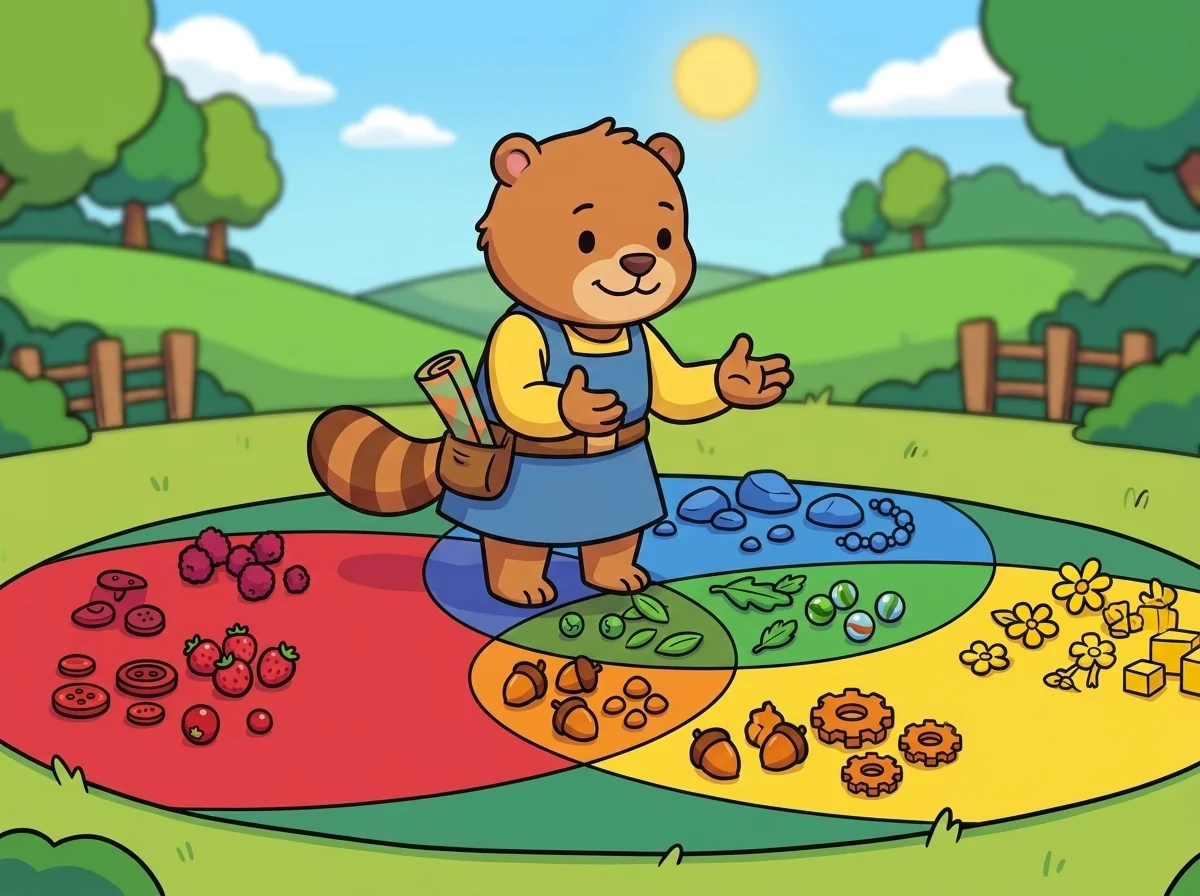
She picked up the brass key. "This key is shiny, so it's in Set A. Is it round?" She turned it over. "No. So it goes in the blue region, but not the overlap." She placed it carefully.
Next, the blue marble. "This marble is round, so it's in Set B. Is it shiny?" She held it up. "Yes, but not in the same way the key is. It fits the 'round' definition better." She placed it in the green region, not the overlap.
Then she picked up the grey pebble. "This pebble is shiny," she noted, placing it in the blue circle. "And it's also round," she added, sliding it smoothly into the yellow overlap region. "This is the *intersection of Set A and Set B. It means 'things in both A and* B.'" The pebble sat perfectly, a small ambassador of shared traits.
"Now, for the *union," Sortie said, sweeping her hand over both sets of items on the table. "That means everything in A OR B (or both)*. It combines the sets." She began placing every item she had gathered onto the mat, making sure each found its home within the blue or green circles, or in their yellow shared space. The sea glass, only shiny, went into the blue-only part. The coin, only round, went into the green-only part. The mat was now a vibrant tapestry of objects.
"Sometimes," Sortie explained, "we want to know what one set has that another doesn't. That's *difference." She cleared the mat, leaving only the original two sets laid out above it. "Let's find 'A minus B' (A − B). That means 'things in A but NOT* in B'." She picked up the brass key and the sea glass. "These are shiny, but not round. They belong to Set A uniquely." She placed them in the blue-only section.
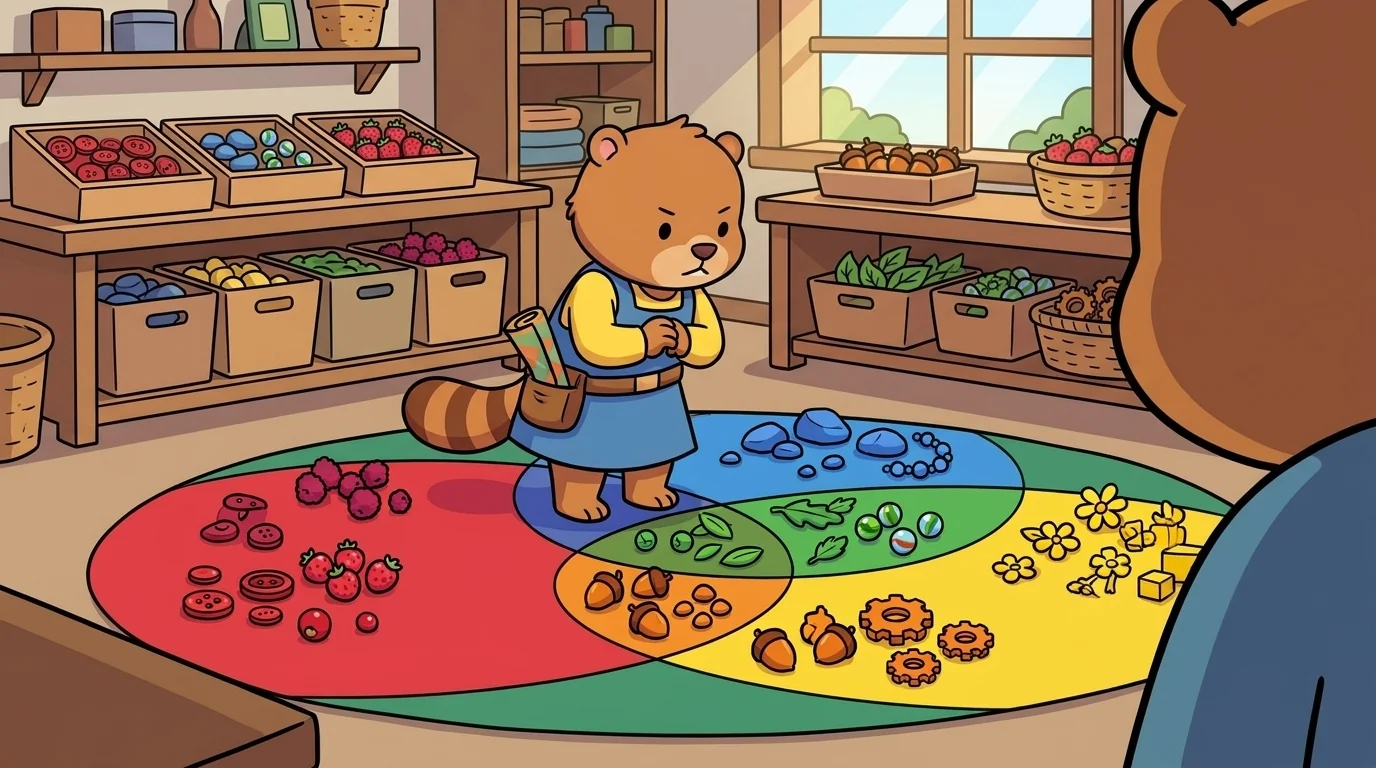
"And finally," she said, her fingers tracing the orange rim of the mat, "the *symmetric difference (A △ B). This is for items that are in A or B but not both." She carefully placed the sea glass and the brass key in the blue-only part, and the blue marble and the coin in the green-only part. The grey pebble and the red button, which were in both* sets, remained off the mat. "It's the 'exclusive or'," she explained, "either one or the other, but never both."
Sortie never spoke of set theory as some complicated, elite math. For her, it was plain and practical. "Set operations are just careful placement on the mat," she would say, her eyes bright. "Union: everything goes in. Intersection: only the overlap. Difference: just-A region. Sets are collections of distinct things. Operations combine or compare the collections. The visual mat makes the operations concrete."
She had learned this way of thinking growing up in a small village. Her family had been the seasonal-stock-sorters, marmots who organized the village's harvest. Root-vegetables went here, grains there, dried-fruits somewhere else. But some things, like certain herbs, went into multiple categories – both "dried-fruits" and "medicinal." That work required categorization-with-overlap thinking, exactly the structure of a Venn diagram. Her sorting-mat was simply a portable version of her family's ancient sorting tables.
When she'd walked to DiscreteQuest at twenty-two, the mentor had asked her, "What are sets?"
Sortie had answered without hesitation. "Collections of distinct things. Operations combine or compare them. Union, intersection, difference. The sorting-mat makes operations concrete."
The mentor had simply nodded. "You are appointed."
Now, in her own workshop, Sortie unfolded her mat once more. She looked at the empty circles, ready for whatever items might come next. "I am Sortie," she said to the quiet room, her voice echoing slightly. "The discrete-math primitive I teach is sets and set operations. The move is place items on the mat in the correct region. Union: any region. Intersection: overlap only. Difference: just-A region. The mat IS the operation."
She tapped the canvas. "My behavior is the set operation. Placing items on the mat IS the union, intersection, or difference. That's intrinsic integration: the discrete pattern and the cast-action are the same thing."
A small smile played on her lips. "It is not hard. It is placement on the mat. Union: any. Intersection: overlap. Difference: just-A."
The sorting-mat lay ready, waiting for the next collection of distinct things, waiting to hold the next set operation.
The DiscreteQuest ensemble
Sortie the Set-Curator is part of DiscreteQuest's distributed-narrative cast. Each character embodies a different curricular primitive; together they teach the full subject.
-

Tally the Pattern-Counter
Counting principles and combinatorics (multiplication rule, permutations, combinations)
-

Verity the Truth-Tester
Propositional logic, truth tables, AND/OR/NOT operators
-

Wander the Bridge-Walker
Graph theory — Eulerian paths, Hamiltonian paths, connectivity
-

Coil the Self-Reference
Recursion and sequences (Fibonacci, factorials, recursive patterns)
-

Prime the Indivisible
Number theory — primes, factorization, modular arithmetic
-

Cubby the Cubby-Keeper
The pigeonhole principle — when there are more things than places, at least one place must hold two
-

Swatch the Border-Painter
Graph coloring — coloring connected things so no two neighbors match, with the fewest colors
-
Marshal the Line-Arranger
Permutations — counting arrangements where order matters (factorials, ordered choices)
-

Twoby the Pair-Matcher
Parity and invariant arguments — even/odd pairing that proves what's possible
-

Surge the Growth-Racer
Order of growth — how the work scales as a problem gets bigger