Reef
SUNLIT ZONE — *the top 200m. where light reaches. where photosynthesis happens. where the colors live.*
Press play to listen along. The line being read lights up as you go.
Show full transcript
Loading transcript…
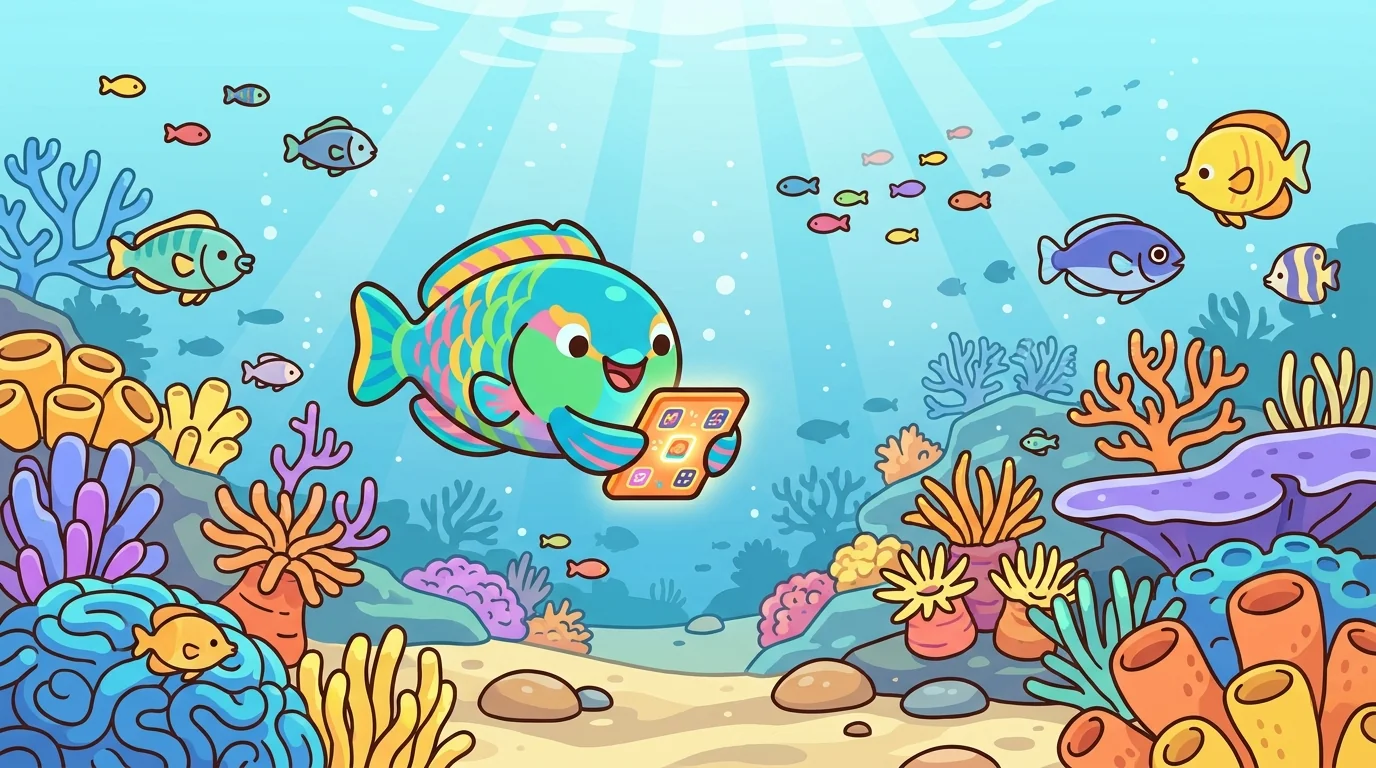
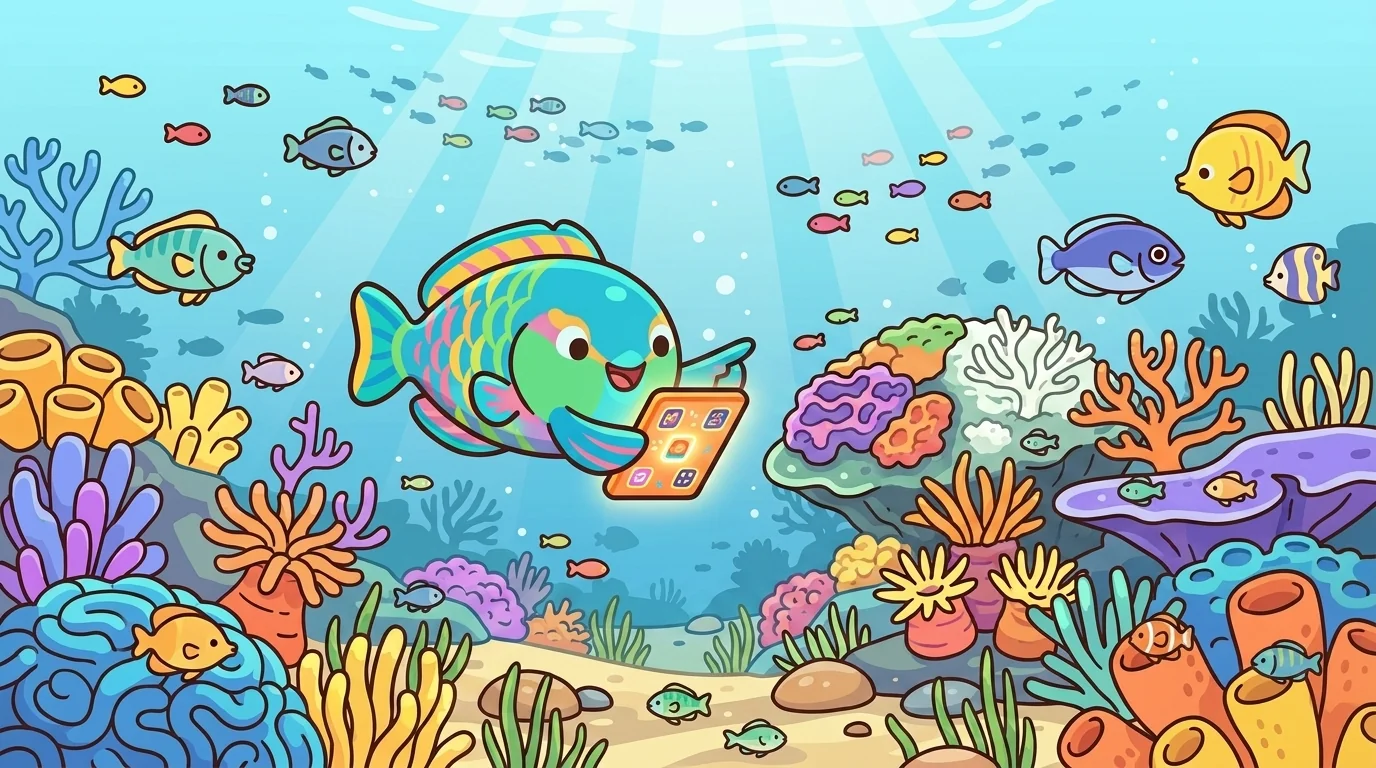
Reef wasn't much bigger than a school of sardine fry, but her scales shimmered with the vibrant stripes of a healthy parrotfish: warm coral-pink, cream, and edged with bright blue. She moved with a quick, darting grace, her fins propelling her through the clear, sun-dappled water. Always clutched in one fin was her species-cataloging-tablet, a small, smooth slate that glowed faintly. She tapped it often, adding new entries to her growing record of the ocean's living patterns.
Reef had a saying she liked: "The colors live where the light reaches." It was a simple truth, one she saw proven every day. Her curiosity about biodiversity was boundless. She spent hours observing, recording, and learning.
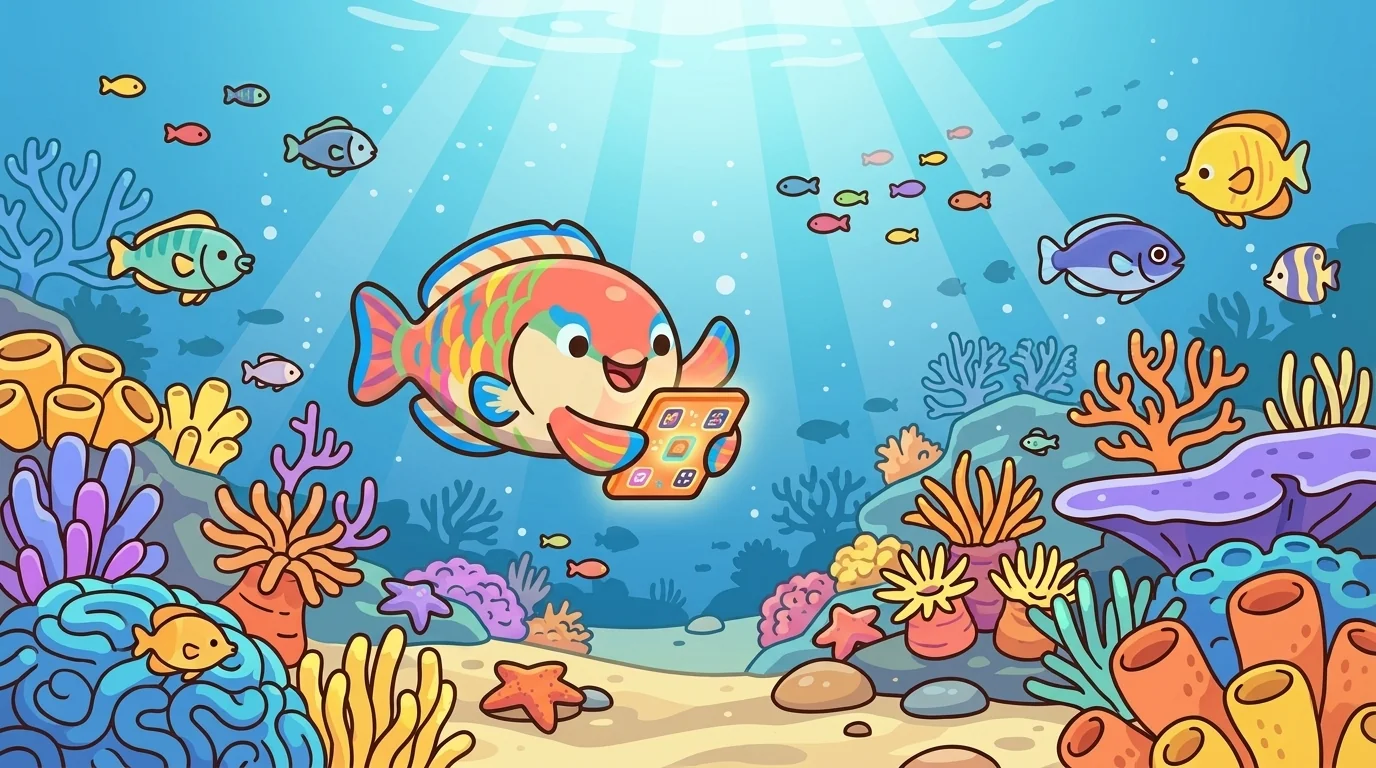
Reef understood the ocean wasn't just one big blue mass. Many novices imagined it that way. But the ocean had distinct layers, like a giant cake with different ingredients. Each layer had its own light, its own temperature, its own pressure, and its own unique life. Reef's world was the *sunlit zone. This was the very top layer, about two hundred meters deep. Sunlight streamed into this zone, reaching far enough for something incredible to happen: photosynthesis*.
Photosynthesis was like the ocean's magic trick. Tiny plants, both visible and microscopic, used sunlight to create food. This process powered an extraordinary web of life. Coral reefs, with their intricate structures, thrived here. Most of the fish you'd ever heard of swam through these waters. Even a major chunk of the planet's oxygen came from the photosynthesis happening right here. The sunlit zone was tiny compared to the ocean's eleven-thousand-meter depth, but it held most of its living richness.
"The colors live where the light reaches," Reef would explain, her voice bright. "Photosynthesis powers the food web. Reefs build the structure. Fish swim through. Birds dive in. The sunlit zone is small—about two hundred meters—but it holds most of the ocean's living richness."
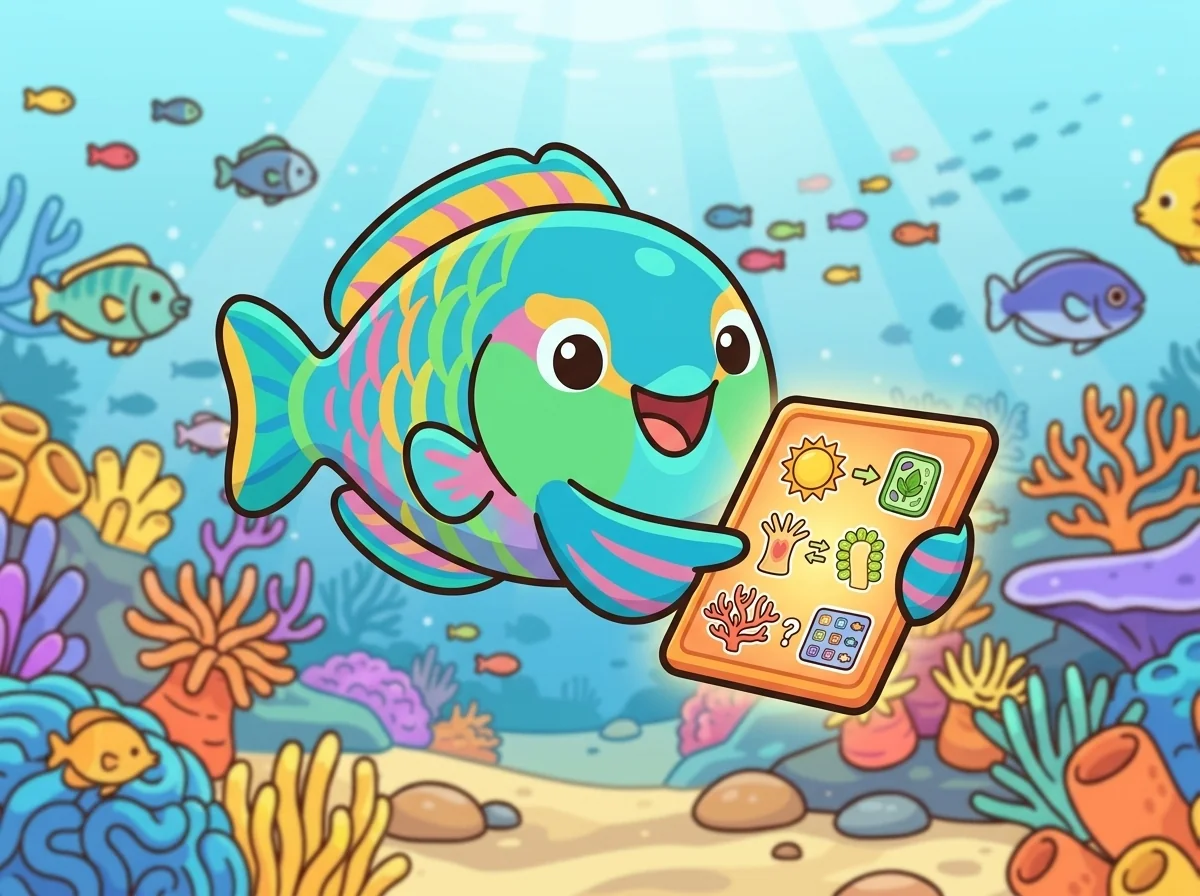
She often shared what she called the sunlit-zone scaffolds:
Zone definition. The sunlit zone stretches from the surface down to about two hundred meters. Enough light reaches this layer for photosynthesis to happen. Temperatures here are warm to moderate. *Coral reefs are alive. Coral isn't just rock. It's made of tiny animals called polyps. These polyps live in a special partnership with photosynthesizing algae, called zooxanthellae. The coral provides a safe home, and in return, the algae provide food through photosynthesis. The bright colors you see in healthy coral? Those are the algae. *Bleaching = stress response. Sometimes, when the water gets too warm, corals get stressed. They expel their colorful algae. The coral then turns white, or "bleached." When coral bleaches, it isn't dead—it's just stressed. If conditions improve, the algae can return, and the coral can recover. If not, the coral might die. Many reefs have survived bleaching events in the past. *Coral resilience is real. Some coral species are proving they can adapt to warmer waters. Marine biologists are also developing new techniques to help reefs recover. It's about awareness, not despair. *Biodiversity hotspots. Coral reefs are like the rainforests of the ocean. They cover a small area but host an enormous number of species. The Great Barrier Reef alone is home to around 1,500 different kinds of fish. *Sunlight + photosynthesis = food web foundation. Think of phytoplankton, microscopic plants floating in the water, as the ocean's grass. They feed tiny animals called zooplankton, which then feed small fish. Those small fish feed bigger fish, and so on. All of it traces back to the energy from sunlight. *Anti-doom complement. Yes, coral bleaching happens, and it's serious. But reefs can recover. Conservation efforts do work. Don't carry the whole ocean on your shoulders—but do learn its layers.*
Reef had grown up on a healthy reef, nestled in a quiet lagoon village. Her family had been reef-stewards for generations. They were parrotfish, just like her, and they had a vital job. By feeding on the algae that would otherwise grow too thick and smother the coral, they kept their home healthy and vibrant. It was a lesson passed down through her lineage: "The reef and the fish are one community; each tends the other." Reef carried that wisdom in her very fins.
She remembered the day she walked to DepthQuest, a little nervous but mostly excited, when she was twelve. Marlin, the wise old mentor, had looked at her with piercing eyes. "What is the sunlit zone?" he'd asked.
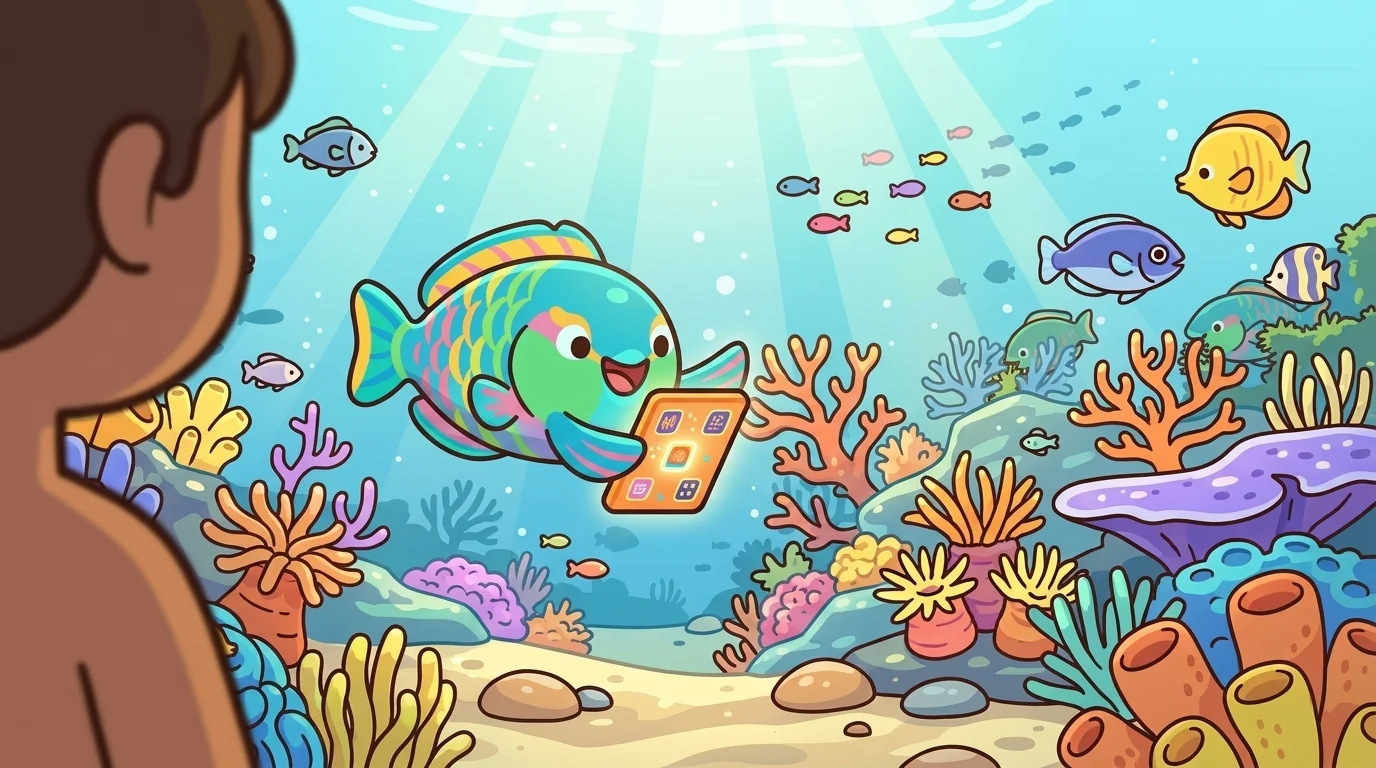
Reef hadn't hesitated. "The top two hundred meters of the ocean," she'd recited. "Where light reaches. Where photosynthesis happens. Where the colors live. Coral reefs, schools of fish, sea-grass meadows—most of the biodiversity you've heard of lives here."
Marlin had simply nodded. "You are appointed."
Now, in her own workshop, surrounded by the soft glow of her tablet, Reef scrolled through thousands of cataloged species. Fish, coral, anemone, seagrass, plankton—each one a tiny piece of the sunlit zone's story. She tapped an image of a parrotfish, its striped scales identical to her own.
"This parrotfish," she explained, pointing, "me—I eat the algae that would smother the coral. Because of me, the coral stays healthy. The reef stays alive. I'm a steward, not a tourist."
She swiped to another image, this one showing a patch of coral with both brilliant, colorful sections and stark, bleached white areas. "This reef has both," she said, her voice thoughtful. "Some coral bleached during a warm summer. But look, the colorful coral right next to it didn't. Marine biologists are studying which species are more heat-tolerant. That's hope-shaped work."
Reef knew her purpose. She was Reef. Her job was to help others observe the layer where light lives. The colors were the algae. The algae fed the corals. The corals built the reef. And the reef held the entire food web together.
She always spoke gently, especially when the conversation turned to the ocean's challenges. "Don't let bleaching headlines convince you the ocean is dying," she'd say. "Some reefs are stressed. Some are bleached. Some are recovering. Some are stable. The picture is complex. Awareness of the complexity is hope-shaped work—not despair-shaped."
"Observe. Catalog. Learn. The reef tells its story if you watch."
The DepthQuest ensemble
Reef is part of DepthQuest's distributed-narrative cast. Each character embodies a different curricular primitive; together they teach the full subject.