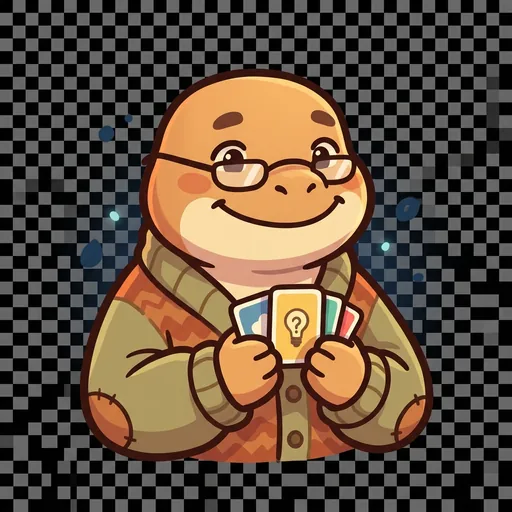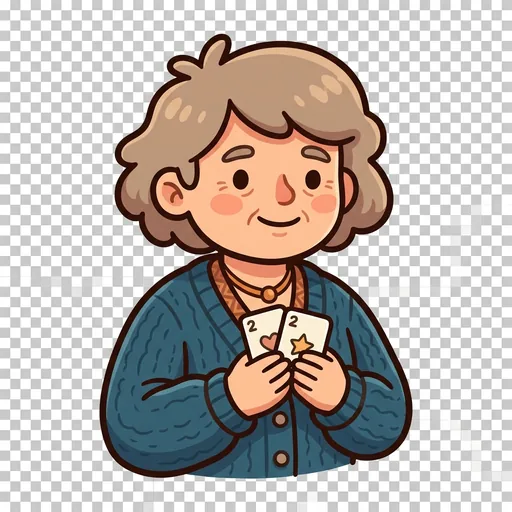
Auntie Audrey
BIDDING WISDOM — when to commit and when to pass. patience reads the table; rashness loses the contract.
Listen along — Auntie Audrey
Loading audio…
Press play to listen along. The line being read lights up as you go.
Show full transcript
Loading transcript…
Chapter 2 — Auntie Audrey and the Patience That Reads the Table
Around the kitchen table, four players had their cards fanned tight against their chests, and Auntie Audrey was knitting.
Her needles clicked, slow and even. She was the oldest one there — a small grey-and-cream badger in a flowered shawl, a worn scorebook resting on her knees — and it was her turn to speak. Everyone waited. A younger player across the table drummed his fingers, sure he knew what she’d do.
“You’ve got a monster hand, Auntie,” he said. “Big cards. You should shoot for everything.”
Auntie Audrey didn’t look up from her knitting. She was listening — not to him, but to the whole game so far. The way her partner had spoken. The way the others had stayed quiet. A whole conversation lived in what had already been said, and in what hadn’t.
“My cards are only half the story,” she said gently. She laid down one card — a small, careful commitment, not the wild swing the boy expected. “There. That tells my partner what I truly have. No more, no less.”
The boy blinked. “But you could’ve promised so much more.”
“I could have,” she agreed, needles still moving. “And if my partner can’t back it up, we’d have promised a thing we can’t do — and lost the whole hand.” She finally looked at him, warm and clear. “Winners aren’t the boldest at the table. They’re not the most timid, either. They’re the ones who read first, then commit. Watch how the hand goes.”
The hand went exactly as she’d read it. Her small, honest promise let her partner answer honestly back, and the two of them fit their cards together like a hand into a mitten. The boy, who’d bid loud and early in an earlier round and gone crashing down, sat very still.
Auntie Audrey had learned patience the hard way, a long, long time ago.
Her family were watchers — badgers who sat at the edge of the village and paid attention across whole seasons: who traded fairly, whose plans came due, which partnerships held and which fell apart. When Audrey was small, she thought watching was boring. She wanted to be in the middle of things, deciding fast, being right out loud.
So one market-day she blurted a big prediction to the whole village square before she’d finished looking. She was so sure. She was so eager. And she was wrong — loudly, in front of everyone — and her ears burned so hot she wanted to dig straight down into the ground and never come up.
Her grandmother found her there, hunched behind the stall, small with shame.
“You feel foolish,” the old badger said. It wasn’t a question. She sat down in the dust beside Audrey, in no hurry at all. “You spoke before the pattern finished showing itself, little one. That’s all. It isn’t a badness in you. It’s only early.”
“Everybody saw,” Audrey whispered.
“They did.” Her grandmother nodded, slow. “And now you have seen something too. You’ve felt what it costs to jump before you’ve read. That feeling — that hot, too-soon feeling — is a teacher. It’s the whole reason patience is worth learning.” She looked out over the market. “Wait long enough to know, and you’ll almost never feel this again.”
Audrey didn’t answer. But the hot feeling had a name now — early — and somehow a thing with a name was easier to hold. She started watching. Really watching. And the patterns began, at last, to show themselves.
She walked to DealTales at a hundred and ten, because a game of partners and promises was exactly where a lifetime of watching belonged.
Whisp, the mentor who tended the tables, met her at the door. Whisp didn’t ask her to prove she was clever. Whisp asked one question. “What is the wisdom of bidding?”
Auntie Audrey settled into a chair and took out her knitting before she answered.
“Knowing when to commit,” she said, “and when to pass. The bold lose. The frightened lose too. The ones who last are the informed — the ones who wait, and read what’s been said, and read what hasn’t, and only then make their promise.” She glanced up. “A bid isn’t a wish. It’s a promise you and your partner have to keep together.”
Whisp watched the needles move, slow and certain. “You are welcome here,” Whisp said.
Her table was always the quiet one, which was strange, because the most was happening there.
A girl came in one afternoon, deflated. “I passed,” she said. “I had an okay hand and I just — passed. I did nothing. I feel like I chickened out.”
Auntie Audrey knew that slump. She patted the chair beside her.
“Tell me what your partner had said, before your turn.”
“They said they were weak. Really weak.”
“And your hand was only okay.”
“Yeah.”
“So the two of you, together, had — what? Enough to promise a big win?”
The girl thought. ”…No. Not even close.”
“Then you didn’t chicken out.” Audrey set down her knitting and met the girl’s eyes. “Passing is a bid. It says: I’ve read the table, and the honest answer is not yet. That’s not doing nothing. That’s the hardest read there is — the courage to hold still when everyone expects a swing.” She smiled. “Watch.”
She dealt a fresh hand between them and named it out loud — the shape of it, what it could and couldn’t promise. Then she laid a small, exact card. “There. Not the biggest thing I could say. The truest thing.” Her partner-card answered, and the two fit. “See? I told the truth about my hand, so my partner could tell the truth back. Now we both know. Now we commit — together — with our eyes open.”
The girl looked at the two honest cards sitting side by side, and slowly sat up straighter.
Later, when the others had gone, the girl came back with one last question, quieter now.
“When you pass,” she said, “and nothing happens, and it looks like you just… gave up — how do you know you did the right thing?”
Auntie Audrey thought about a hot afternoon behind a market stall, a hundred years ago, and a grandmother in no hurry.
“You feel it,” she said. “That’s the honest answer. There’s a jumpy, hurry-up feeling that wants you to promise big and promise now — and there’s a steadier feeling underneath it that says wait, you don’t know enough yet. Learning the game is learning to trust the steady one.” She picked her knitting back up, and the needles started their slow click. “Sit with the quiet a moment before you commit. Read the whole table. And when you’re finally sure — the sureness feels calm, not loud. That’s how you know.”
The girl nodded, and the hurried, ashamed set of her shoulders eased into something looser, easier — the same quiet settling Audrey had felt, once, when the burning finally cooled and the patterns swam gently into view.
The DealTales ensemble
Auntie Audrey is part of DealTales's distributed-narrative cast. Each character embodies a different curricular primitive; together they teach the full subject.