
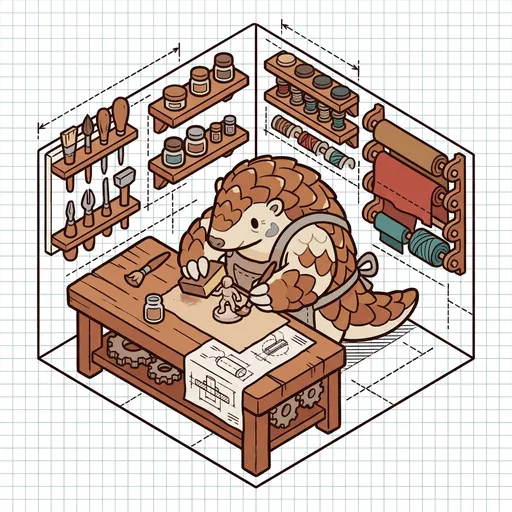
Sand (ELDER)
SURFACE PREPARATION — ready surface first; the paint listens to the surface.
Listen along — Sand (ELDER)
Loading audio…
Press play to listen along. The line being read lights up as you go.
Show full transcript
Loading transcript…
Chapter 1 — Sand and the Invisible Foundation
In the quietest corner of CraftForge, a small pangolin-elder named Sand was rubbing a tiny plastic knight with a block of grey sponge, and had been doing it for a very long time.
The knight was no bigger than her thumb. Sand held it up to the light, turned it slowly, found a faint ridge running down its arm, and went back to smoothing. Her soft, cream-and-brown armor-plates caught the lamplight. She was not painting. She was not gluing. She was just working the little block back and forth along the plastic, patient as a tide.
A tween wandered up, a half-finished dragon in his hand and impatience in his eyes. “You’ve been on that one knight all morning. When do you actually paint it?”
“Soon,” Sand said. “The paint’s not the hard part.”
He frowned. She held the knight closer to him. “Feel the arm.” He ran his claw along it — smooth as a river stone. Then she handed him his own dragon. He touched the wing and winced; a rough seam scraped under his claw like a splinter.
“Your dragon’s beautiful,” Sand said gently. “But the paint’s going to catch on that seam and go thin, and in a week it’ll peel there first. Not because you painted it wrong. Because the surface underneath wasn’t ready.” She set the knight down. “The paint listens to the surface. Always has. A rough surface makes rough paint. A clean, smooth one makes the color sit down and behave.”
The tween looked at his dragon a long time.
Sand had learned this the slow way, generations ago, before CraftForge, back when her family kept the roofs of a whole village.
The pangolins were thatchers. Season after season they climbed onto the houses and mended the reeds and packed the underlayers — the plain, boring layers no one inside ever saw. Young Sand had hated it. She wanted to do the pretty work, the woven trim along the eaves that everyone admired from the square.
So one autumn she’d hurried the underlayer on a neighbor’s roof. Packed it thin. Skipped the second pass. Went straight to the handsome trim. It looked wonderful.
The first hard rain, the roof leaked through in a dozen places. The family’s blankets soaked. Their firewood spoiled. And the beautiful trim she’d been so proud of held up perfectly — it just had nothing worth protecting underneath it.
Her grandmother hadn’t scolded. She’d climbed up beside Sand in the drizzle and put a claw on the sagging reeds. “You feel that ache in your chest, watching it fail?” Sand had nodded, throat tight. “That ache isn’t for nothing, little one. That’s you learning the thing that takes people decades. The work no one sees is the work everything else stands on. Skip it, and the pretty part has nowhere to live.”
Sand fixed that roof from the inside out. It took her four times as long as building it right the first time would have. She never forgot the difference.
She walked to CraftForge at one hundred and twenty, because a place that studied making ought to honor the part of making that no one ever gets to admire.
Iris, the mentor who ran the workshops, met her at the door and did not ask her to prove she could paint. She asked one question. “What is surface preparation?”
Sand didn’t answer with a speech. She picked up two identical plastic soldiers from Iris’s bench. One she rubbed with her sanding-block, wiped clean, and laid a thin, even coat of primer over — grey and quiet and unremarkable. The other she left exactly as it came, faint mold-lines and all. Then she dabbed one stroke of red paint across each.
On the primed one, the red sat down smooth and rich. On the raw one, it beaded and streaked and slid, thin in some places, gummy in others.
“Same paint,” Sand said. “Same hand. The only difference is the minute I spent before.” She set them side by side. “Wash off the oil. Trim the seams. Smooth the rough. Lay the first thin coat and let it dry all the way. Then — only then — the color can do its work.”
Iris looked at the two soldiers for a long moment. “You belong here,” she said.
Sand’s workshop was full of tiny things waiting to be made ready.
A girl came in one afternoon, deflated, holding a knight whose gold armor was flaking off in patches. “I did everything,” she said. “I painted so carefully. And it’s already coming off. Feels like I wasted the whole week.”
Sand knew that slump. She’d felt it on a wet roof a long time ago.
“Can I see the bare plastic underneath?” The girl scraped a flake loose. Sand tilted it to the light — a filmy sheen. “There it is. New minis come coated in a slippery oil from the mold. Paint can’t grip it. It’s not your painting. It never was.” She fetched a soft toothbrush and a dish of soapy warm water. “Watch.”
She scrubbed a fresh knight gently, rinsed it, dried it, ran the sanding-block over one stubborn seam, and brushed on a whisper-thin coat of primer. She did it unhurried, narrating each step. “Wash. Trim. Smooth. Prime. Dry — all the way, no rushing this part.” She handed it back. “Now paint your gold on that.”
The girl painted one careful stroke. The gold gripped and glowed and stayed. She pressed a fingernail against it — it held. “It’s stuck,” she breathed.
“It’s home,” Sand said. “The paint finally had a surface it could trust. Every good mini in this whole workshop is standing on a minute of quiet work nobody will ever see.”
Later, when the workshop had gone still, the girl came back with one more question, quieter now.
“But nobody sees the prep in the finished mini,” she said. “So how do you not mind that the boring part is the part that matters most?”
Sand thought about a rain-soaked roof and a grandmother’s claw on sagging reeds.
“You feel it,” she said. “That’s the honest answer. There’s a steady, settled feeling in your hands when you’ve made something ready and you’re not rushing — like packing the reeds right, like the moment before rain when you know the roof will hold. The praise all goes to the color. That’s fine. The color earned its shine. But the quiet, unhurried work underneath is what let it shine at all.” She looked at the little knight, gleaming and firm. “Some of the best things you’ll ever make, no one will thank you for. You’ll just know they held. And that steady feeling in your hands — that’s enough.”
The girl nodded slowly, and Sand watched the tightness lift off her shoulders, the way it had lifted off her own, once, in a long-ago drizzle.
The CraftForge ensemble
Sand (ELDER) is part of CraftForge's distributed-narrative cast. Each character embodies a different curricular primitive; together they teach the full subject.
-

Dab
Basecoat + wash — the confident vole-tween of broad strokes who treats basecoats as the loud first hello and washes as the quiet shadow-finder ('big shapes first, shadows fall second')
-

Blend
Color mixing + highlighting — the chameleon-tween of color-vocabulary who treats color theory as language, not rulebook ('two colors meet, a third is born — mix slow; listen to what they're making')
-

Coat
Layered application + varnish — the steady badger-tween who treats every coat as deliberate next-stratum patience ('layer waits for layer; patience is the secret pigment')
-

Tip
Fine detail + freehand — the relaxed treefrog-tween of fearless small-brush play who carries the cluster's perfectionism-gate anchor ('tiny brushes, loose wrist — wobbly is fine; the eye fixes it from arm's length')