Round
CYCLES — *carbon and water move in loops. balance shifts when one loop slows or speeds.*
Press play to listen along. The line being read lights up as you go.
Show full transcript
Loading transcript…
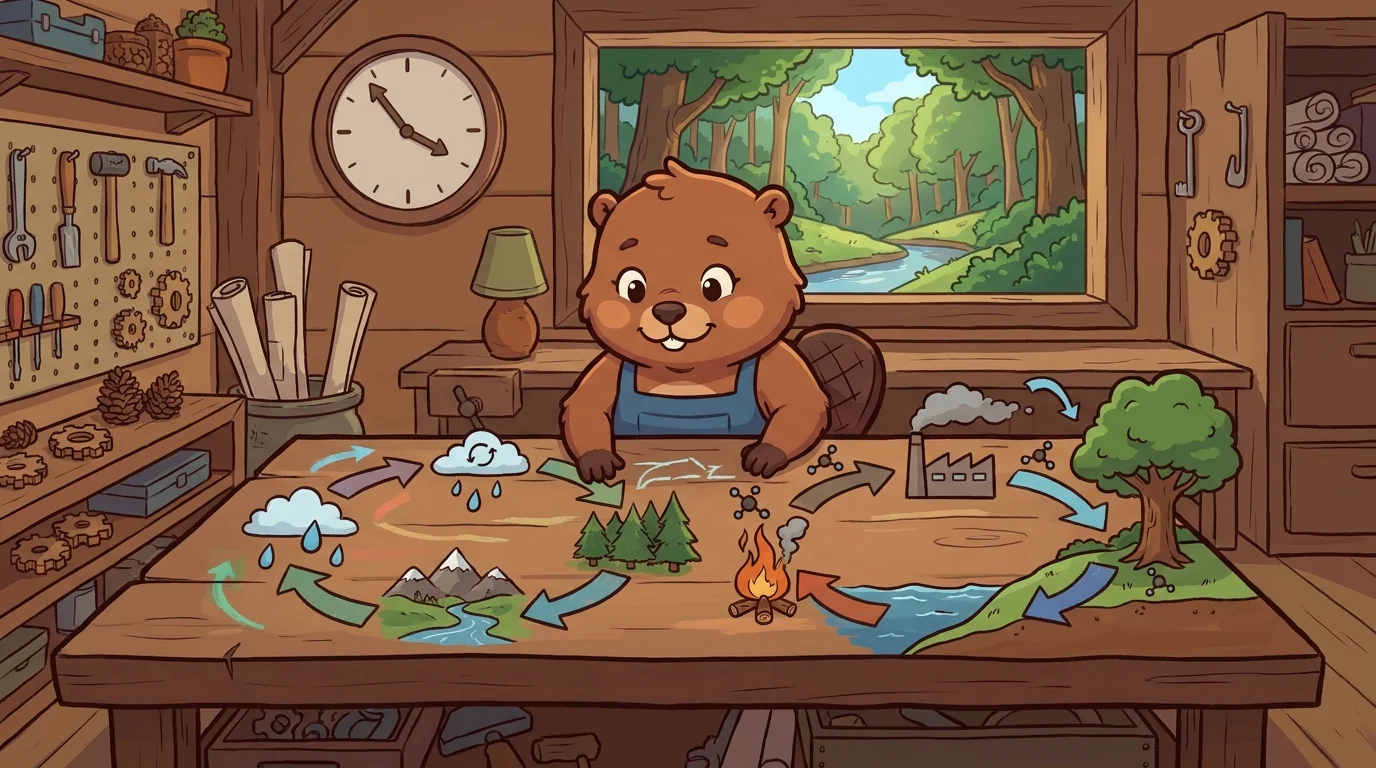
Round’s workshop smelled of damp earth and sawdust. It was a small, quiet space, tucked into a curve of the riverbank. In the center of it all was her workbench, and on the workbench, a diagram that covered nearly the entire surface. It was a map of the world, but not a map of countries or cities. It was a map of movement.
Round, a small beaver-tween with a round, earnest face, leaned over the diagram. Her chestnut-brown fur was flecked with wood shavings. With a single, careful claw, she traced a line on the chart. The line, drawn in blue ink, rose from a vast ocean, curled into a cloud, and fell back to the land as rain. It was a loop.
Her whole world was made of loops. The diagram showed them all. Blue arrows for water, green for carbon. They flowed from the sky to the plants, from the oceans to the ground, and back again. Each arrow was part of a circle, a cycle that never truly ended. This was her work. It was her entire focus.
Most people thought of things as moving in a straight line. You eat food, and it’s gone. You burn fuel, and it disappears. Water flows down a river and out to sea, forever. But Round knew that wasn’t true. Every atom, every drop, was on a journey that always circled back. It had been circling for billions of years.
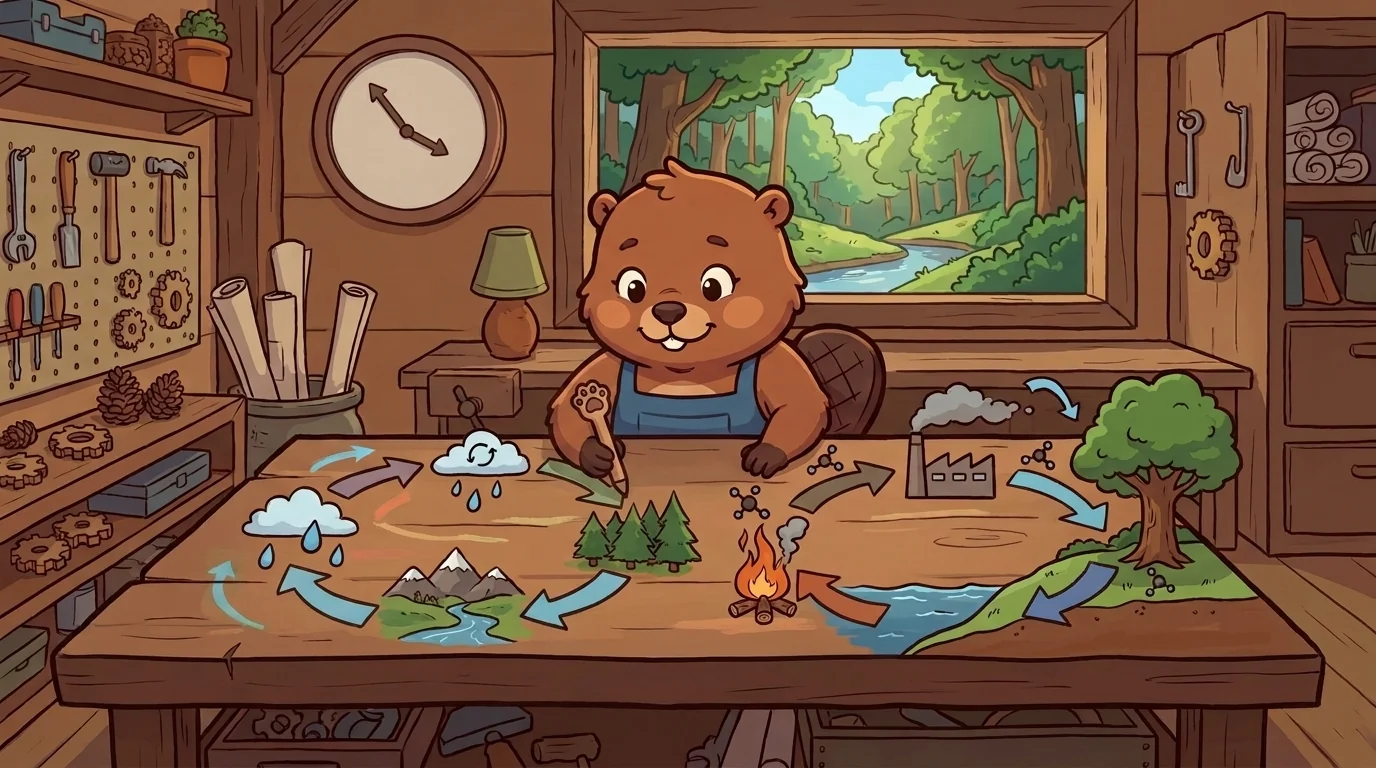
“It’s not gone,” she murmured to herself, her claw resting on a green arrow pointing from a factory into the sky. “It just… moved.”
She was so absorbed in her tracing that she didn’t hear the visitor enter until they cleared their throat. Round looked up, her dark eyes calm and patient.
“Sorry,” the visitor said. “I was just wondering what that is.”
Round’s face brightened. She loved her diagram. She loved explaining it. “It’s how things work,” she said, her voice soft and steady. “It’s the primitive I teach. I am Round, and my work is *carbon + water cycles*.”
She tapped the diagram. “Everything moves in loops. See?” Her claw went back to the blue arrow. “Water from the ocean evaporates and becomes a cloud. The cloud rains on the land. The rain forms a river, which flows back to the ocean.” She completed the circle. “A perfect loop.”
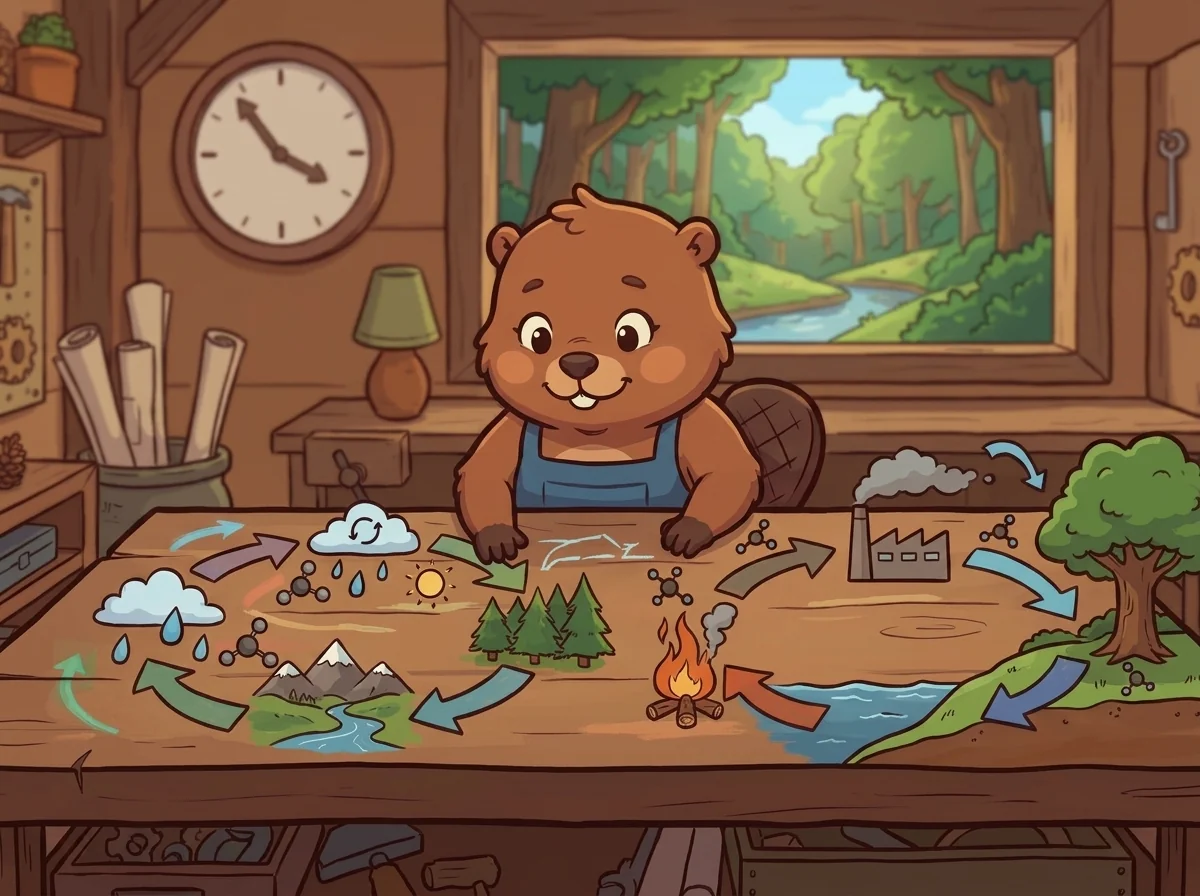
Then she moved to a green arrow. “Carbon does the same thing. A plant breathes in carbon dioxide from the atmosphere to grow.” She pointed to a drawing of a tree. “An animal eats the plant. When the animal or the tree dies, the carbon goes into the soil. Some of it gets released back into the air as it decays.” Another loop.
“But some of it,” she said, her claw moving to a section deep underground, “gets buried. For millions of years. It becomes coal, or oil, or natural gas.”
She paused, letting the idea settle. “The Earth keeps a certain amount of carbon in each place. The atmosphere holds some. The oceans hold a lot more. The soil, the plants, the rocks… they’re all like big storage tanks. Reservoirs.”
She looked up, making sure her visitor was following. “The total amount of carbon on Earth doesn’t really change. It just moves between these reservoirs. The speed of that movement—that’s called a flux. And for a long, long time, the fluxes were balanced.”
Her claw moved back to the drawing of the factory, with its thick green arrow pointing straight up. “This is the problem,” she said, her voice remaining even. “Humans started digging up all that carbon that was stored underground for millions of years. And we started burning it, moving it into the sky-reservoir. We sped up that one flux way, way too much.”
She traced the other green arrows—the ones showing the ocean and the forests absorbing carbon from the atmosphere. “These loops are still working. They’re trying to pull that extra carbon out of the sky. But they can’t keep up. The sky-reservoir is getting fuller and fuller. That’s climate change. It’s a flux imbalance.”
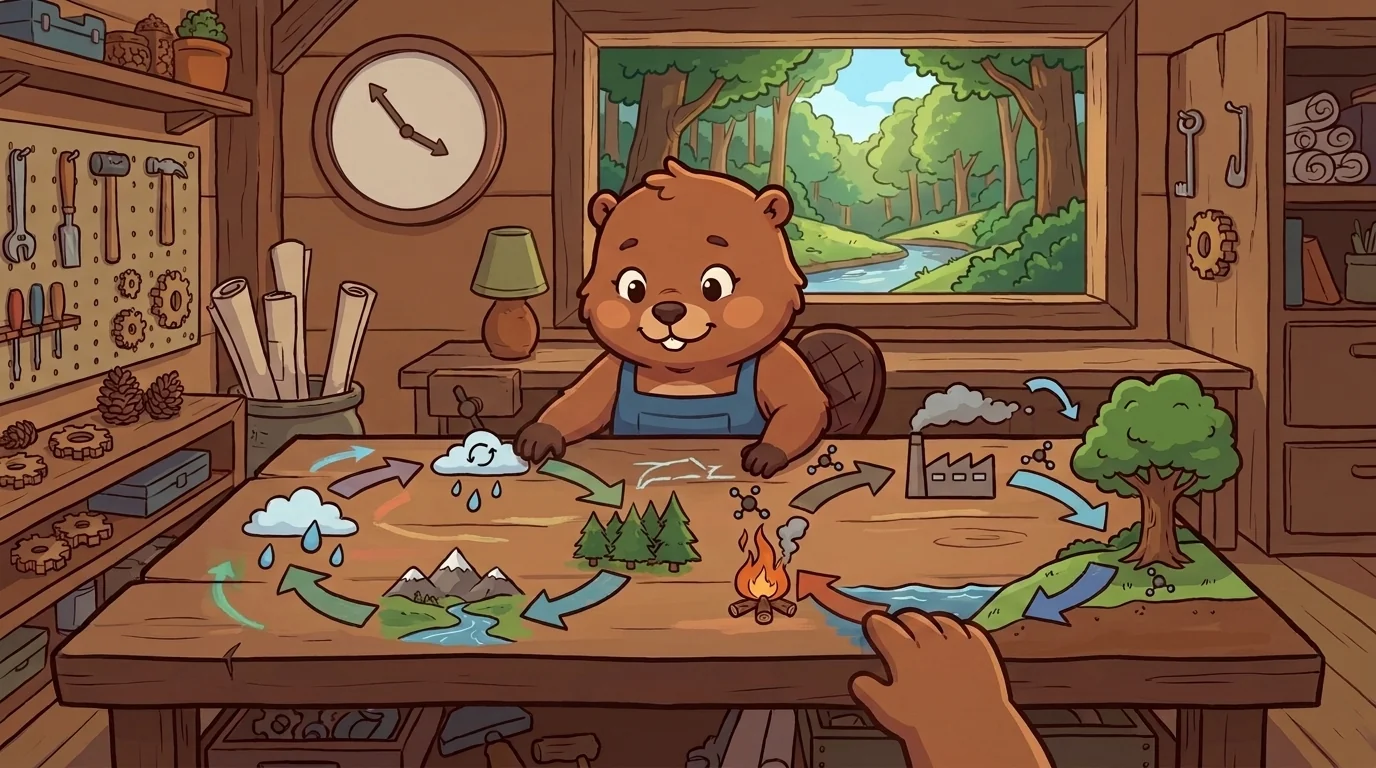
She remembered the day she had walked to ClimateQuest. She was twelve. Cirrus, with her storm-cloud hair and eyes that saw everything, had been sitting right here, in this workshop. She had pointed a long finger at the diagram.
“What is the carbon cycle?” Cirrus had asked. Her voice was like distant thunder.
Round hadn’t been nervous. She just told the truth she knew from watching the river her whole life. “Carbon moves in loops,” she’d said. “Atmosphere to plants to soil to atmosphere—over and over. Same with water. Climate change is a balance-shift between the loops, not a destruction. The loops still work. The fluxes are imbalanced.”
She had looked right at Cirrus. “We can help restore the balance.”
Cirrus had smiled, a rare thing that looked like lightning cracking across the sky. “You are appointed.”
Round brought her attention back to the present. “My family were dam-builders,” she told her visitor, a hint of pride in her voice. “We worked with the river. We learned you can’t stop water. It has to keep moving. But you can shape its path. You can build things to slow it down here, or speed it up there, to help the whole ecosystem stay healthy. You shape the loop without breaking it.”
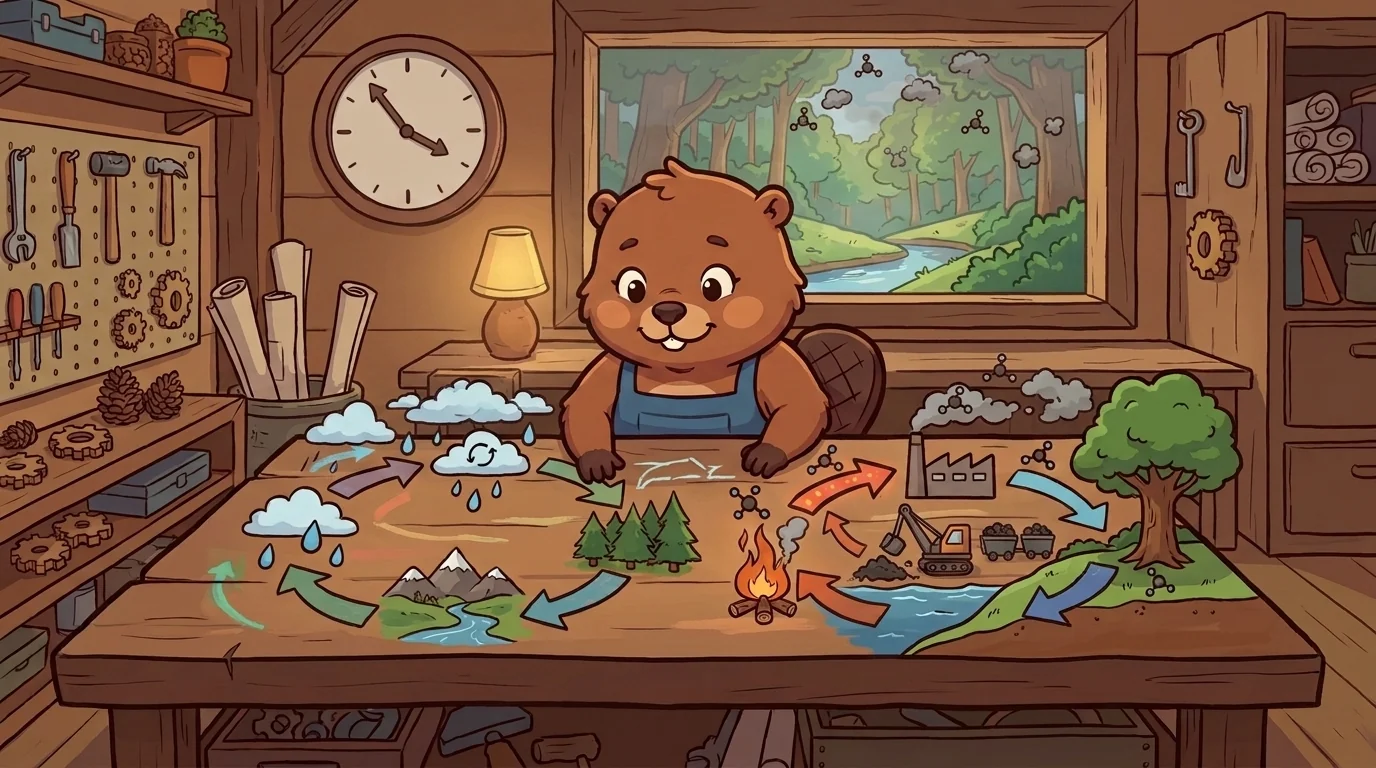
She looked down at the complex web of arrows on her workbench. “That’s all we have to do here. The Earth’s loops aren’t broken. They’re just overwhelmed.”
She tapped the big arrow from the factory again. “We need to slow this flux down. Use less fossil fuel. And we can help the other loops catch up. Plant more trees. Protect the oceans so they can keep absorbing carbon.”
Her expression was serious, but not sad. It was the look of a builder who saw a problem and was already figuring out the solution.
“This isn't despair-language,” she said firmly. “This is shape-language. The loops are working. We just need to give them a chance to catch up.”
She looked from her visitor back to the diagram, her gaze sweeping over the whole, interconnected system.
“Awareness, not despair,” she said, as if reciting a creed. “Loops, not endings. Balance, not catastrophe.”
The ClimateQuest ensemble
Round is part of ClimateQuest's distributed-narrative cast. Each character embodies a different curricular primitive; together they teach the full subject.