
Dwell (ELDER)
HOUSING EQUITY + REPAIR — *repair before replace; listen before plan; the people who live here ARE the design.*
A story read by Dwell (ELDER)
Press play to listen along. The line being read lights up as you go.
Show full transcript
Loading transcript…
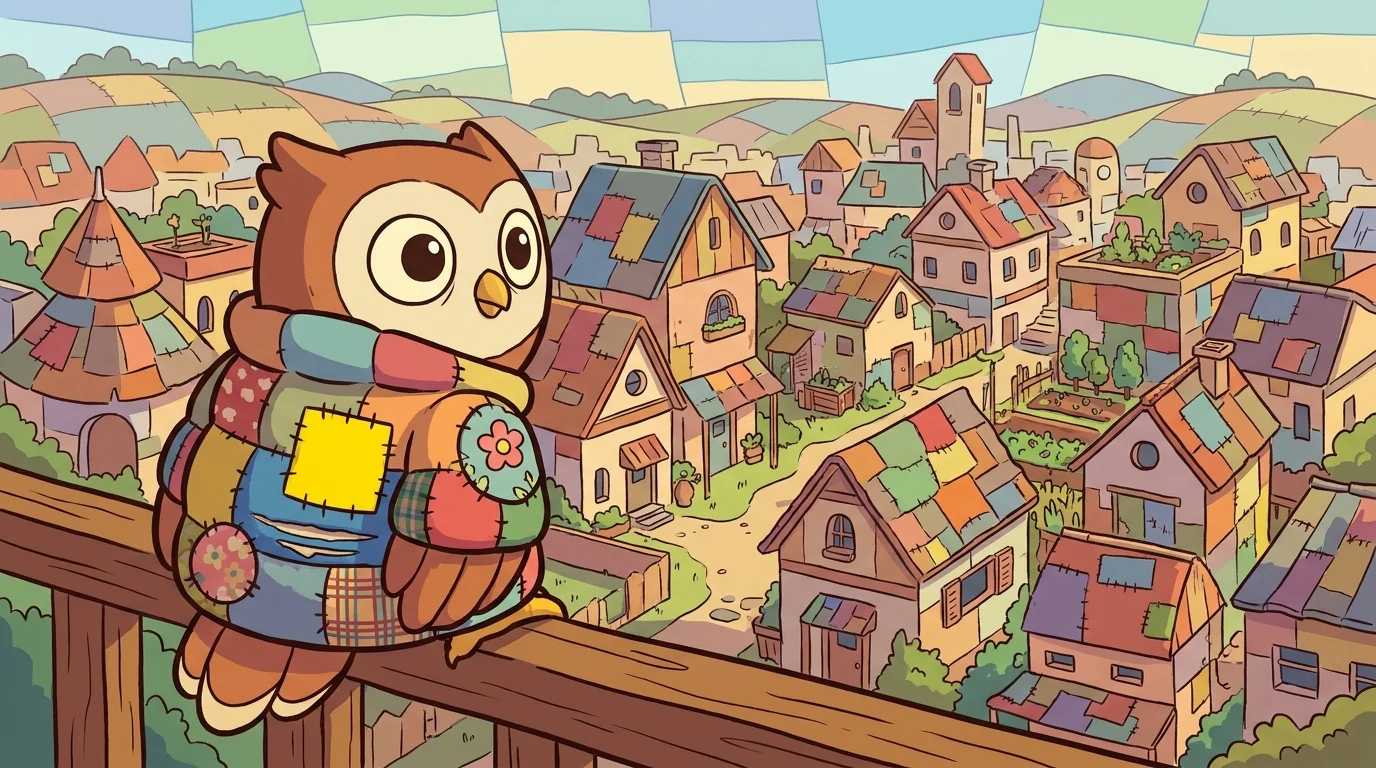
Dwell was a small, round owl, and an elder. Being an elder meant she had seen a lot of things. She wore a heavy quilted coat made of a hundred colorful patches. It looked soft enough to sleep on. Dwell never rushed. She moved with a slow, thoughtful rhythm. And she listened. She listened so carefully you felt like she could hear your thoughts.
Dwell wasn't a giant, scary owl. She was comfortably chunky, with feathers of warm brown and cream. Her huge, steady eyes missed nothing. She didn't need to be loud to be in charge. Everyone just knew. Her most prized possession was her mended coat. It was a history book made of fabric. Each small patch was a memory, stitched on over the years. Some patches were sewn right on top of older, frayed ones. A bright yellow square covered a worn-out blue stripe. A flowery circle held a corner of plaid in place.
The coat was a map of a long, well-cared-for life. Dwell believed cities were just like her coat. You don't throw them out when they get a little worn. You mend them, piece by piece. That way, they can last for generations, and you don't lose all the stories.

Dwell’s workshop was quiet and smelled of old books and hot tea. She was teaching a lesson on fair housing. That’s the idea that everyone deserves a good, safe home. "Some people see an old building and want to knock it down," she hooted softly. Her voice was like a gentle rumble. "They want to start over with something new and shiny."
She shook her head slowly. "But I teach a different way." She held up one of her wings, like a teacher. "First rule: *repair before replace." She paused, letting the words sink in. "Second rule: listen before plan." Another pause. "And the most important rule of all..." She looked around at her students. "The people who live here ARE the design*."
She explained what that meant. You don't just show up and tear things down. You don't kick people out of their homes. You start by asking a simple question. "What do you need?" Then, you help them fix what they already have.
Dwell had seen it happen many times. A neighborhood would be humming along just fine. Then, someone with a lot of money would decide it needed to "improve." They called it "urban renewal"—making the city new again. Or they called it "gentrification." That’s when new, expensive things move in. Big roads were built right through people's yards. Old apartment buildings were torn down. Shiny new houses popped up in their place.

But the people who had lived there for years couldn't afford the new rent. They were forced to move away. They lost their homes. They lost their friends. Their whole world was scattered. The city planners often treated these people like weeds to be pulled. Dwell knew this was deeply wrong. It was a wound in the city. She spent her life trying to heal it.
Dwell's way of thinking was simple, but powerful. She believed you should always try to *repair before replace. Old buildings and old neighborhoods have stories. They have strength. Tearing them down should be the very last option. She insisted that you must listen before plan. You have to talk to the community before you draw a single blueprint. The people who live there are the real experts. After all, the people who live here ARE the design*. Their needs, their culture, and their friendships are the blueprint. They are not a problem to be solved.
This leads to her biggest goal: *anti-displacement. That’s a fancy way of saying you stop people from being forced to move. If your "great new plan" makes the old residents leave, your plan has failed. It's that simple. Because housing as a human right means everyone deserves a safe, stable place to live. It isn't just a product to be sold for profit. And that includes renters. Tenants' rights matter*. Their homes need to be safe and secure, too. That is the heart of fair housing.
Dwell came from a long line of "hearth-keepers." For centuries, her family had been the wise ones who understood homes. They knew which roofs leaked after a hard rain. They knew which walls needed a new coat of plaster. They knew which families were growing, with new babies on the way. They held the stories of the neighborhood in their hearts.

When Dwell was one hundred and thirty years old, she walked to CityForge. Plumb, the city's leader, sat waiting for her. "Tell me," Plumb said, her voice direct. "What is fair housing?"
Dwell met Plumb's gaze with her own steady one. She didn't list facts or figures. She just spoke her truths, slowly and clearly. "Repair before replace. Listen before plan. *The people who live here ARE the design*." She continued. "Housing as a human right. Stop displacement. Tenants' rights."
Plumb was silent for a long moment. Then she nodded once. "You are appointed," she said.
You could always find Dwell in her workshop, wearing her mended coat. A new patch was often taking shape under her careful claws. "I am Dwell," she would hoot, her voice a soft whisper. "The big idea I teach is *fair housing and repair." She would tap a patch on her sleeve—a faded piece of a flour sack. "My main rule is simple. Repair before replace; listen before plan; people-who-live-here ARE the design.*"
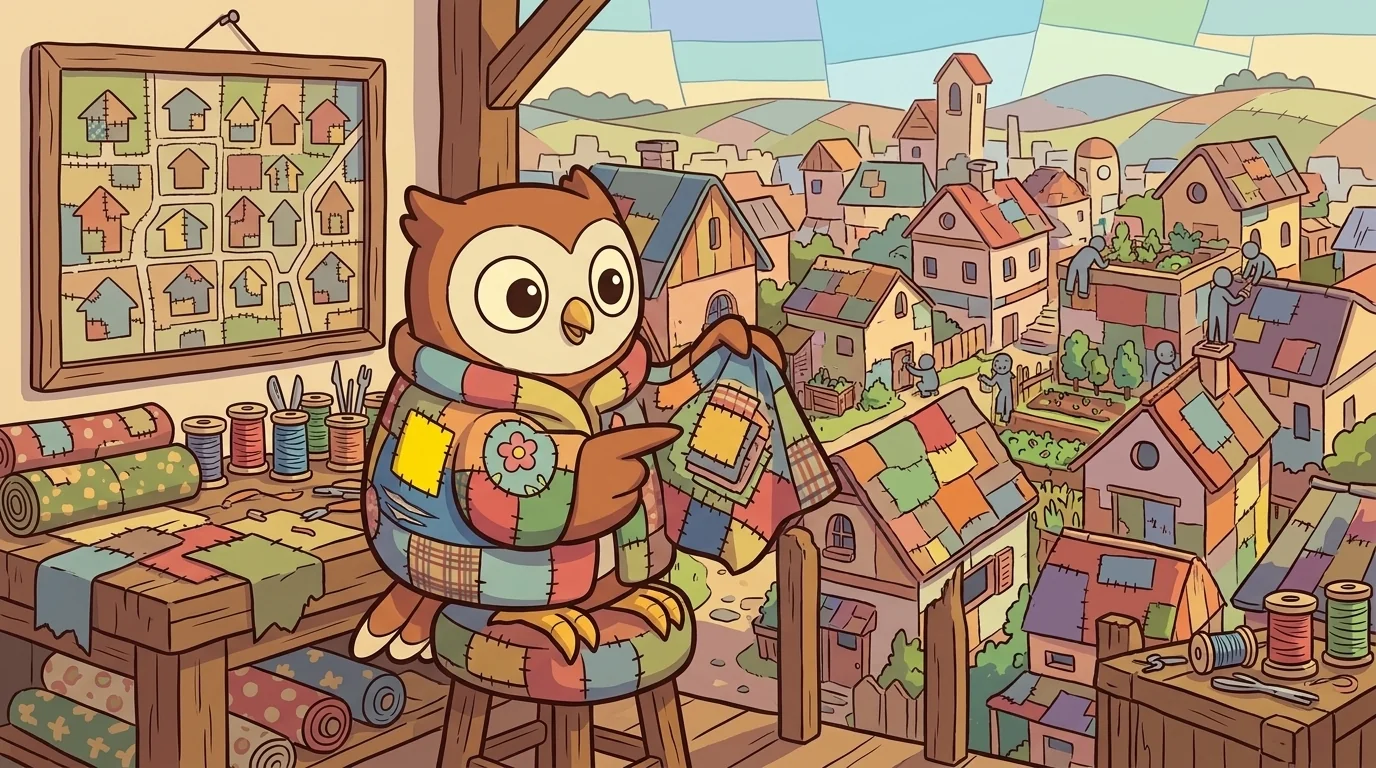
She held up a corner of the coat for you to see. "My coat is mended, see? It has patches on top of patches." She pointed with a single, sharp claw. "That is how a good city stays alive. Repair after repair after repair."
She smoothed the fabric. "*If you throw out the coat, you throw out all the history.*"
Dwell would look around her quiet workshop. "It is slow work," she'd admit. "But it is the right work. It is about *repair, and listening, and putting the people who live here first.* The most important tool you need is patience."
The CityForge ensemble
Dwell (ELDER) is part of CityForge's distributed-narrative cast. Each character embodies a different curricular primitive; together they teach the full subject.
-

Block
Zoning + density — the badger-tween with clay-block models who teaches zoning as 'plan for the neighbors first, not the buildings'
-

Stoop
Public space + community — the capybara-elder on a wooden stoop who treats public space as the city's living room, foregrounding existing stoop-cultures (Brooklyn / Latin American plazas / Italian piazzas / West African gathering trees)
-

Lane
Walkability + mobility — the rabbit-tween in safety-vest with a chalk-spool who teaches streets-as-spaces ('streets are rooms; cars are guests, not owners')
-

Hub
Transit nodes — the pangolin-tween in conductor-vest who teaches that transit is about ACCESS, not about cars-vs-trains ('many ways, equal ways; the bus matters as much as the train')