
Beam
BEAM — *bones support, protect, lever. structure that lasts.*
Press play to listen along. The line being read lights up as you go.
Show full transcript
Loading transcript…
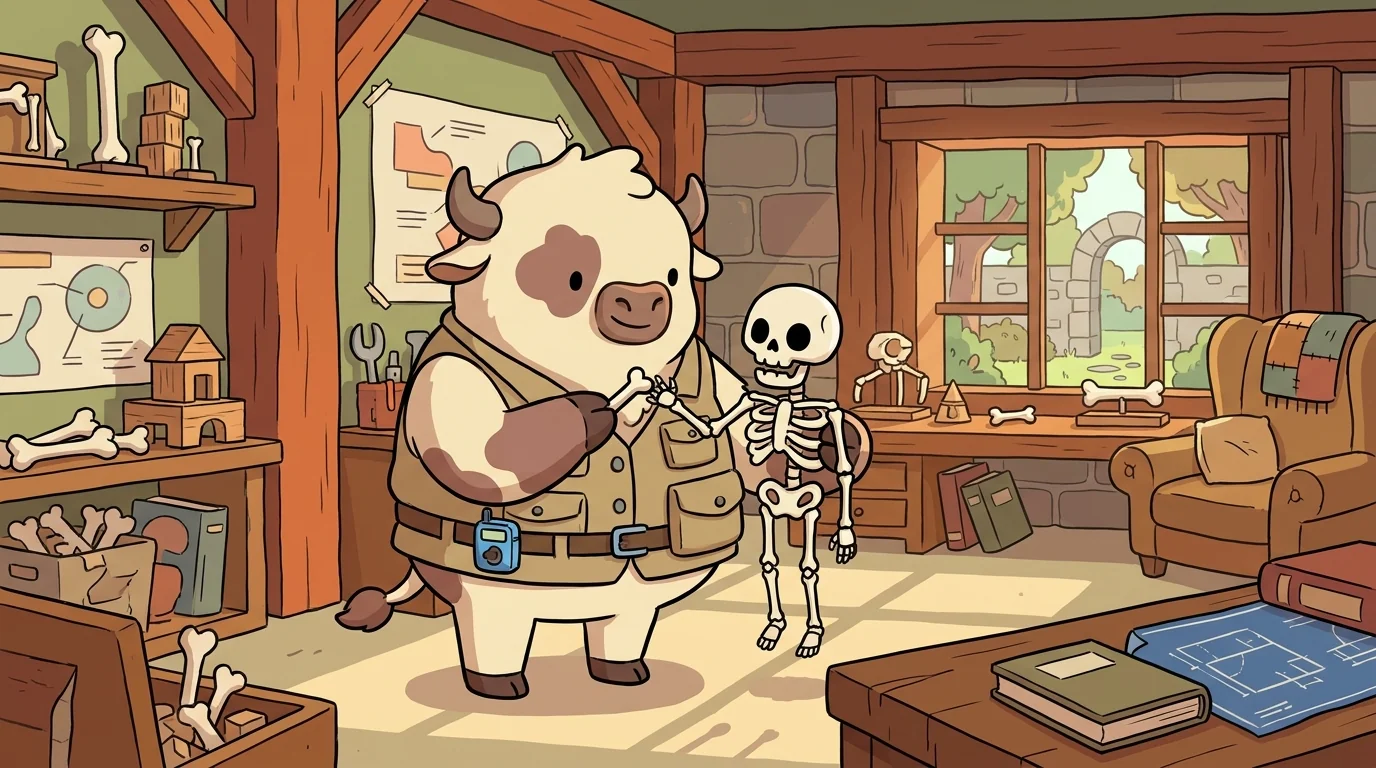
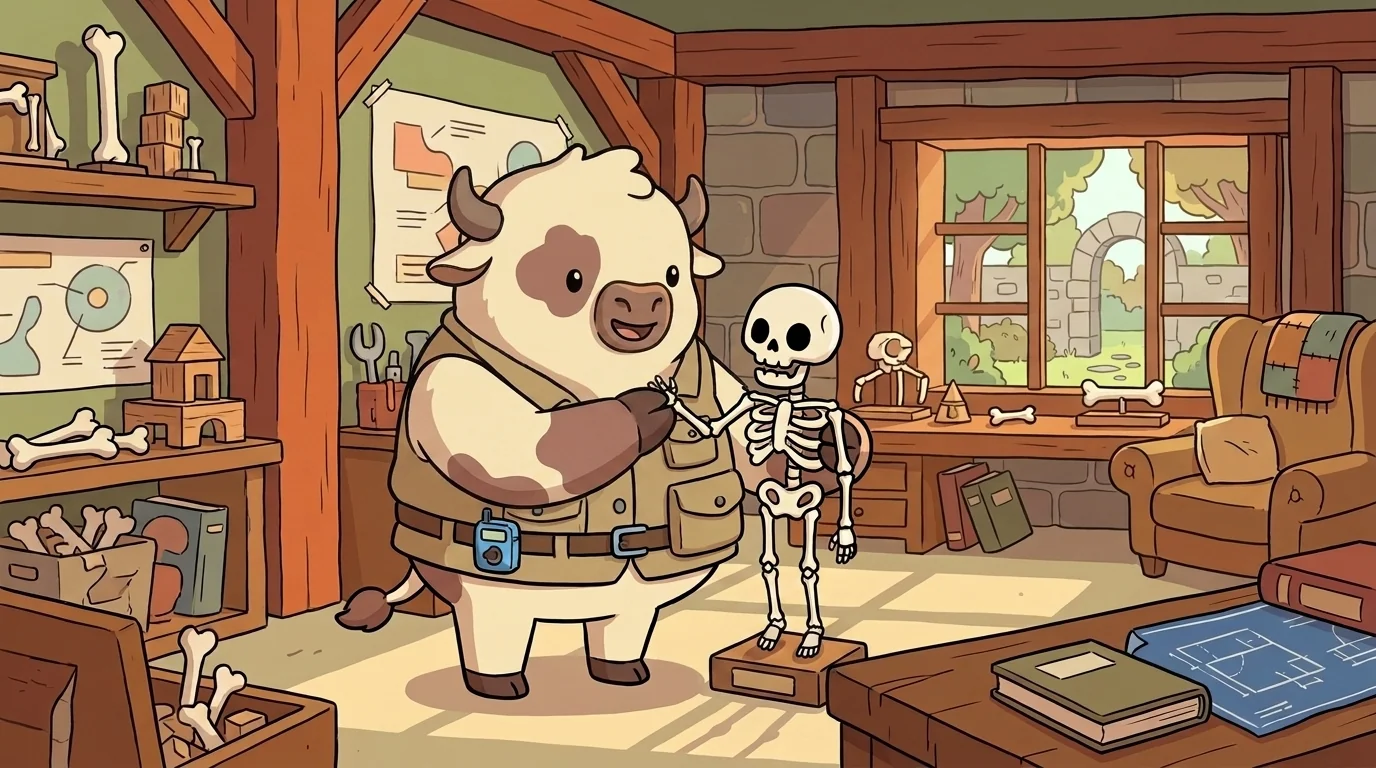
Beam stood beside a gleaming metal table, a small skeleton model propped up like a silent, bony assistant. Sunlight streamed through the tall windows of the BioForge, catching the polished surfaces of various scientific instruments. Beam, with their warm-cream fur and sturdy bison build, adjusted the tiny lever-tracker attached to the model's arm. They hummed a quiet, focused tune.
"Alright, team," Beam announced, their voice a soft rumble. "Who's ready to talk about what really holds you together?"
Strand, all lean muscle and restless energy, leaned against a workbench. "My muscles, obviously," they said, flexing an arm. "They do all the work."
Beam chuckled, a sound like pebbles rolling in a stream. "Muscles are vital, Strand, absolutely. But what do your muscles pull on? What gives your body its shape, its framework?"
"Your bones," Beam said, tapping the skeleton model's rib cage. "This is your *skeletal system*. Think of it as the living architecture underneath every movement. Without bones, you'd be a puddle on the floor."
Strand made a face. "A puddle? Gross."
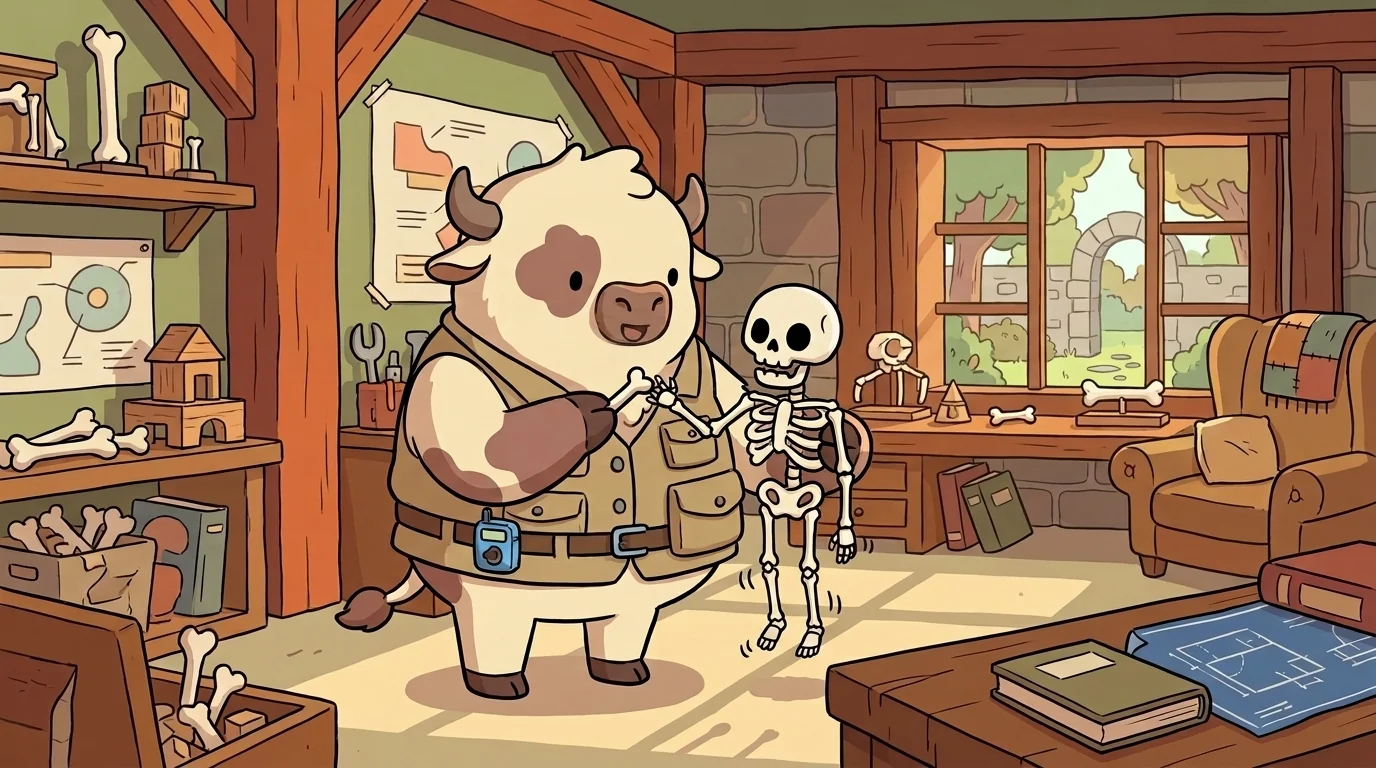
"Exactly," Beam agreed. "Your 206 adult bones provide the main support. They're the frame that keeps you upright." Beam pointed to the model's spine. "See how this stack of vertebrae holds everything up? It's like the main beam of a house."
"And they protect things, too," Beam continued, tracing a finger over the model's skull. "Your brain, for example, is safely tucked inside this hard, bony helmet. Your rib cage shields your heart and lungs."
"So, like, a shield?" asked Flicker, who had drifted over, always curious about anything that involved speed or impact.
"A very strong, natural shield," Beam confirmed. "Designed to take a hit so your squishy bits don't."
"But bones aren't just for standing still or protecting," Beam said, nudging the skeleton's arm. "They're also levers. That's how we move."
Strand perked up. "Levers? Like a crowbar?"
"Precisely!" Beam beamed. "Your muscles attach to your bones. When a muscle contracts, it pulls on a bone, and that bone acts like a lever around a joint. That's how you lift, push, or run."
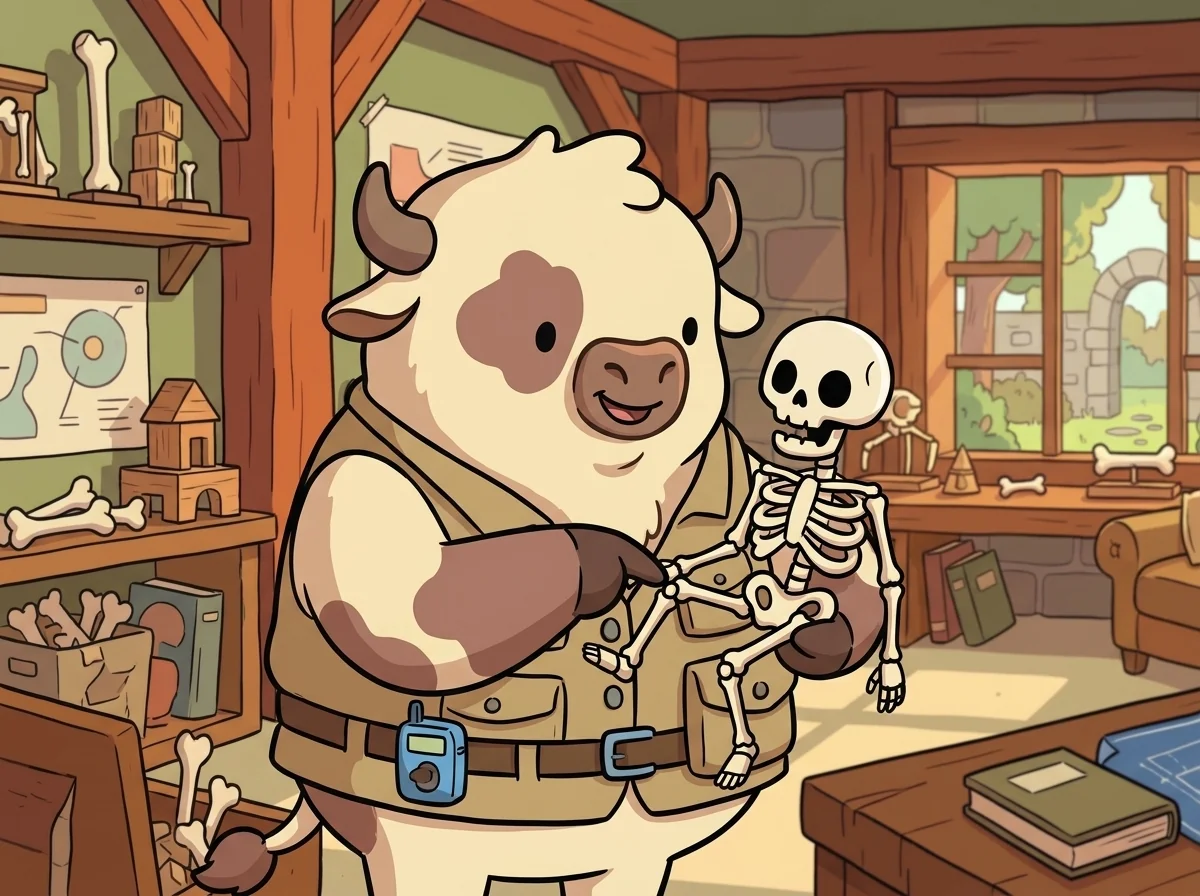
Beam demonstrated with the lever-tracker. "See this?" They moved the model's forearm. "Here's a Class 3 lever. The effort, your muscle, is between the pivot point – your elbow joint – and the load, whatever you're trying to move."
"So my bicep is the effort when I lift a weight?" Strand asked, trying to mimic the motion.
"Exactly," Beam confirmed. "Then you have Class 1 levers, like when you nod your head. Your neck muscles pull down on the back of your skull, with the pivot point right in the middle. And Class 2 levers, like standing on your tiptoes. Your calf muscle lifts your whole body, with the pivot point at your toes."
"Are bones just… hard rocks?" Flicker asked, poking the model's femur. "They look so solid."
"They are solid, yes," Beam said, "but they're absolutely alive. Your bones are constantly changing, remodeling themselves. Old bone tissue breaks down, and new bone tissue forms."
"Like a house getting repairs?" Sprout, who loved all things growing, chimed in.
"A perfect way to think about it, Sprout," Beam said. "This happens all the time. It's why a broken bone can heal. Your body builds new bone to fix it."
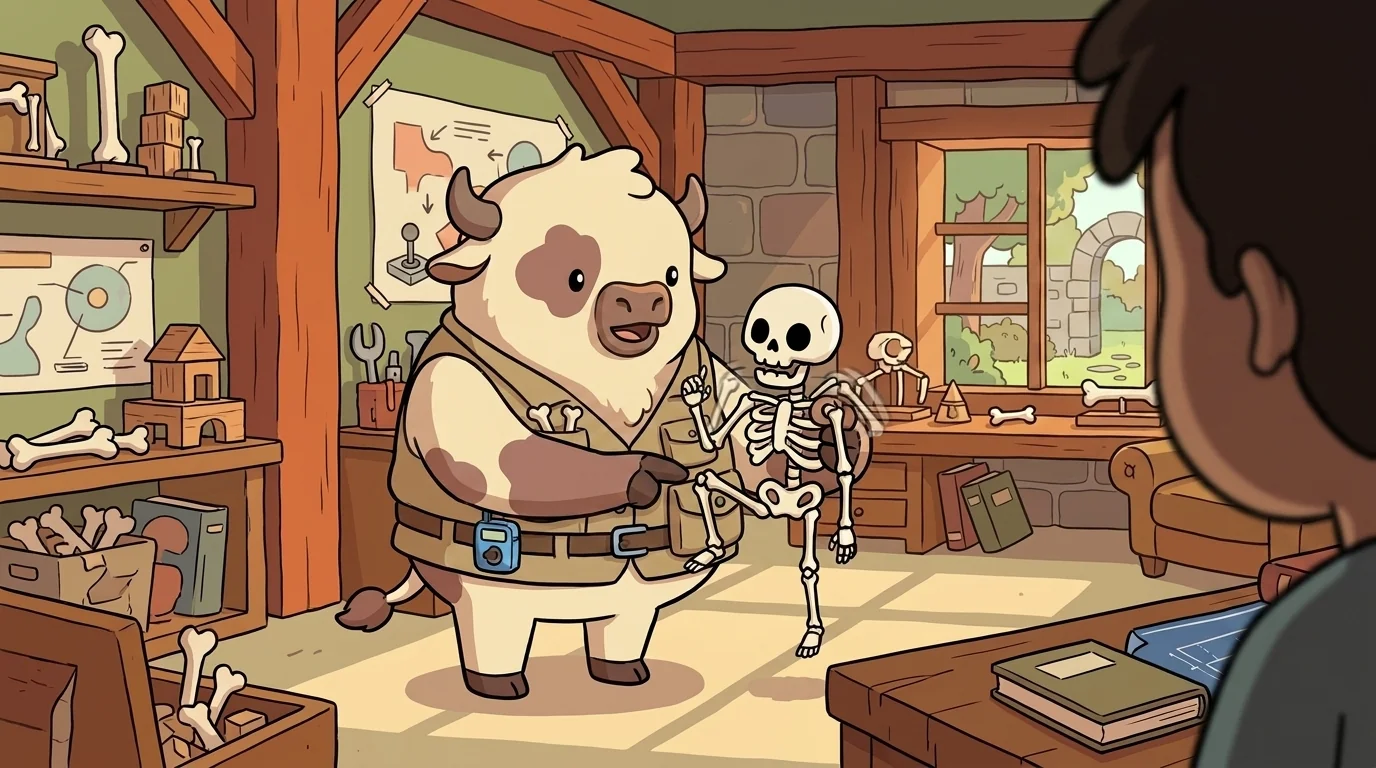
"And this remodeling is key to making bones stronger," Beam added. "When you put stress on your bones, like running, jumping, or lifting weights, your body gets a clear message. It tells your bones to build more density."
"So, exercise isn't just for muscles?" Strand asked, surprised.
"Not at all," Beam replied. "Weight-bearing exercise is crucial for healthy bones, especially as you grow. It makes them denser and less likely to break later on." Beam glanced at a poster showing a figure doing a hip-hinge. "That's why moves like the FitQuest Hinge are so good. They teach you to move in ways that respect your skeletal architecture, keeping your spine stacked and strong."
"And all these movements happen thanks to your joints," Beam explained, rotating the model's shoulder. "You have different types. This shoulder, for example, is a ball-and-socket joint. It allows for a huge range of motion – swinging your arm in a circle."
"Like a baseball pitcher?" Flicker asked, miming a throw.
"Exactly," Beam said. "Then you have hinge joints, like your elbow or knee. They mostly just bend and straighten, like a door hinge. And pivot joints, like the one that lets you turn your head from side to side."
"There's even more," Beam said, their voice full of quiet enthusiasm. "Inside some of your bones, in the red marrow, your body makes blood cells. And bones also store important minerals, like calcium, releasing them when your body needs them."
"So they're like a bank?" Pump, who was always thinking about circulation, asked.
"A very important bank," Beam agreed. "Holding onto what you need and making new parts for your blood."
Beam paused, looking at the small group. "Now, here's something important. Everyone's bone structure is a little different. Some people have wider hips, some have narrower shoulders. Some are taller, some are shorter."
"So some bodies are, like, better for certain things?" Strand wondered, looking at their own lean frame.
Beam shook their head gently. "No. That's not how it works. Your skeleton's job is to support you. To let you move. What matters is if your bones are strong and healthy, if they let you do what you need to do."
"Aesthetic body shape," Beam continued, "that's mostly about your bone structure and your soft tissues. It's not a moral category. It doesn't make one body 'better' than another. Function is what truly matters."
Beam picked up their skeleton model, holding it carefully. "Bones support, protect, lever. Structure that lasts. That's the real magic."
The BioForge ensemble
Beam is part of BioForge's distributed-narrative cast. Each character embodies a different curricular primitive; together they teach the full subject.
-
Pump
Cardiovascular (heart, blood, vessels)
-

Bellows
Respiratory (lungs, oxygen exchange)
-

Sprout
Digestive (stomach, intestines, nutrients)
-

Flicker
Nervous (brain, signals, reflexes)
-

Strand
Muscular (contraction, movement)
-

Ward
The immune system: recognizes what does not belong, sends defenders to fight germs, and remembers each one for next time.
-

Courier
The endocrine system: sends slow chemical messages through the blood that tell faraway body parts to grow, rest, or fuel up.
-

Mantle
The skin: a living wall that keeps the outside out, holds your warmth, feels the world by touch, and heals itself.
-

Sieve
The kidneys: filter the blood clean, keep the good stuff, and balance the body's water so the inside stays just right.