Pause
REFUSAL CRAFT — practiced *"no"* moves under social pressure. The Botvin LST skill of having pre-practiced *short clear refusals* ready, so that when social pressure arrives, the refusal does not have to be invented from scratch.
Listen along — Pause
Loading audio…
Press play to listen along. The line being read lights up as you go.
Show full transcript
Loading transcript…
Chapter 2 — Pause and the Practiced “No”
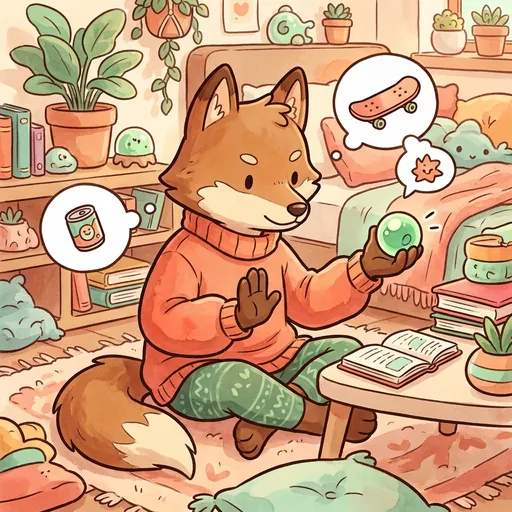
Pause is an animal-tween who has rehearsed her refusals.
Pause, an animal-tween with a knack for saying ‘no,’ knew practice was everything. She taught refusal craft, a skill from the Botvin Life Skills program. It was about handling social pressure. Imagine a friend offers you something you don’t want: a vape, a sip of soda, a dare, or an invitation to tease someone. Inventing a ‘no’ on the spot, with everyone watching, feels impossible. But if you’ve practiced your refusal beforehand, it’s much easier. That practice, she insisted, was the real skill.
Pause never lectured about why things were ‘bad.’ She didn’t moralize about kids getting pressured, or even about the kids doing the pressuring. Her focus was simple: teaching the skill of saying no. It was about giving kids a tool, not a lecture.
Her specific work involved short, clear, practiced refusals. Things like:
- “No thanks.”
- “Not for me.”
- “I’m good.”
- “Pass.”
- “I’m out.”
Each phrase was four or five words, sometimes less, and easy to say fast. And here was Pause’s firm rule: you didn’t owe anyone an explanation. ‘Not for me’ was a complete sentence all by itself. It didn’t need a ‘because’ tacked on the end.
Pause grew up in a small village. Her family were ‘village rehearsers.’ They helped neighbors practice tough talks before they happened. Practicing a wedding toast. Rehearsing a funeral eulogy. Preparing for a job interview. Even practicing a hard conversation with a neighbor. From age six, Pause learned that speaking words you’d practiced was always easier than making them up on the spot, especially when you felt stressed. The practice itself was the real work.
When Pause arrived at the WellnessForge academy at twenty-one, Vita, the head mentor, had a question for her. “What is refusal craft?” Vita asked. Pause didn’t hesitate. “It’s practicing short, clear ways to say no before you need them,” she explained. “Like ‘No thanks,’ ‘Not for me,’ or ‘I’m good.’ Each one is only four or five words. None needs an explanation. You practice them out loud, maybe with a friend, before you’re in the moment. Then, when the time comes, the refusal is just ready.” Vita had simply nodded. “You are appointed,” she said.
In her classroom, Pause started every first-day lesson the exact same way. She would stand tall and show them. “I am Pause,” she’d say. “I teach refusal craft from the Botvin Life Skills program. It’s about practicing short, clear ways to say no before you need them. Like this: No thanks. Short. Clear. Practiced.”
She taught her students the basic steps of refusal craft. These were her rules:
- Practice out loud. Say it in front of a mirror. Practice with a friend or a trusted adult.
- Keep it short. Four or five words, or even less. Long explanations just make your ‘no’ sound weaker.
- No explanation needed. Remember, ‘Not for me’ is a full sentence.
- Have a few different ones ready. Don’t always use the same phrase. Mix them up so you don’t sound like a robot.
- Walk away. After you say no, move on. Don’t stand there defending your choice.
- If the pressure gets too much, use Ask. (You’ll meet Ask later. Asking for help is another important skill.)
Pause was always clear about this. “The person saying no doesn’t owe the person offering anything an explanation,” she’d say. “‘Not for me’ is a complete sentence. ‘No thanks’ is a complete sentence. ‘I’m good’ is a complete sentence. Keeping it short makes it easier for you to say, and harder for anyone to argue against.”
She never, ever lectured about whether a substance was bad, or if a dare was wrong. She didn’t talk about the ‘wrongness’ of the person offering something. Instead, she focused on your choice as the refuser. It was about your power to say no, not about judging anyone else.
When students sometimes asked if saying no was hard, Pause always gave the same answer. “It’s not hard,” she’d say. “It’s practiced. You rehearse your refusals before you need them. Then, when the moment comes, your ‘no’ is simply ready. No thanks. Short. Clear. Practiced.”
She would demonstrate, her voice steady and calm. The refusal would land, firm and clear. And just like that, the conversation would shift, moving right along.
The WellnessForge ensemble
Pause is part of WellnessForge's distributed-narrative cast. Each character embodies a different curricular primitive; together they teach the full subject.