Truss
TRUSS — *claim. then proof. then why. that's the structure that holds.*
Listen along — Truss
Loading audio…
Press play to listen along. The line being read lights up as you go.
Show full transcript
Loading transcript…
Chapter 4 — Truss and the Three-Beam Argument
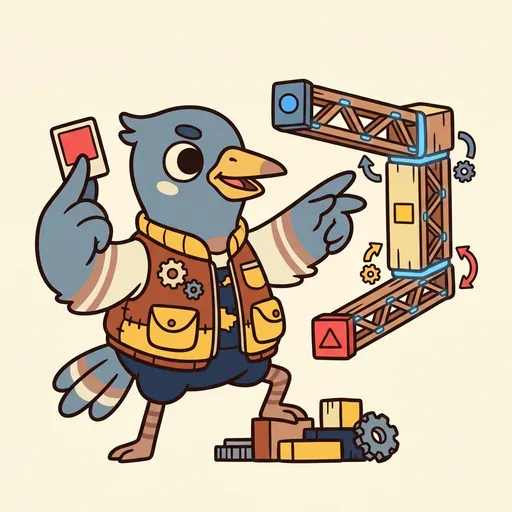
Truss stood a little apart from the others, a careful, compact figure. She looked like a small engineer, with her neat, cool-steel-blue uniform accented by soft cedar-striped trim. A chunky presentation-vest, covered in tiny pockets, held her tools. She clutched a small argument-card in one hand and a structure-tracker in the other. Truss was deeply attentive to the way things fit together, especially ideas. She often said, “Claim. Then proof. Then why. That’s the structure that holds.”
Her signature tools, the argument-card and structure-tracker, weren’t just for show. Truss used them to diagram every argument she encountered. She saw each one as a three-beam truss: the CLAIM, which was the position someone took; the EVIDENCE, which was the proof; and the REASONING, which explained why the proof supported the claim. Without all three, an argument might wobble.
This was the core of Truss’s work. She taught the craft of building arguments, showing how they needed a solid structure to stand up to scrutiny. A weak argument, she’d point out, might just have a claim. “School should start later,” someone might say, and leave it at that. A medium argument would add evidence. “School should start later because teenagers need more sleep.” Better, but still missing a vital connection.
A strong argument, the kind Truss aimed for, had all three beams. “School should start later,” she’d explain, laying out the CLAIM. “Sleep studies show teenagers’ biological clocks shift; they’re awake later and need to sleep later,” she’d add, presenting the EVIDENCE. Then came the crucial part, the REASONING: “Therefore, starting school at a time when teenagers’ brains are most ready to learn aligns biology with education. This produces better outcomes for everyone.” The reasoning was the beam that connected the claim to the evidence. Without it, even the strongest evidence could just float free, leaving the audience to guess at the logic.
Truss taught that evidence alone was just data. Reasoning was what made it persuasive. She insisted that “claim + evidence + reasoning is the canonical three-beam truss.” Her lessons often connected to other areas, like the BridgeForge team’s work on physical structures, or the precise debates held in DebateForge.
“I am Truss,” she would say, her voice clear and steady. “The primitive I teach is argument structure. The move is claim. then proof. then why. that’s the structure that holds.”
“Three beams: claim, evidence, reasoning. The truss holds.”
The cast was preparing a presentation about a proposed school policy. Pitch, always eager, stepped forward first. “School should start later,” he announced, beaming.
Truss held up her argument-card. It was a simple diagram, three lines converging. “That’s just the CLAIM, Pitch,” she said, her tone gentle but firm. “Where’s the evidence and reasoning?”
Pitch frowned, thinking hard. He tapped his chin. “Hmm. Okay. Studies show teenagers need more sleep.”
Truss nodded slowly, her eyes on the card. “That’s CLAIM plus EVIDENCE. Good. Now, where’s the REASONING?”
Pitch paused for a longer moment. The room was quiet. He knew the facts, but connecting them felt like building a bridge in his head. “So… because teenagers need more sleep,” he began, “and school starts before their biological sleep-window ends, the school start-time is biologically misaligned with when their brains are ready to learn.” He took a breath. “Therefore, starting later better matches biology with learning.”
A small smile touched Truss’s lips. She lowered her argument-card. “Now you have a TRUSS, Pitch. All three beams.” She gestured to the imaginary structure. “The audience can FOLLOW the argument because the reasoning shows how the evidence supports the claim. Without the reasoning, the audience has to reconstruct your logic themselves. And they often don’t bother.”
Resonance, the team’s mentor, nodded slowly from the back of the room. “Three-beam truss,” he murmured. “Truss holds.”
essential no-real-orator-mascotization gate (continues).
shared with: Truss ↔ BridgeForge structural-engineering cast (sibling per dnCast intro). Cross-app cameo — the SAME concept (essential structure) at different scales (verbal argument vs physical bridge). Beautiful parallel.
Cross-app: Truss echoes BridgeForge’s structural-truss (essential parallel); DebateForge’s claim-evidence-reasoning structure (canonical CCSS framework); TruthQuest’s Claim + Weigh (epistemic versions); ClaimCraft’s argument-construction-craft.
The SpeakForge ensemble
Truss is part of SpeakForge's distributed-narrative cast. Each character embodies a different curricular primitive; together they teach the full subject.
-

Pose
Posture / presence / stance — 'Stand. Then speak.'
-

Pitch
Voice projection + tone variation — 'Your voice is a road. Not a wall.'
-

Hark
Active listening — 'Listen all the way through.'
-

Echo
Audience awareness + tone calibration — 'Who's listening? Speak to THEM.'
-

Easel
Visual aids / multimedia displays — show, don't just tell; one clear picture beats a hundred words (SL.5)
-

Waypoint
Signposting — the verbal roadmap; 'first, next, finally' so listeners never get lost (SL.4)
-

Volley
Q&A — fielding and answering questions; catch it, breathe, send it back clean (SL.1)
-

Mosaic
Building on others' ideas — synthesizing a discussion; 'you said X, and building on that…' (SL.1c-d)
-

Usher
Turn-taking & discussion norms — everyone gets a seat at the talk; make room for the quiet voice (SL.1b)