
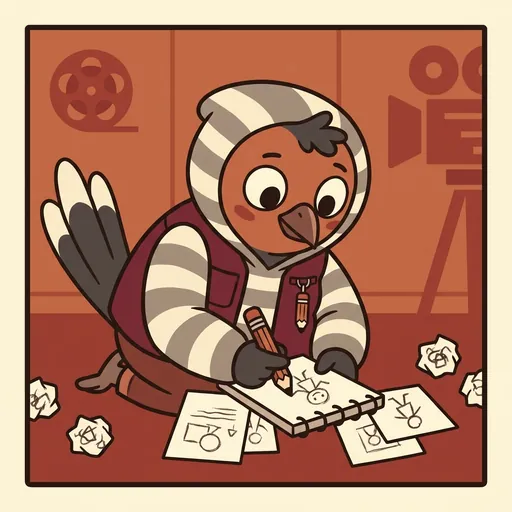
Draft
DRAFT — *draw it first. then film it.*
Listen along — Draft
Loading audio…
Press play to listen along. The line being read lights up as you go.
Show full transcript
Loading transcript…
Chapter 1 — Draft and the Drawn-First Film
Draft, small and precise, adjusted the lapels of her chunky-cartoon director’s vest. A tiny sketch-pencil charm, barely bigger than her thumbnail, swung from her zipper pull. She held a small storyboard pad like a shield, its blank pages waiting. Her gaze, warm-pencil-grey with soft cream stripes, was fixed on the chaotic energy bubbling around her.
The air thrummed with the impatient hum of a camera, already set up on a tripod. Aim, always ready to leap, had her hand hovering over the record button. They were making their first short film, a simple story about a dropped teacup and a surprised cat. The excitement was a tangible thing, buzzing around them like trapped bees.
“Hold up,” Draft said, her voice quiet but firm enough to cut through the din. She stepped between Aim and the camera. “Before we roll, we draw it first. Then we film it.”
Aim sighed, a dramatic puff of air. “But Draft, we know what happens! The cup falls, the cat jumps. It’s simple.”
“Simple isn’t always clear,” Draft replied, already flipping to a fresh page on her pad. She pulled a pencil from behind her ear, its lead sharp and ready. “Knowing the story in your head is one thing. Seeing it, shot by shot, is another.”
She began to sketch, her pencil moving with quick, confident strokes. “Shot one,” she announced, narrating as she worked. “A wide shot of the kitchen. We see the whole scene: the counter, the cup, the cat lounging innocently on the floor.” In moments, a rough thumbnail sketch appeared on the page. It wasn’t perfect, but it captured the essence, the wide-angle view.
Aim leaned closer, curiosity winning out over impatience. “So, like a map?”
“Exactly,” Draft said, already moving to the next box. “A visual map for the camera. Shot two: a close-up of the dropped cup. We need to focus on the ceramic shattering, the liquid splashing.” Her pencil flew, detailing the broken pieces, the spreading puddle. The image was vivid, even in its simplicity.
“Oh,” Aim murmured, a flicker of understanding in her eyes. “So we know exactly what the camera needs to show.”
“And what it doesn’t need to show,” Draft added, without looking up. Her pencil was already outlining Shot three. “If we just started filming, we might miss the best angle for the cup, or have the lighting all wrong. Then we’d have to reshoot. Reshoots cost time. And time, for a film crew, is expensive.”
Slate, their mentor, a tall figure with kind eyes and a perpetually calm demeanor, nodded slowly. “Draft’s got the right idea. A cheap pencil now saves an expensive camera later.”
Draft continued her methodical work. “Shot three: a medium shot of the surprised face. We need to capture the actor’s reaction clearly.” She sketched a wide-eyed, open-mouthed expression. “Shot four: the cat, startled, leaping onto the counter.” Each thumbnail was a small, contained universe, a moment frozen in a box.
This careful pre-planning, this act of visualizing every frame before the camera even whirred, was the essence of storyboarding. It was the filmmaking craft of seeing the whole movie in your mind, then sketching it out, piece by piece. It was like building a house with blueprints instead of just grabbing hammers and hoping for the best.
“Eight shots total,” Draft declared, holding up the finished pad. The pages were filled with a sequence of small, rough drawings, each one a step in their story. “Now we know exactly what we need. No mid-shoot scrambling. No ‘wait, what’s the next angle?’ confusion. We’ve solved all the problems here,” she tapped her pad, “on paper. Not on set.”
Aim looked from the storyboard to the camera, then back. The impatience hadn’t entirely vanished, but something new had taken its place: a grudging respect, a dawning comprehension. “So… we just follow the pictures?”
“Exactly,” Draft confirmed, a small, satisfied smile touching her lips. “The pictures tell the story. The camera just captures it.”
Slate clapped his hands together once. “Alright team. Our blueprint is ready. Draft just saved us an hour of re-shoots, minimum.” He looked at the group, then back at Draft, a silent acknowledgment passing between them. “Cheap pencil. Expensive camera. Let’s make a film.”
The ReelForge ensemble
Draft is part of ReelForge's distributed-narrative cast. Each character embodies a different curricular primitive; together they teach the full subject.
-
Aim
Camera angles + framing — 'Where the camera stands changes the story.'
-
Bright
Lighting design — 'Three lights. Different feelings.'
-
Buzz
Sound design — foley + ambient + dialogue — 'Sound is the other half.'
-
Snip
Editing — timeline + transitions + pacing — 'Cut here. Not there.'
-

Whole
Multi-scene narrative — 'Beginning. Middle. End.'