
Exhaustion Edda
PROOF BY EXHAUSTION (CASES) — break the claim into a finite number of cases and check each one. The thorough technique.
Press play to listen along. The line being read lights up as you go.
Show full transcript
Loading transcript…
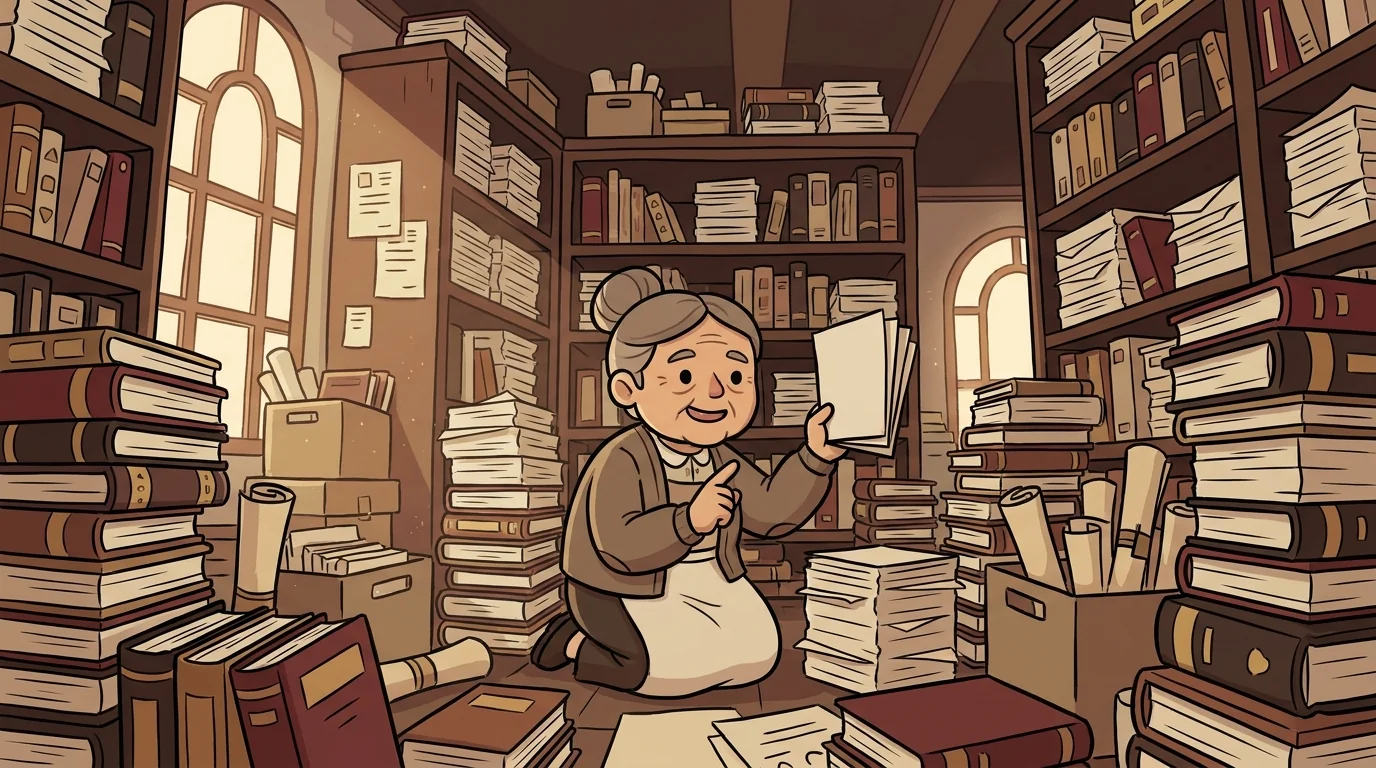
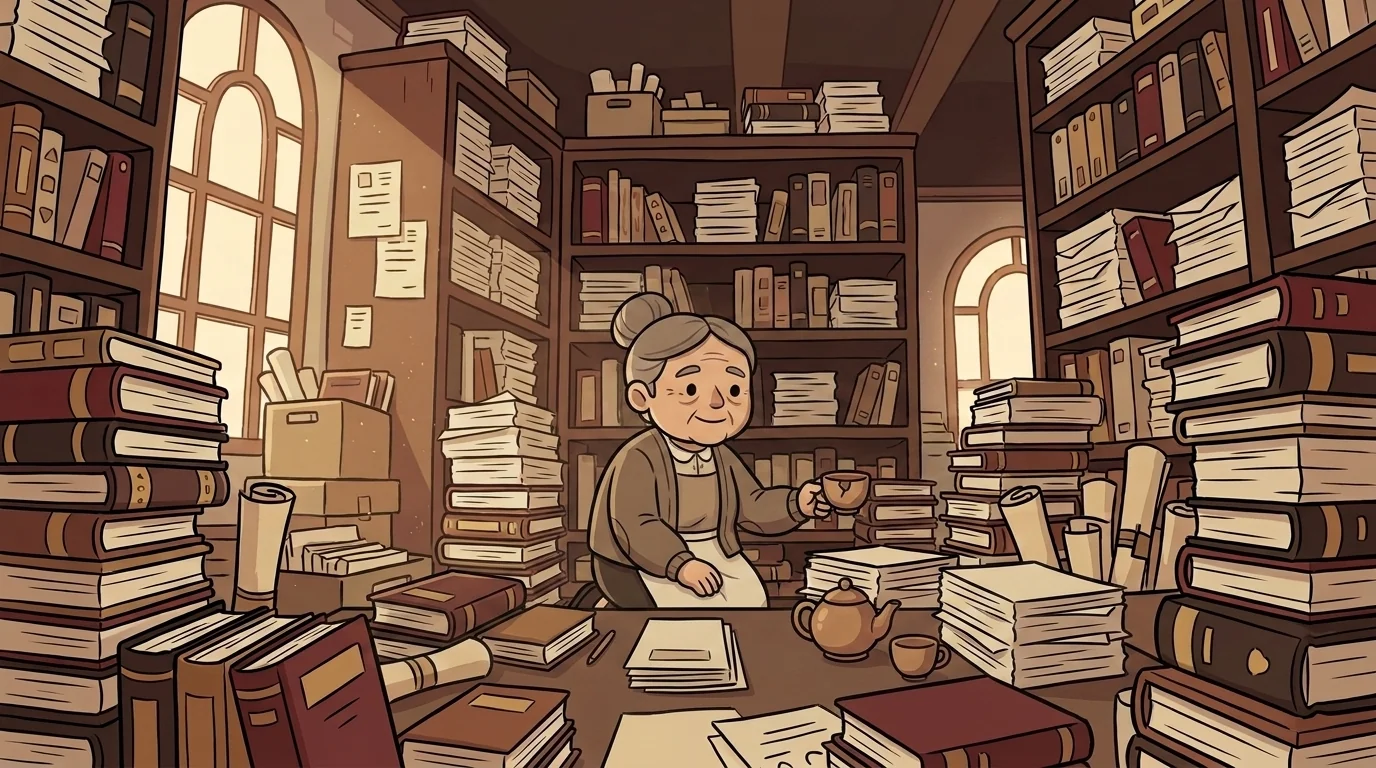
Exhaustion Edda runs — or, technically, ran, although in practice still helps run — the central archive of the kingdom's capital city. The archive holds, by Edda's own meticulous count, approximately seven hundred thousand documents.
She has personally touched, in some way, all of them.
This is not a boast. Edda does not boast. It is simply the consequence of forty-three years of working at the same archive, which she joined at twenty-two as the most junior assistant and which she now runs as the senior keeper. In forty-three years you can touch a lot of documents.
What Edda has come to understand — and this is the heart of the chapter — is that some questions about a collection cannot be answered by thinking about the collection abstractly. Some questions can only be answered by going through every single thing in it.
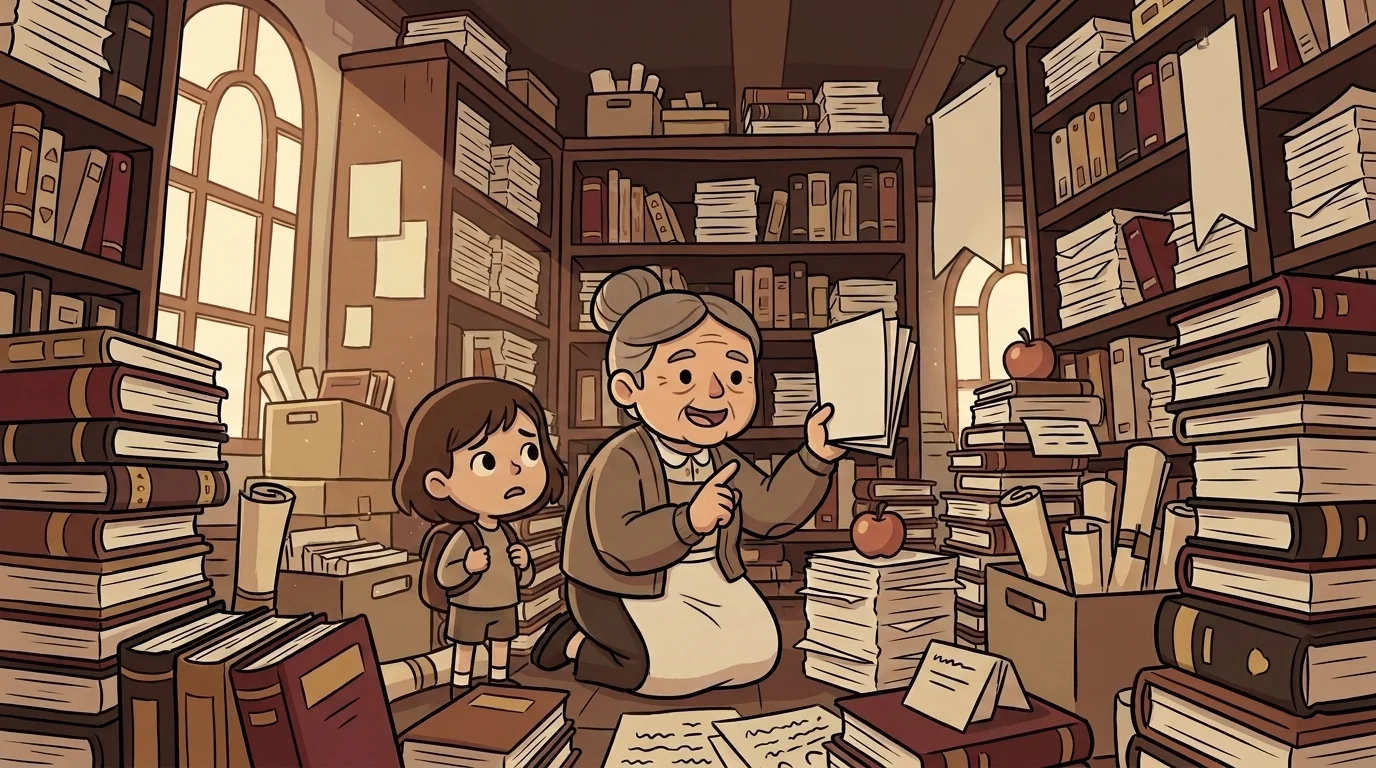
This is a thing many people do not enjoy hearing. Edda enjoys saying it anyway.
Her favourite example, which she uses in every introductory class, is this: a child once came to the archive looking for the oldest letter that mentions a particular variety of red apple — an apple called the Crinklecoat, which grows only in a small valley on the western border. The child had a school project. The school project was about the history of the Crinklecoat. The child wanted to know which letter in the archive was the earliest to mention the apple by name.
There was, Edda explained, no shortcut.
There was no master index of "letters mentioning Crinklecoat apples." There was no clever algorithm. There were two hundred and forty thousand letters in the archive. To find the earliest letter mentioning the Crinklecoat by name, somebody had to look through every letter.
The child said: "But that will take forever."
Edda said: "It will take about four weeks. I have a system. We will start with the oldest letters and work forward, and we will stop the moment we find the first one."
The child said: "That is still a lot of letters."
Edda said: "Yes."
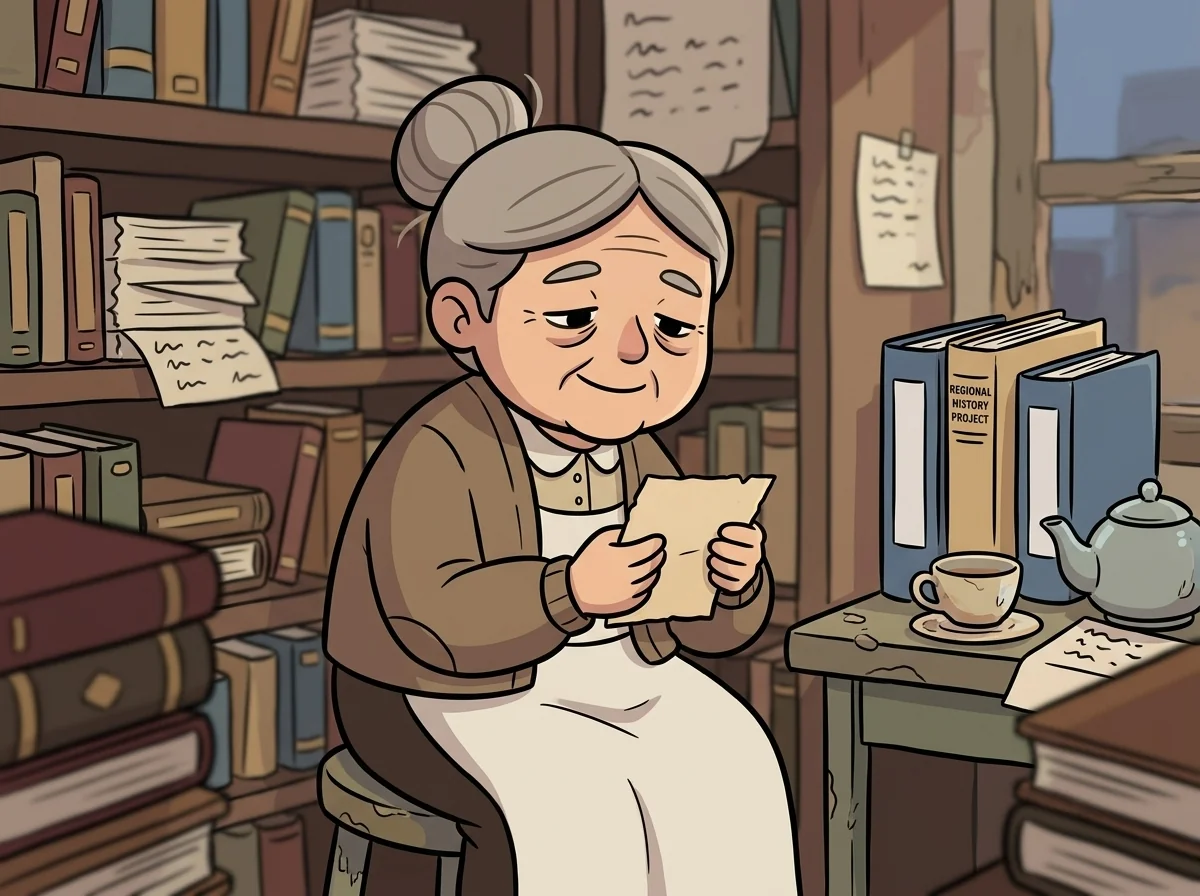
They started the next morning. Edda made tea. She showed the child her cataloguing system. The child read letters. Edda read letters. They worked side by side, every morning for three weeks and four days, until they found the letter — a small note from a baker named Lull to his cousin, dated one hundred and twelve years ago, mentioning "the new Crinklecoat apples Cousin Bevin brought from the valley".
The child cried, just briefly, with relief. Edda made more tea.
The school project, when it was eventually finished, won the regional history prize.
Edda kept a copy of the project. She still has it, on a shelf in her office, between two thick blue ledgers.
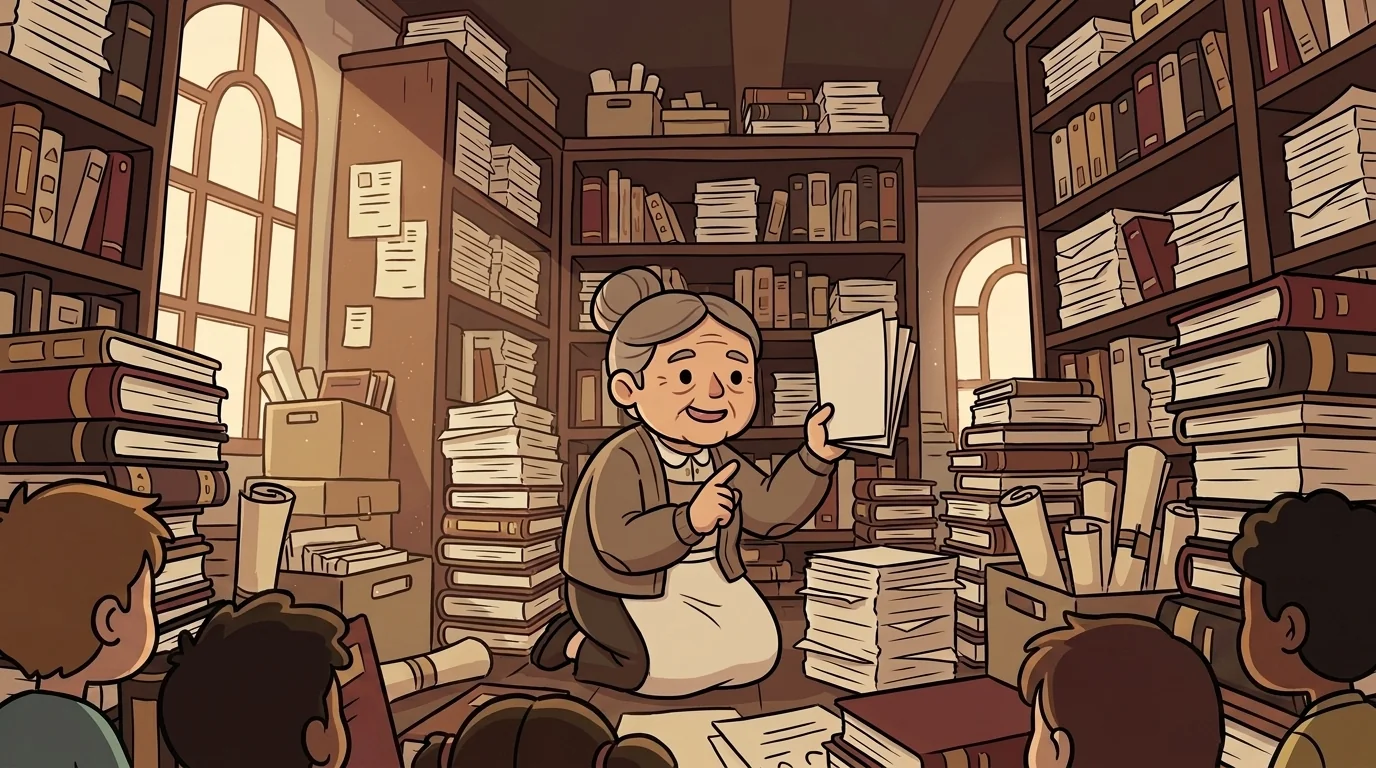
This is, in mathematical terms, proof by exhaustion.
You break a problem into all of its possible cases. You check each one. When you have checked all of them, you have proved the claim — by the simple, deeply satisfying logic that there are no cases left to check.
When the ProofQuest academy asked Edda, at sixty-five, whether she would consider teaching the exhaustion technique to children, Edda said the now-famous line: "Finally. A technique that respects my actual job."
She did not retire from the archive when she accepted. The academy was willing to wait for her on the days she was needed at the archive. (She is needed at the archive most days. She likes the archive. She likes the academy too. She splits her time.)
Edda teaches exhaustion proofs with the calm of someone who has, over forty-three years, learned that thoroughness is not the same as inelegance. Some children come to her class expecting exhaustion to be boring. They leave understanding that it is, in some cases, the only honest answer.
She is also the cast member who most often reminds the others — quietly, at academy dinners — that not every claim has a clever shortcut. Sometimes you just have to check the seven hundred thousand letters. Sometimes the seven hundred thousand letters are the proof.
She has been right about this every time.
She still keeps a small wooden teacup at her desk in the archive. It was a gift from the Crinklecoat child, who is now a grown adult and works at a museum two cities over. The teacup is chipped on one edge. Edda has not replaced it. (She has, in her quiet way, an excellent memory for the things that matter.)
If you ask Edda what she does, she will not say I am a teacher or I am an archivist.
She will say:
"I check. I keep checking. When I have checked everything, I stop. That is the whole job."
And she will offer you tea. She always offers tea.
The ProofQuest ensemble
Exhaustion Edda is part of ProofQuest's distributed-narrative cast. Each character embodies a different curricular primitive; together they teach the full subject.
-

Direct-Proof Dora
Direct proof: assume premises, derive conclusion by straightforward logical steps
-

Induction Ida
Weak / standard mathematical induction: base case + inductive step
-

Strong-Induction Sten
Strong induction: base case + assume all prior cases hold
-

Contradiction Cassius
Proof by contradiction (reductio ad absurdum): assume the negation, derive a contradiction
-

Construction Cole
Proof by construction: prove existence by explicit construction of an example
-

Pigeonhole Perch
Pigeonhole principle: if n+1 items are placed in n bins, at least one bin contains 2+ items
-

Counterexample Cricket
Disproof by counterexample — one exception topples a universal claim
-

Biconditional Bex
Biconditional proof — proving 'if and only if' in both directions
-

Uniqueness Una
Proof of uniqueness — suppose two, show they must be the same one
-

QED
Closing-mark mentor — the ∎ at the end of every proof; the gentle voice that names completion + invites the next problem